
5 Dharma Shastra Tips for Long & Healthy Hair and Less Hair Fall
Riya Kumari | Apr 10, 2026, 12:57 IST

Long curls
Image credit : AI
What if the secret to thick, lustrous, and virtually hair-fall-free hair wasn’t in expensive products but hidden in ancient wisdom? For centuries, Dharma Shastra has quietly preserved powerful hair care rituals rooted in nature, balance, and inner well-being. These aren’t quick fixes - they’re time-tested practices that nourish your scalp, strengthen your roots, and transform your hair from within.
Before the world was loud with shampoos, serums, and hurried fixes, hair care in India was imagined more slowly, almost ritually. A woman’s hair was not treated as an afterthought. It was washed with care, perfumed with flowers, protected from dust, and tied with intention. The old Sanskrit tradition does not give us one single “queen’s hair manual,” but across Ayurvedic daily-regimen texts and historical studies of women’s adornment, a picture emerges: long, healthy hair was believed to come from order, oiling, herbs, protection, and rhythm.
The herbs that touched the hair
![Flower in hair]()
If you step into that older world, the first thing you notice is that hair was fed before it was styled. Ayurvedic material on care of the head describes oiling of the head, and mentions preparations using herbs such as tila taila (sesame oil) as a nourishing base oil, amalaki/amla, madhuka/licorice, reetha/aritha/soapberry, shikakai, bhringraj, henna, and fragrant additions such as sandalwood powder and flowers/flower garlands.
The habits tradition valued most
The real secret, though, was not a miracle herb. It was habit. Ayurvedic dinacharya guidance explicitly recommends: do not neglect the hair, do not leave it wild to dust and dryness, and do not wait for damage before beginning care. First, the hair would be opened gently by hand; second, it would be divided into sections; third, each section would be detangled from the lower length upward, so the knots did not drag the root; fourth, the comb would be taken from scalp to end to spread oil and align the strands; and finally the hair would be formed into a plait or knot rather than being left loose for long.
The hair oiling technique
![Curls]()
Daily shiroabhyanga or head oiling is directly praised, and later procedural descriptions of the same therapy preserve a fairly consistent application method: warm the oil mildly, place a small amount first on the crown, then spread it across the scalp, and massage with the finger pads using gentle pressure. One review of shiroabhyanga also notes that abhyanga is done in the direction of the hair. Pull a little oil through the lengths, especially ends. Leave it on before bath rather than washing immediately.
When hair was left open, and when it was tied
The old imagery of women with endlessly flowing hair is only half true. Historical study of the Mahabharata’s world suggests that women generally kept their hair carefully combed, braided into plaits, or arranged in knots, while loose hair was more associated with indoor privacy or mourning. Hair was also adorned with perfumed oils, sandal powder, flowers, and garlands. So the traditional logic was graceful and practical at once: keep the hair tied for movement, dignity, and protection; open it in intimate or restful spaces; decorate it on festive occasions.
Auspicious days and the rhythm of grooming
![Hair]()
In traditional belief, even grooming had a calendar. Later ritual summaries of kshoura karma say that hair cutting was often avoided on Ekadashi, Chaturdashi, Amavasya, Purnima, Sankranti, Shraddha days, and commonly on Tuesday and Saturday. Days such as Wednesday and Friday were often treated as more favorable. This was not about biology in the modern sense, but about living in rhythm with sacred time. Hair was not merely cut when convenient. It was handled when the day itself felt supportive.
A queen’s day, from morning to night
Imagine a palace morning. A woman rises before the heat gathers. Her hair, loosened from the night braid, is gently detangled. A light oil is pressed into the scalp, not in haste, but with patient fingers. Then the hair is combed through and braided or coiled into a knot. After bathing, it may be refreshed with fragrant ingredients and adorned with flowers. During the day, it stays tied and orderly, sometimes partly covered, protected from sun, smoke, and dust. By evening, the braid is loosened, the hair is combed again, perhaps lightly re-oiled if dry, and then braided softly for sleep. Long hair was not chased through panic, but grown through discipline. The women of the past seem to remind us that beauty was never only about appearance. It was about how gently, how regularly, and how reverently one cared for what had been given.
The herbs that touched the hair
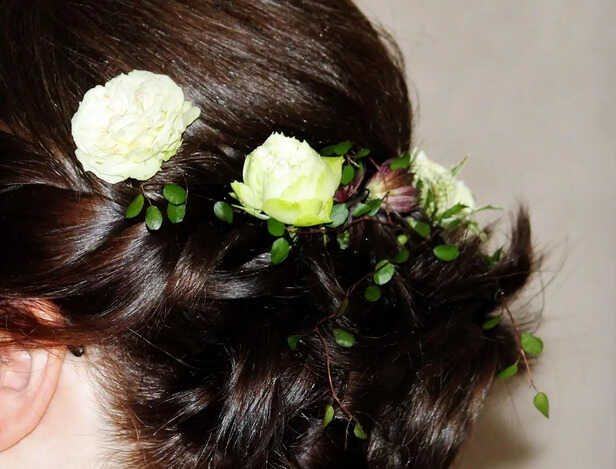
Flower in hair
Image credit : Pixabay
If you step into that older world, the first thing you notice is that hair was fed before it was styled. Ayurvedic material on care of the head describes oiling of the head, and mentions preparations using herbs such as tila taila (sesame oil) as a nourishing base oil, amalaki/amla, madhuka/licorice, reetha/aritha/soapberry, shikakai, bhringraj, henna, and fragrant additions such as sandalwood powder and flowers/flower garlands.
The habits tradition valued most
The hair oiling technique
Curls
Image credit : Pixabay
Daily shiroabhyanga or head oiling is directly praised, and later procedural descriptions of the same therapy preserve a fairly consistent application method: warm the oil mildly, place a small amount first on the crown, then spread it across the scalp, and massage with the finger pads using gentle pressure. One review of shiroabhyanga also notes that abhyanga is done in the direction of the hair. Pull a little oil through the lengths, especially ends. Leave it on before bath rather than washing immediately.
When hair was left open, and when it was tied
The old imagery of women with endlessly flowing hair is only half true. Historical study of the Mahabharata’s world suggests that women generally kept their hair carefully combed, braided into plaits, or arranged in knots, while loose hair was more associated with indoor privacy or mourning. Hair was also adorned with perfumed oils, sandal powder, flowers, and garlands. So the traditional logic was graceful and practical at once: keep the hair tied for movement, dignity, and protection; open it in intimate or restful spaces; decorate it on festive occasions.
Auspicious days and the rhythm of grooming
Hair
Image credit : Pixabay
In traditional belief, even grooming had a calendar. Later ritual summaries of kshoura karma say that hair cutting was often avoided on Ekadashi, Chaturdashi, Amavasya, Purnima, Sankranti, Shraddha days, and commonly on Tuesday and Saturday. Days such as Wednesday and Friday were often treated as more favorable. This was not about biology in the modern sense, but about living in rhythm with sacred time. Hair was not merely cut when convenient. It was handled when the day itself felt supportive.
A queen’s day, from morning to night
Imagine a palace morning. A woman rises before the heat gathers. Her hair, loosened from the night braid, is gently detangled. A light oil is pressed into the scalp, not in haste, but with patient fingers. Then the hair is combed through and braided or coiled into a knot. After bathing, it may be refreshed with fragrant ingredients and adorned with flowers. During the day, it stays tied and orderly, sometimes partly covered, protected from sun, smoke, and dust. By evening, the braid is loosened, the hair is combed again, perhaps lightly re-oiled if dry, and then braided softly for sleep. Long hair was not chased through panic, but grown through discipline. The women of the past seem to remind us that beauty was never only about appearance. It was about how gently, how regularly, and how reverently one cared for what had been given.