
5 Revealing Clothes That Were Not Shameful for Women in Ancient India
Riya Kumari | Apr 09, 2026, 13:49 IST

Ancient Saree
Image credit : AI
You’ve probably felt it - that quiet hesitation before stepping out, the subtle question: “Will this be judged?” Clothing, which should feel like a second skin, often becomes a second burden. But what if the shame stitched into certain clothes isn’t ancient truth but recent forgetting? What if the discomfort you feel isn’t yours, but something handed down, unquestioned? There was a time when the body was not a problem to solve. It simply was.
If your waist shows, it’s “attention-seeking.” If your back is bare, it’s “too bold.” If your body simply looks feminine - curved, alive, unapologetically itself - it becomes something that needs to be controlled before it can be accepted. So you adjust. Not because you’re uncomfortable. But because you’ve been taught that comfort in your own body is dangerous. But here’s the quiet truth no one tells you: There was a time when none of this existed. When the body wasn’t something to defend. When clothing didn’t carry judgment, only expression. The shame you feel today? It didn’t begin with you. And it doesn’t belong to you either.
The Blouse-less Saree
![Saree]()
Temple sculptures like those at Khajuraho Temples and Konark Sun Temple depict women draped in sarees without blouses - graceful, unhidden, completely at ease. Early photographs from the 19th century, especially from Kerala and Bengal, show the same The shift came later, under colonial influence and imposed modesty codes, where covering the upper body became a marker of “respectability.”
And yet today, the same idea is met with discomfort, even judgment. But pause for a moment - what changed? Not the body. Not the fabric. Only the gaze. Shame is often just a story repeated long enough to feel like truth. Your body isn’t inappropriate; it’s just been placed under a harsher light.
The Deep Backless Blouse
Look closely at sculptures in Chennakesava Temple or Hoysaleswara Temple - the intricate carvings reveal women with bare backs, adorned only with jewelry. In classical dance forms like Bharatanatyam, the costume still echoes this aesthetic, where the back is not hidden but honored as part of the body’s expression. The back was never something to conceal; it was part of the body’s natural poetry.
But now, a backless blouse can invite whispers. It’s strange, isn’t it? How something once carved into stone as sacred beauty is now treated as excess. The discomfort isn’t in the clothing, it’s in the conditioned eye. Wearing it isn’t bold; it’s simply returning to a version of ease that once existed without apology.
Drapes That Revealed the Waist and Navel
![Lehenga]()
Sculptures across temples like Meenakshi Amman Temple and Ellora Caves consistently depict women with visible waists and navels - uncovered, unremarkable. In Indian philosophy, the navel is seen as a center of life and creation, not something to hide.
Today, it’s often treated as something to hide or control. But why does something so natural feel so complicated? Perhaps because we’ve tied identity too tightly to perception. When you dress, it’s no longer just about comfort—it becomes about approval. And yet, beneath all of that, there is a quieter truth: your worth was never in the fabric, nor in the gaze that judges it.
The Short Choli
Miniature paintings from the Mughal Empire and Rajput Kingdoms often show women wearing short cholis that left the midriff uncovered. In regions like Rajasthan and Gujarat, this wasn’t fashion - it was function. The climate demanded lightness, and culture didn’t resist it.
Today, the same exposure is often policed. But the body doesn’t change meaning on its own - we assign it. Like waves that don’t question their form, the body simply exists. It is the mind, restless and conditioned, that turns simplicity into conflict. Wearing a short choli isn’t crossing a line; it’s realizing the line was drawn later.
Transparent or Sheer Fabrics
![White saree]()
Ancient texts and art describe garments made of such fine muslin that they were called “woven air.” The famed muslin of Bengal, so delicate it could pass through a ring - was worn by women without stigma. Paintings and accounts from travelers in pre-colonial India describe these sheer fabrics as symbols of refinement, not impropriety.
Now, transparency is often equated with impropriety. But ask yourself: is the discomfort in the cloth, or in the thoughts it awakens? There’s a quiet teaching here, what we react to outside often mirrors something unsettled within. The fabric hasn’t changed; only our relationship with seeing has.
This Isn’t About Clothes
Maybe it’s about how easily we inherit rules without questioning them. How we begin to see ourselves through borrowed eyes. And how, somewhere along the way, we forget that the body was never meant to be a battlefield. There’s a deeper tension you might feel - the pull between wanting to express yourself and the fear of being misunderstood. It’s the same tension that lives in every part of life: between action and attachment, between who you are and who you think you should be.
The Blouse-less Saree

Saree
Image credit : AI
Temple sculptures like those at Khajuraho Temples and Konark Sun Temple depict women draped in sarees without blouses - graceful, unhidden, completely at ease. Early photographs from the 19th century, especially from Kerala and Bengal, show the same The shift came later, under colonial influence and imposed modesty codes, where covering the upper body became a marker of “respectability.”
And yet today, the same idea is met with discomfort, even judgment. But pause for a moment - what changed? Not the body. Not the fabric. Only the gaze. Shame is often just a story repeated long enough to feel like truth. Your body isn’t inappropriate; it’s just been placed under a harsher light.
The Deep Backless Blouse
Look closely at sculptures in Chennakesava Temple or Hoysaleswara Temple - the intricate carvings reveal women with bare backs, adorned only with jewelry. In classical dance forms like Bharatanatyam, the costume still echoes this aesthetic, where the back is not hidden but honored as part of the body’s expression. The back was never something to conceal; it was part of the body’s natural poetry.
But now, a backless blouse can invite whispers. It’s strange, isn’t it? How something once carved into stone as sacred beauty is now treated as excess. The discomfort isn’t in the clothing, it’s in the conditioned eye. Wearing it isn’t bold; it’s simply returning to a version of ease that once existed without apology.
Drapes That Revealed the Waist and Navel

Lehenga
Image credit : AI
Sculptures across temples like Meenakshi Amman Temple and Ellora Caves consistently depict women with visible waists and navels - uncovered, unremarkable. In Indian philosophy, the navel is seen as a center of life and creation, not something to hide.
Today, it’s often treated as something to hide or control. But why does something so natural feel so complicated? Perhaps because we’ve tied identity too tightly to perception. When you dress, it’s no longer just about comfort—it becomes about approval. And yet, beneath all of that, there is a quieter truth: your worth was never in the fabric, nor in the gaze that judges it.
The Short Choli
Miniature paintings from the Mughal Empire and Rajput Kingdoms often show women wearing short cholis that left the midriff uncovered. In regions like Rajasthan and Gujarat, this wasn’t fashion - it was function. The climate demanded lightness, and culture didn’t resist it.
Today, the same exposure is often policed. But the body doesn’t change meaning on its own - we assign it. Like waves that don’t question their form, the body simply exists. It is the mind, restless and conditioned, that turns simplicity into conflict. Wearing a short choli isn’t crossing a line; it’s realizing the line was drawn later.
Transparent or Sheer Fabrics
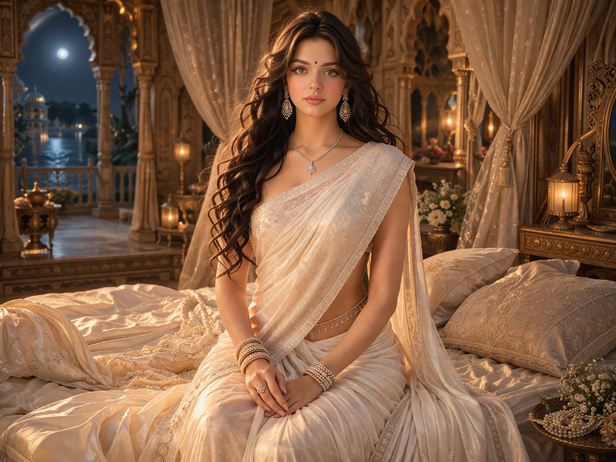
White saree
Image credit : AI
Ancient texts and art describe garments made of such fine muslin that they were called “woven air.” The famed muslin of Bengal, so delicate it could pass through a ring - was worn by women without stigma. Paintings and accounts from travelers in pre-colonial India describe these sheer fabrics as symbols of refinement, not impropriety.
Now, transparency is often equated with impropriety. But ask yourself: is the discomfort in the cloth, or in the thoughts it awakens? There’s a quiet teaching here, what we react to outside often mirrors something unsettled within. The fabric hasn’t changed; only our relationship with seeing has.
This Isn’t About Clothes
Maybe it’s about how easily we inherit rules without questioning them. How we begin to see ourselves through borrowed eyes. And how, somewhere along the way, we forget that the body was never meant to be a battlefield. There’s a deeper tension you might feel - the pull between wanting to express yourself and the fear of being misunderstood. It’s the same tension that lives in every part of life: between action and attachment, between who you are and who you think you should be.