The dupatta is still pinned the way the mehendi artist's sister folded it the morning of the wedding. You know this because you checked, once, about four years ago, then closed the box and pushed it back into the corner of the loft where it has lived ever since.
It Is Not Clutter. It Is a Held Breath.
Every other thing in that loft has a category. Old textbooks. A broken air cooler. Suitcases you use twice a year. The lehenga does not have a category because the categories available to you, keep, donate, sell, repurpose, each require you to decide what the lehenga means now, and that is the decision you have been deferring for twelve years.
Clutter is things you do not think about. This is the opposite. You think about it every time you open that loft, and then you close it again, and the thinking stops exactly where it always stops: at the moment you would have to say out loud what it is worth to you today.
![Zardozi Silk Detail]()
Zardozi Silk Detail
Image credit : AI
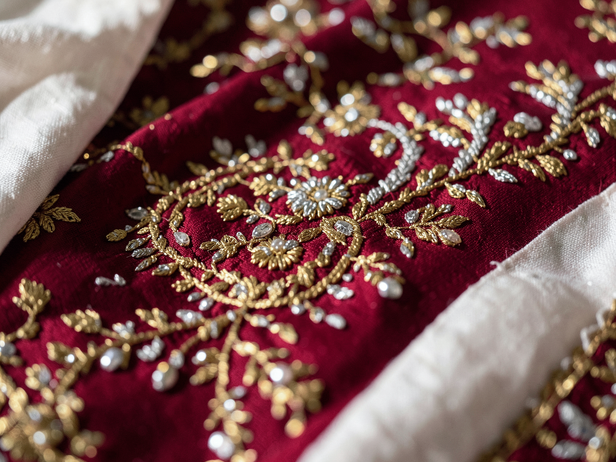
Examining the exquisite zardozi embroidery, a testament to traditional craftsmanship. Perfect for bridal lehenga preservation.
What You Are Actually Preserving
The lehenga is raw silk, most likely a Banarasi base with zardozi embroidery on the hem and the blouse back, the kind of work that takes a kaarigar weeks and does not exist in the same form twice. That is real. The craftsmanship does not expire. The silk, stored in breathable muslin away from direct light and moisture, will hold for decades if the silver-thread embroidery is kept from oxidising. What you are preserving is genuinely preservable.
But that is not the whole of what you are preserving. You are also preserving the option to decide later. The loft is doing the emotional work of not choosing. It holds the lehenga so you do not have to hold the question.
The Daughter Calculation
A lot of women in this situation have done the daughter calculation: she will wear it someday. It is worth sitting with how much weight that calculation is carrying. A lehenga fitted to your measurements, chosen for your wedding's specific palette and your family's specific aesthetic, may or may not suit a daughter who is her own person with her own ideas about what she wants to walk into a mandap wearing.
This is not an argument against keeping it. It is an argument against keeping it on the daughter's behalf without asking her. If she is old enough to have an opinion, she has one. If she is not yet old enough, the calculation is about your comfort, not hers, and there is nothing wrong with that, as long as you know which one it is.
![Golden Silk Keepsake]()
Golden Silk Keepsake
Image credit : AI
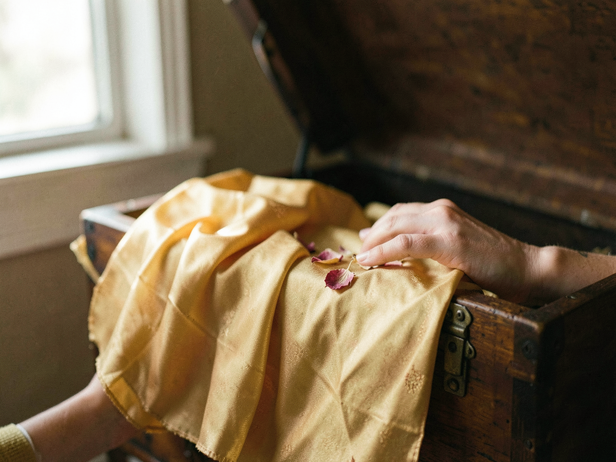
Preserving cherished memories. This silk dupatta, a part of my wedding lehenga storage, evokes timeless elegance.
What Repurposing Actually Means for Zardozi Work
The repurposing option sounds creative and feels like a middle path. In practice, it depends entirely on what the lehenga is made of. Heavy zardozi or gota patti on a structured skirt does not translate easily into cushion covers or a salwar. The weight and stiffness that make it magnificent on a wedding day make it difficult to cut and re-stitch into something that will actually be used. A skilled karigar can sometimes salvage the blouse fabric into a jacket or the dupatta into a stole, but this requires finding someone who works with bridal-weight silk embroidery, which is not the same as a standard tailor.
If repurposing is the direction, the honest first step is taking it to a craftsperson and asking what is actually possible with this specific fabric and this specific embroidery, before you decide. The answer may change what you want to do.
The Donation Question Has a Real Answer
There are organisations in India that accept bridal wear for women who cannot afford it, some through NGOs that facilitate weddings for women from low-income families, some through community networks. If the lehenga is in good condition, which yours likely is, it can be worn again by someone for whom a wedding outfit of this quality would otherwise be impossible. This is not a consolation prize. It is the lehenga being used for exactly what it was made for, once more.
The reason this option stalls is not logistics. It is that donating it feels like closing something. Which is true. It is closing something. The question is whether keeping it open has been serving you.
Twelve years is long enough to know that the decision is not going to make itself. The lehenga is not waiting for the right moment. It is waiting for you to stop waiting for the right moment.