A mukaish-worked dupatta does not catch your eye from across the room. It waits. You are standing in conversation, you shift your weight, the fabric moves, and for one second the surface becomes a scatter of cold silver light, and then it is plain again. That is the whole point.
What Mukaish Actually Is
![Mukaish Embroidery Glow]()
Mukaish Embroidery Glow
Image credit : AI
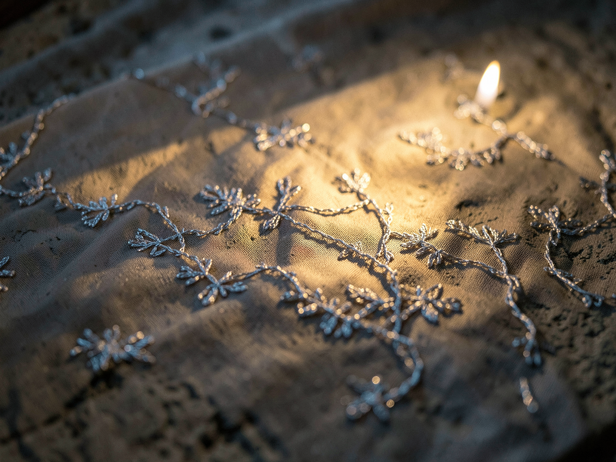
Exquisite mukaish kamdani dupatta, showcasing traditional Lucknow embroidery craft with scattered light on aged stone.
Mukaish, also called mukaish kamdani, is a form of metal-wire embroidery native to Lucknow. Artisans press flat, coiled lengths of wire, called badla, into the weave of a fabric, usually chikankari-worked cotton, georgette, or fine muslin, so the metal sits flush with the surface rather than sitting above it. The wire is not sewn through the cloth in the way a bead or sequin is attached. It is folded and locked into the existing weave, which means the fabric keeps its drape and the embellishment does not pull or distort.
The effect is entirely dependent on angle. Under flat overhead light, a mukaish piece looks like a plain fabric with a faint metallic texture. Under directional light, a candle, a chandelier, late-afternoon sun, the badla picks up the beam and throws it back. The embroidery is not decorative in the way a print is decorative. It is optical.
The Difference Between Badla and Everything Else
Sequins are plastic discs that sit on top of fabric and catch light from any direction, at any distance. They are designed to be seen. Zardozi uses gold or silver threads couched onto a stiff base, building texture and relief. Both are visible embellishments, you can see the craft from across a room.
Mukaish is the opposite of that. The badla wire, once pressed into the weave, becomes part of the fabric's surface. It does not add height. It does not add weight in any meaningful way. A mukaish-worked georgette still falls the way georgette falls. The embellishment has no presence of its own until the angle is right, and then it has complete presence.
That restraint is what makes it difficult to photograph and difficult to sell online, and it is exactly what makes it extraordinary to wear. A garment that only reveals itself in motion, in specific light, in proximity, that is a garment that rewards the people close to you rather than the room at large.
The Lucknow Context
![Bazaar Dusk Georgette Stall]()
Bazaar Dusk Georgette Stall
Image credit : AI
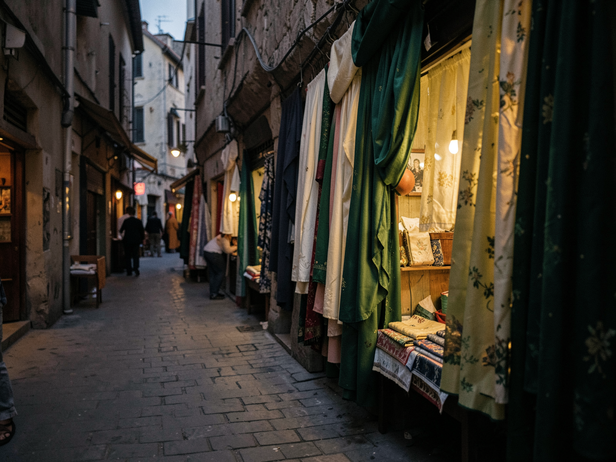
Draped georgette at dusk, showcasing the rich textures of traditional Lucknow embroidery craft. A glimpse into artisanal heritage.
Mukaish developed alongside chikankari in the Nawabi court culture of Lucknow, where the aesthetic was always about subtlety over spectacle. Chikankari itself is white-on-white shadow embroidery, embellishment that is almost invisible in some lights and fully present in others. Mukaish follows the same logic, adding metal to that tradition of restraint. The two crafts are often found together on the same piece: chikankari for the texture, mukaish for the occasional flash of cold light.
The craft is concentrated in the old city of Lucknow, particularly in the workshops around Chowk. The artisans, many of them women working from home, are trained in the specific pressure and angle required to lock badla into a weave without breaking the thread. The skill is in the consistency: a mukaish piece that is well made looks even and deliberate; a poorly made one has wires that lift or sit at irregular angles and catch light unevenly.
How to Read the Quality
Hold the fabric at a low angle to a light source and tilt it slowly. The badla should catch and release light evenly across the surface, not in patches. Run a finger across it, the wire should feel flat and smooth, not raised or scratchy. A well-pressed piece will not snag fine fabric when the dupatta is folded against itself.
Check the base fabric too. Mukaish on a thin, hand-woven muslin or fine georgette will drape and move differently from mukaish on a heavier synthetic base. The wire work on a synthetic base tends to look harsher because the fabric does not move enough to give the light play its full effect. The craft is at its best on a fabric that breathes and shifts.
Price varies sharply by the density of the work and the quality of the base cloth. A dupatta with sparse mukaish on a mid-weight georgette starts around a few hundred rupees at Chowk. A fully worked kurta on fine muslin, with dense badla across the yoke and sleeves, can reach several thousand. The difference is visible when you hold both to the same light.
Wearing It
Mukaish does not need to be saved for occasion wear, though it earns its place there. A plain cotton kurta with a mukaish dupatta in white or ivory is an entirely practical combination, the dupatta reads as simple fabric until the light catches it. That shift is the thing you are wearing it for.
The craft also works in colours other than the traditional silver. Gold badla on deep green or burgundy georgette is common in Lucknow's market. The principle is the same: the colour of the fabric sets the mood, the badla adds the moment of light.
Mukaish does not compete with what you are wearing. It does not compete with your jewellery. It surfaces when conditions are right and disappears when they are not. Every sequin in the room will be visible all evening. The mukaish will be noticed once, by the right person, at the right moment, and that is the more interesting thing to wear.