Cyanoacrylate bonds a lash extension to your natural hair in under ten seconds. That same compound, in slightly different formulations, is used in surgical wound closure. The speed is the point, and so is the problem, because once it cures, it is not coming off without a dedicated solvent, and if it lands on your eyelid skin or your conjunctiva, the ten seconds are already up.
What the Adhesives Actually Contain
Lash extension glues are built around cyanoacrylate, most commonly ethyl-2-cyanoacrylate. The fumes released during curing, not the cured adhesive itself, are what trigger most immediate reactions: watering eyes, a stinging sensation, and in sensitive individuals, a sharp burning at the lash line within the first hour. Formaldehyde is a secondary concern: many cyanoacrylate adhesives release trace formaldehyde as they off-gas, and while the quantities are small, repeated exposure across multiple appointments accumulates. Clients who return every three to four weeks for infills are not getting one exposure; they are getting twelve or more a year.
Brow lamination uses a different chemistry entirely. The first step is a lifting solution, typically a thioglycolate compound, the same class of chemical used in hair perms, that breaks the disulfide bonds in the brow hairs so they can be repositioned. A neutraliser then reforms those bonds in the new direction. The skin directly beneath the brow sits in contact with both solutions for several minutes each. Thioglycolate is an effective reducing agent; it does not distinguish between the keratin in a brow hair and the keratin in the skin barrier just below it.
![Beauty Prep Essentials]()
Beauty Prep Essentials
Image credit : AI
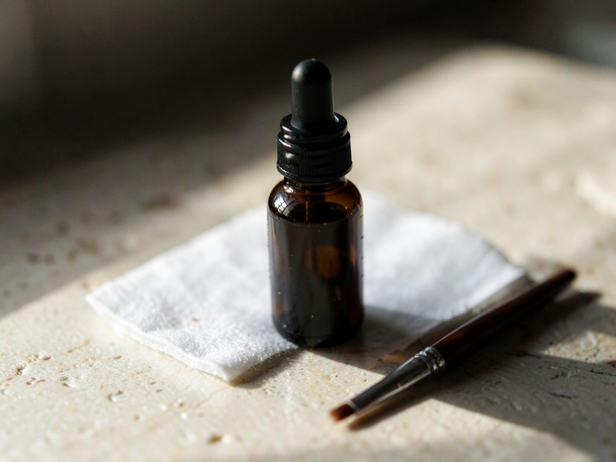
My beauty routine essentials, including a patch test for lash extensions, ready for application.
The Reactions Worth Knowing Before You Book
Allergic contact dermatitis is the most common serious outcome from lash adhesives. It is not the same as irritation. Irritation from cyanoacrylate fumes is immediate and usually resolves within a day. Allergic contact dermatitis is a Type IV hypersensitivity reaction, it takes 24 to 72 hours to appear, peaks as swollen, itchy, weeping eyelids, and once sensitised, the client will react to cyanoacrylate at lower and lower thresholds with each subsequent exposure. There is no desensitisation. The only management is avoidance.
Brow lamination reactions tend to present as redness, peeling, and sometimes blistering along the brow ridge and the skin immediately above and below it. The Indian Association of Dermatologists, Venereologists and Leprologists has noted a rise in chemical contact dermatitis presentations linked to at-home lamination kits, where timing controls and patch testing are rarely followed. In-salon treatments are not automatically safer, they are only safer when the technician is trained, the products are professional-grade, and the client's skin has been assessed beforehand.
A less-discussed risk with lash extensions is traction alopecia of the natural lashes. Extensions that are too heavy for the natural lash diameter, or infills applied before the previous set has shed naturally, place mechanical stress on the follicle. The Indian Dermatology Online Journal has published case reports of permanent lash loss in clients who wore extensions continuously for over a year without adequate recovery periods.
The Patch Test Problem
Most salons offer a patch test. Fewer clients take it. The standard window is 24 to 48 hours before the appointment, which is long enough to catch a strong reaction but not always long enough to catch a borderline one. For lash adhesive specifically, some dermatologists recommend a 72-hour window for clients with a personal or family history of contact allergies, atopic eczema, or known sensitivities to acrylates, which includes certain nail products and dental adhesives.
The patch test itself matters less than where it is applied. A test on the inner forearm tells you something about your general reactivity. A test at the outer corner of the eye, on skin that is thinner, more mobile, and closer to the mucous membrane, tells you considerably more. Ask your technician which they do. If they test only on the arm, factor that into your decision.
![Gel and Spoolie Still Life]()
Gel and Spoolie Still Life
Image credit : AI
Examining the subtle texture of lash extension adhesive risks with a clean spoolie.
Questions Worth Asking Your Technician Before the Appointment
A trained technician will not find these questions unusual. One who does is worth noting.
Ask for the brand and full ingredient list of the adhesive or lamination kit in use. A reputable salon will have the product's safety data sheet on hand. If the adhesive contains formaldehyde-releasing preservatives in addition to cyanoacrylate, that is relevant if you have a history of formaldehyde sensitivity.
Ask how the room is ventilated during lash application. Cyanoacrylate fumes concentrate in still air. A nano-mister used to cure the adhesive at the end of the appointment disperses fumes faster, but the application phase itself, which can last 90 minutes for a full set, happens in a closed environment. Proper ventilation is not a luxury; it is a basic occupational health requirement for the technician as much as for you.
For brow lamination, ask how long each solution sits and whether the timing is adjusted for fine or sensitive skin. The standard lifting solution contact time is around ten to fifteen minutes, but finer brow hairs and thinner skin around the brow ridge warrant a shorter application. A technician applying the same timing to every client regardless of hair texture is not customising the treatment, they are running a script.
Ask what the aftercare protocol is and what to do if you notice a reaction within 48 hours. A clear answer, which should include removing extensions with a professional solvent rather than pulling, and seeing a dermatologist rather than a GP for a suspected allergic contact dermatitis, tells you the technician has thought past the appointment.
What the Recovery Period Actually Requires
Lash extensions need an infill every three to four weeks as natural lashes shed. Wearing them continuously without a break of four to six weeks every six months gives the follicle no recovery period. The weight and adhesive contact are cumulative. This is not a reason to avoid extensions; it is a reason to plan them rather than treat them as permanent infrastructure.
Brow lamination results last six to eight weeks. In that window, the brow hairs are in a chemically altered state, more brittle, more prone to breakage if rubbed or caught. Sleeping face-down, rubbing the brows during cleansing, and using oil-based products directly on the brows in the first 48 hours all accelerate the breakdown of the treatment and increase the chance of breakage. The aftercare is not decorative guidance; it is structural.
Both treatments sit in a category that Indian regulatory frameworks have not yet standardised at the salon level the way pharmaceutical products are. The onus for safety sits with the client who asks the right questions and the technician who can answer them. The adhesive does not care whether you knew what was in it. The reaction arrives either way.