There is a specific exhaustion that belongs to the woman who has organised the puja, remembered the supari, and is still the one everyone looks at to check whether the ritual is going right. Tulsi Vivah, when it happens in your own courtyard, puts you at the centre of something sacred and logistical at the same time. The clothes you choose for it have to answer to both.
The Saree Question Is Actually a Fabric Question
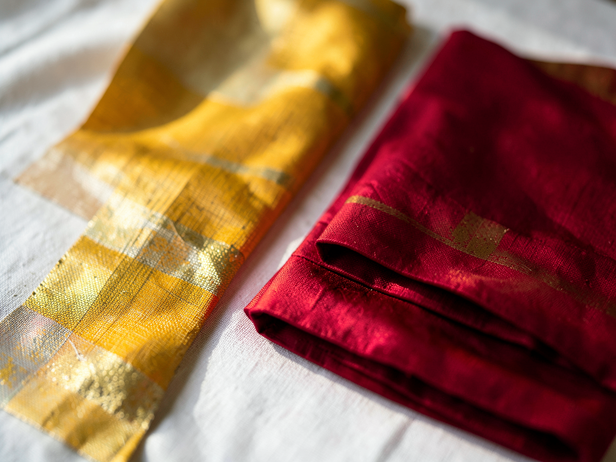
A saree is not a single thing. A heavy Banarasi silk in a November courtyard, where you will sit cross-legged on a mat, rise to adjust the lamp, and walk to the kitchen four times before the muhurat, is a different garment from a cotton-silk blend or a lightweight chanderi. The Banarasi is for the woman who will be seated and photographed. The chanderi or a fine cotton-silk is for the woman who is running the event. Both can carry the gold zari border that reads as ceremonial from across the courtyard. The difference is in the drape's weight on your shoulder after two hours. Choose the fabric before you choose the colour.
![Saffron-Gold Chanderi, Deep Red Saree]()
Saffron-Gold Chanderi, Deep Red Saree
Image credit : AI
Elegant fabrics for a home puja function. Saffron-gold chanderi and deep red saree.
The Colour Carries Meaning Whether You Plan It or Not
Tulsi Vivah is Vishnu's wedding, and the colours that recur in the ritual itself are yellow, green, and red. Yellow is the colour of turmeric and of auspiciousness; green is the colour of the tulsi plant and of new beginnings; red is the colour of the married woman, of sindoor, of the mangalsutra. If you are the host and a married woman, red or a deep yellow reads as intentional and appropriate without requiring explanation. If you are unmarried, green or a saffron-adjacent yellow sits within the ceremony's palette without carrying the married-woman signifier. These are not rules enforced by anyone. They are the visual grammar of the occasion, and wearing within it means you do not have to explain your clothes to your mother-in-law during the puja.
Blouse Construction Matters More Than the Blouse's Embroidery
The blouse that photographs well is often the one with the heaviest work on the back. The blouse that lets you move through a two-hour puja, bend to light diyas, and carry a heavy thali is the one with a back that does not gap, sleeves that do not cut into the arm when raised, and a neckline that does not require constant adjustment. A well-stitched cotton-lining inside a silk blouse keeps it from slipping. A hook closure rather than a zip gives you micro-adjustments across the evening. Embroidery on the front, near the neck, photographs from the front and does not interfere with movement. This is not a sacrifice of beauty. It is beauty that functions.
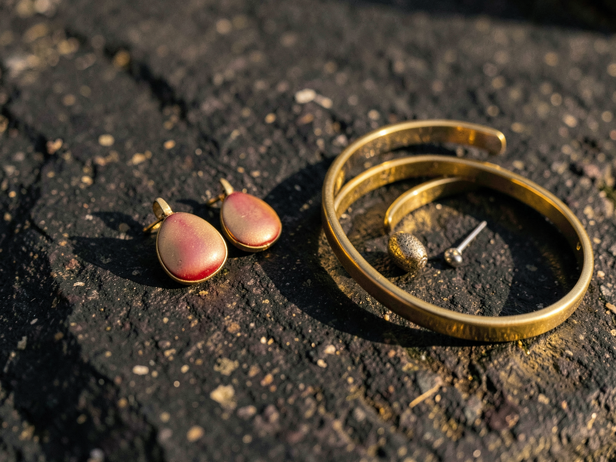
![Golden Temple Jewellery Still Life]()
Golden Temple Jewellery Still Life
Image credit : AI
My traditional temple jewellery, perfect for a Tulsi Vivah outfit at home. Rich gold and red stones gleam.
Jewellery for a Woman Who Will Use Her Hands
Temple jewellery, the flat, matte-gold style with red or green stones, was designed for exactly this kind of occasion. It does not catch on fabric the way heavily textured Kundan settings can. A single broad gold bangle on each wrist is less likely to clink against the puja thali than a stack of thin ones. Earrings that sit close to the ear rather than swinging long keep themselves out of the way when you lean forward to tend the lamp. The maang tikka, if you wear one, should be pinned rather than balanced; you will bend your head more than once. None of this means plain. Temple gold with a red stone against a yellow saree is as dressed as it gets. It is dressed in a way that survives the evening intact.
The Dupatta and the Ghoonghat Are Not the Same Decision
If your family's practice includes covering the head during the puja, a dupatta in the saree's fabric pinned at the crown with a single flat pin stays in place without needing a free hand to hold it. A chiffon dupatta slips. A net dupatta catches on earrings. A cotton or silk dupatta in the saree's weave, pinned once, does not move. If covering the head is not your practice, a dupatta draped over the shoulder and tucked into the waistband gives you the visual weight of the garment without the management problem. The decision is yours and your household's. The fabric and the pin are practical answers to whichever decision you make.