The bag is smaller than she thought it would be. That is the first surprise of solo travel, how little you need when you are not packing around someone else's schedule, someone else's formality, someone else's cold. What goes in is precise. What she wears on the day she leaves tells you everything about what she has learned to trust in herself.
The Fabric Does the Work She Used to Assign to Confidence
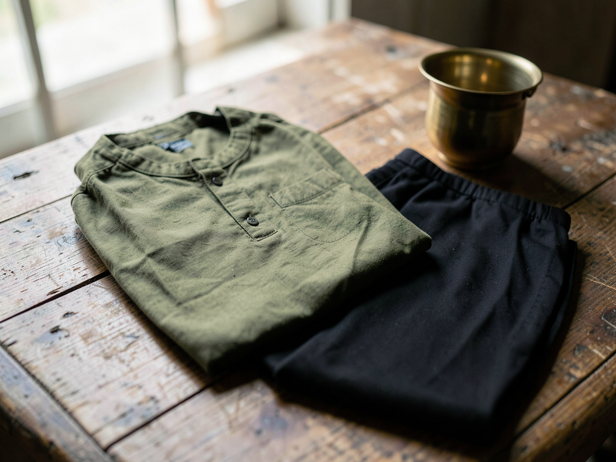
Cotton does not ask anything of you. A full-sleeved kurta in a medium-weight cotton, not the tissue-thin kind that turns translucent at the shoulders by noon, not the stiff handloom that needs ironing after every fold, is the garment that shows up in almost every first solo trip without anyone planning it that way. It breathes on a Rajasthan platform in October. It covers arms in a temple without requiring a separate dupatta to manage. It does not announce itself. The woman wearing it is the one who gets noticed, not the cloth.
Linen works the same way but creases badly in a sleeper berth. Rayon is cooler but clings when damp and damp is a condition of most Indian travel between March and September. Chanderi is beautiful and entirely wrong for a backpack. The cotton kurta survives a twelve-hour train, a shared auto, and a guesthouse bathroom with one hook. That is the real specification.
![Olive Kurta & Black Palazzo]()
Olive Kurta & Black Palazzo
Image credit : AI
My comfortable solo travel outfit for India: a deep olive kurta and black palazzo pants, perfect for exploring.
The Bottom Half Is a Practical Decision Dressed as an Aesthetic One
Palazzos in a solid, black, navy, deep olive, travel as a single item that reads as three different outfits depending on what sits above them. They pack flat, they dry overnight, and they do not require a belt. A woman who has traveled alone before will tell you she stopped wearing jeans on trains after the first trip. Denim holds heat, takes two days to dry if it gets wet, and requires a particular kind of confidence at a squat toilet. The palazzo does not.
Churidars work if the kurta is long enough to cover the knee. Leggings in a thick cotton-spandex, not the sheer kind, are the choice for hill stations in October, where the temperature drops faster than the forecast says it will. Skirts depend on the route. A midi in a non-sheer fabric is fine in Goa, fine in Pondicherry, less fine on a crowded sleeper where climbing to the upper berth in it becomes a calculation. The woman packing for her first solo trip usually brings one anyway and figures this out herself.
Footwear Is the Decision She Gets Wrong Once
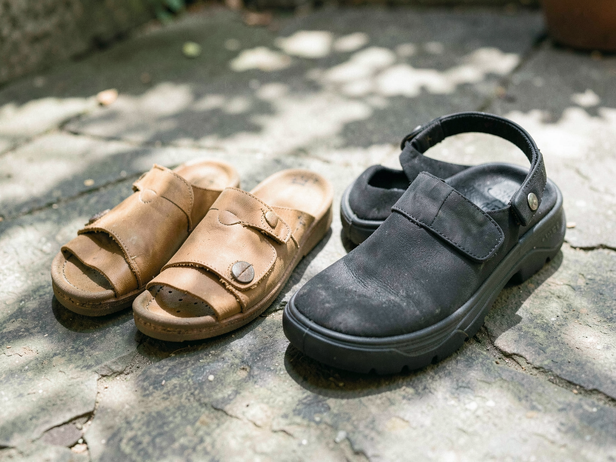
Kolhapuris are the answer to most questions about footwear in India, except the question of what to wear when it rains, or when the pavement is uneven, or when she needs to walk four kilometres because the auto driver did not know the lane. A flat leather Kolhapuri in tan or black is the right shoe for a heritage walk, a café, a temple where shoes come off at the gate, and a market. It is the wrong shoe for Coorg in monsoon or Manali in October.
The first solo trip often involves one pair of Kolhapuris and one pair of sports sandals, the kind with a back strap, a rubber sole, and enough grip that a wet step is not a catastrophe. The sports sandal is the shoe she wears on the train. The Kolhapuri is the shoe she wears when she arrives and wants to feel like herself again.
![Footwear Contrast: Kolhapuri vs. Sports]()
Footwear Contrast: Kolhapuri vs. Sports
Image credit : AI
My choice for a solo travel outfit India: the comfort of sports sandals meets the tradition of Kolhapuri.
The Dupatta Is Not Optional, But It Is Not What She Thinks
She packs it for modesty and uses it for everything else. A cotton dupatta in a solid or a simple block print becomes a pillow cover on the sleeper, a wrap when the train air conditioning is set to a temperature that has no relationship to the weather outside, a quick cover for a bag left on a seat, a scarf in a cold temple corridor. The one she reaches for most is not the beautiful embroidered one she almost packed. It is the plain one, soft from washing, that takes up no space and dries in an hour.
What She Does Not Pack
The heels she thought she might need for one nice dinner. The white anything. The structured handbag that does not fit over a shoulder when both hands are occupied. The outfit she bought specifically for this trip that she has not worn yet and does not know how it moves.
What she does pack, every time after the first: a crossbody bag with a zip, worn in front in crowded stations. Pockets, wherever the garment has them. A safety pin on the inside of the bag's main compartment. A stole that doubles as everything. And the kurta she has worn so many times she does not have to think about it, which means, on the platform at six in the morning with a bag on her back and a ticket in her hand, she is already thinking about something else entirely. The city she is going to. The person she is when she gets there.