Gota patti is not embroidery. No thread passes through the base fabric. Instead, a narrow ribbon of metal or metallic-coated material is folded, pleated, and stitched flat onto the cloth in petals, borders, and geometric fills. That distinction matters because the ribbon itself is the decoration, which means the ribbon's material is everything.
What Real Gota Patti Is Made Of
![Golden Ribbon on Silk]()
Golden Ribbon on Silk
Image credit : AI
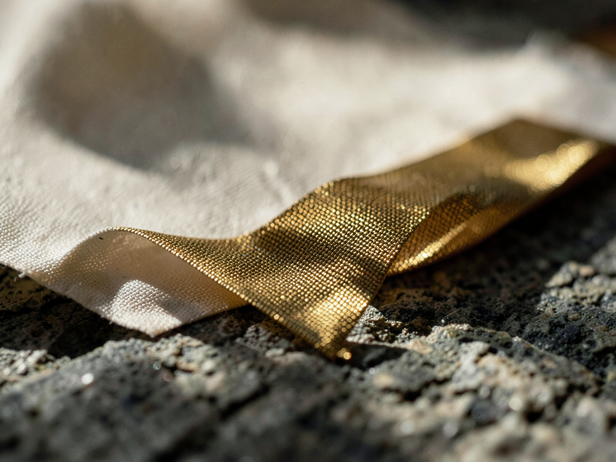
Authentic metal ribbon embellishment India, showcasing intricate weave texture on raw silk. Soft light highlights its natural sheen.
Real gota is woven from a fine metal strip, historically silver or gold, wound around a silk or cotton core. The version still produced in Jaipur and Jodhpur uses a brass or copper strip with a gold or silver wash, woven on a small handloom into a ribbon between two and twelve millimetres wide. The weave is tight enough that the ribbon holds a crease without cracking. When you fold a genuine gota strip between your fingers and then open it flat, the fold line disappears or nearly does. The metal has give. Run your thumbnail across the face of a real gota ribbon and it resists. It does not scratch off in a line. Hold it at an angle to a single light source and the surface reflects in one clean direction, the way a woven textile does, not the way a mirror does. The colour is warm, slightly uneven, and does not look the same from every angle. That unevenness is the weave catching light differently across each thread.
What Plastic Gota Looks Like Before You Buy It
Machine-made plastic or polyester-film gota ribbon is pressed, not woven. Under close inspection the surface is uniform and glassy. Fold it once and a white stress line appears along the crease. The colour is flat and consistent from every angle, the way a foil sticker is consistent. It is lighter in the hand than metal gota of the same width, almost weightless. Against a light source it flares rather than reflects, sending light in several directions at once because the surface is smooth rather than textured. In a shop, under tube lighting, this can look brighter than the real thing. That brightness is the first tell. Real gota is luminous. Plastic gota glitters.
After the First Wear
![Gota Patti Lehenga Detail]()
Gota Patti Lehenga Detail
Image credit : AI
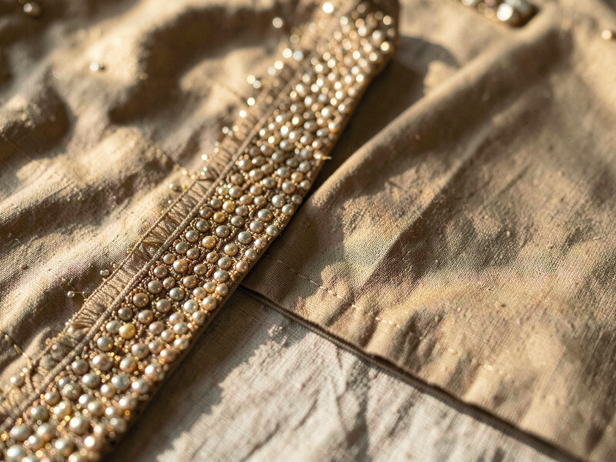
Close-up of a lehenga hem with detailed gota patti work. Learn how to identify genuine gota work.
Heat and movement are the first tests. A real gota ribbon softens very slightly with body warmth, which means the pleats and petals settle into the fabric and the stitching relaxes without puckering. The edges stay flat. If the garment is a lehenga or a dupatta, the gota border drapes with the cloth rather than holding stiff. Plastic ribbon does the opposite. It has memory but not flexibility. After a few hours of wear, the ribbon at stress points, the hem, the shoulder seam, the wrist edge, begins to lift slightly from the base fabric because the ribbon cannot follow the cloth's movement. By the end of an evening the lifted edges catch on things. You notice it when you fold the dupatta and the gota border does not lie flat.
After the Second Wear and the First Storage
This is where the gap becomes impossible to ignore. Real gota, stored folded in a muslin cloth, shows crease marks that a light press with a low-heat iron through a damp cloth will remove. The metal tarnishes slowly, the way silver does, and a gentle rub with a soft dry cloth brings back most of the sheen. The ribbon does not peel, because there is nothing to peel. It is woven metal. Plastic gota after one storage cycle shows delamination at the fold lines. The metallic film separates from the base ribbon in thin flakes or in a continuous strip along the crease. Once that separation starts it does not stop. Pressing with an iron accelerates it because the film melts or bubbles. The grey or white lines that appear at every fold are permanent. No product fixes delaminated foil. The garment is not ruined but the gota work is, and replacing gota trim on a finished garment is skilled, time-consuming work that often costs more than the original difference in price between the real and the copy.
How to Check Before You Buy
Ask the seller to give you a ten-centimetre offcut of the ribbon, or ask to examine the inside of the hem where the ribbon ends are tucked. On a real gota garment the ribbon end is folded under and stitched, and the cut edge shows a woven cross-section of fine metal threads. On a plastic garment the cut edge is clean and uniform, like the edge of a piece of tape. If an offcut is not possible, fold a small section of the ribbon against itself firmly and release it. A white crease line that does not recover in a few seconds is plastic. A crease that softens and partially disappears is metal. The weight test is useful on loose ribbon but less reliable on a finished garment where the base fabric adds mass. The fold test works on both. On price: real gota ribbon in Jaipur wholesale markets runs from roughly eighty to several hundred rupees per metre depending on width and the quality of the metal wash. A lehenga border using genuine gota at honest retail is not cheap. If the price of the finished garment seems low for the density of the work, the ribbon is almost certainly plastic.