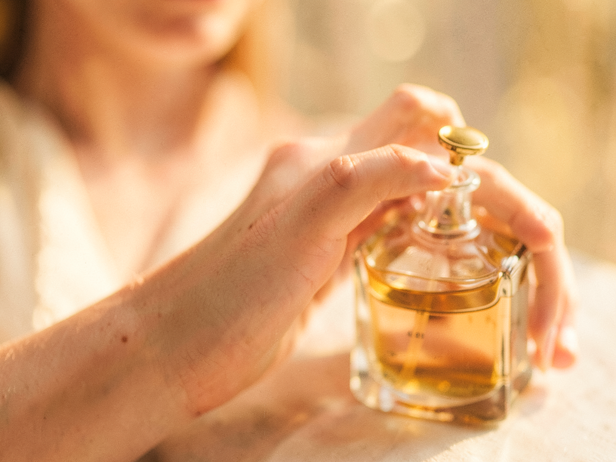
The bottle has been sitting in the same spot for years, on a shelf, in a drawer, inside a box that still smells faintly of her. You opened it once and put it back. Then one morning you didn't put it back.
Wearing a dead woman's perfume is not the same as wearing a vintage find. The fragrance carries a specific memory of a specific person, and when you spray it on your wrist, you are not reaching for aesthetics. You are reaching for her.
What the Nose Remembers That the Mind Forgets
Smell is the only sense that routes directly to the limbic system, the part of the brain that holds emotion and long-term memory, before it reaches the cortex where conscious thought lives. This is not metaphor. It is the reason a scent can collapse twenty years in under a second, returning you not just to a place but to the feeling of being inside a particular afternoon.
Your grandmother's perfume does this with a precision no photograph can match. A photograph shows you what she looked like. Her scent returns you to the physical fact of being near her, the warmth of her sari, the particular quality of her attention, the way the room felt smaller and safer when she was in it.
When you wear it, the memory does not stay inside you. It moves with you into every room you enter.
![Morning Ritual, Vintage Scent]()
Morning Ritual, Vintage Scent
Image credit : AI
The scent of grandmother's perfume, a whisper of memory on my wrist. This vintage fragrance carries so much identity.
Being Recognised Before You Arrive
Fragrance trails. It enters a space ahead of your face, ahead of your voice, ahead of any choice you make about how to present yourself that day. To be recognised by a scent, to have someone turn before they see you and say her name, is one of the stranger forms of intimacy available to the living.
It unsettles people in the best way. They are not reacting to you. They are reacting to the ghost of someone they loved, briefly convinced she has walked back in. For a moment, the room holds both of you.
This is not a trick and it is not manipulation. It is what fragrance has always done, carried identity across time and space in a way that clothing and jewellery cannot. A ring can be recognised. A scent is experienced. The difference matters.
The Fragrance Itself: What You Are Actually Wearing
Many of the perfumes that belonged to the previous generation were built around structures that are rarely made now. Heavy base notes, sandalwood, vetiver, musk, labdanum, anchored by florals that were not sheer but dense: rose absolute rather than rose water, jasmine with its indolic edge, ylang-ylang worn without apology. These were sillage perfumes, designed to announce and to linger, built for a time when presence was something a woman was expected to declare.
If the bottle is old, the juice inside has changed. Fragrance oxidises. Top notes, the citrus, the green, the light aldehydes, fade first. What remains is often richer and darker than the original, the base notes exposed and amplified. You are not wearing what she wore on her wedding day. You are wearing what time has made of it. That is its own kind of truth.
If the bottle is empty, or if the fragrance has turned, the house may still exist. Chanel No. 5, Shalimar, Arpège, Tabu, L'Air du Temps, many of the perfumes that defined a certain generation of Indian women in the mid-twentieth century are still in production, though reformulated. A perfumer or a fragrance specialist can sometimes identify a scent from description alone and point you toward what comes closest.
![Dawn's Quiet Dressing Table]()
Dawn's Quiet Dressing Table
Image credit : AI
The scent of grandmother's perfume lingers, a whisper of memories in the quiet dawn.
The Question of Ownership
There is a moment, usually quiet and usually alone, when you stop thinking of it as her perfume and start thinking of it as yours. This does not happen because you decided it. It happens because the scent has spent enough time on your skin, your particular skin chemistry, your warmth, your body, that it has begun to smell like you.
Fragrance does not smell the same on two people. The same bottle produces a different result on different skin, depending on pH, hydration, diet, and the natural oils the body produces. What she wore is not what you are wearing, even from the same bottle. The molecule is identical. The experience is not.
Claiming a scent is not erasure. It is continuation. You are not replacing her. You are becoming the next person the scent belongs to, the next woman someone will smell and be briefly, helplessly returned to.
The bottle will run out eventually. By then, the question of whose perfume it is will already be settled.