The average bra does one structural job: the band holds the weight. The cups position. The straps, despite what most women adjust first when something feels wrong, contribute almost nothing to support, about 10 to 15 percent on a well-fitted bra, and closer to zero when the band is riding up at the back. If your straps are digging in, your band is too loose. That is where most Indian women's fit problems begin and end.
What the Band Actually Does
The band should sit parallel to the floor all the way around, level at the front, level at the back. If it rides up at the back, it is too big. A correct band sits firmly enough that you can slide two fingers underneath it, but no more. On the loosest hook when new, the band should feel snug. As the elastic relaxes over months of washing and wear, you move to the middle hook, then the tightest. A bra that only fits on the tightest hook when new has already failed.
The band size is a measurement of your ribcage, taken directly under your bust. Use a soft measuring tape. Exhale normally and hold the tape snug but not tight, parallel to the floor. Round to the nearest whole number. If that number is even, that is your band size. If it is odd, try both the number below and above, Indian sizing typically runs in even numbers, so a 31-inch ribcage usually fits a 30 or 32 band depending on the brand's cut and your build.
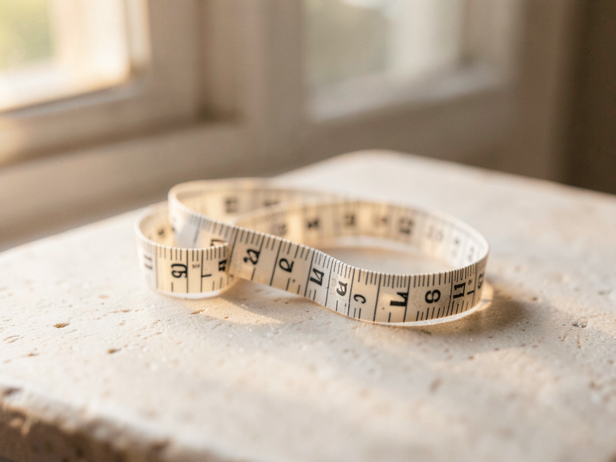
![Measuring Tape Loop]()
Measuring Tape Loop
Image credit : AI
A soft measuring tape, essential for understanding bra band size India, lies ready for use.
How to Measure Your Cup Size at Home
Cup size is not a fixed letter. It is the difference between your band measurement and your bust measurement, taken at the fullest point of the chest, again parallel to the floor, without compressing. Stand straight, arms relaxed at your sides.
Subtract your band measurement from your bust measurement. Each inch of difference corresponds to a cup letter: one inch is an A, two is a B, three is a C, four is a D, five is a DD or E depending on the brand. A woman with a 34-inch ribcage and a 38-inch bust is a 34D, not a 36B, which is what she is often sold because D sounds large and 36 sounds safer. The cup volume is identical in what is called sister sizing, but the band changes how the weight is carried.
Sister sizing matters when a style runs large or small in the band. A 34D and a 36C hold the same cup volume. If a 34D band feels too tight in a particular brand, a 36C in that brand will fit the cup while giving the band a little more room, though the support will be marginally less. Use this as a fit tool, not a permanent substitution.
Why Indian Sizing Feels Inconsistent
India does not have a single standardised bra sizing system. Brands sold through large retail chains often follow UK sizing. Brands manufactured for the domestic mid-market sometimes use their own internal grading. International brands sold through e-commerce may follow US sizing, which labels the same cup one letter differently from UK sizing above a D. A UK DD is a US DDD. A UK E is a US DD. None of this is marked on the tag in any consistent way.
Cotton-dominant fabrics, which dominate the Indian mid-market because of climate, stretch differently from microfibre or nylon-spandex blends. A cotton-rich band will loosen faster with washing. If you are buying a primarily cotton bra, start on the middle hook rather than the loosest, or size down one band and confirm the cup still fits.
The practical workaround: measure yourself before buying, use the brand's own size chart rather than assuming your size transfers across brands, and always try the back closure on the loosest hook in the fitting room. If you cannot do that, if you are buying online, treat the first wear as a fitting session and check the return window before cutting the tag.
![Bra Closure Detail]()
Bra Closure Detail
Image credit : AI
Examining the bra band size for a correct bra fit. Essential for comfort and support.
What Correct Fit Feels Like
The centre gore, the small bridge of fabric between the cups, should sit flat against your sternum. If it floats away from your body, the cups are too small. If the underwire (where present) sits on breast tissue rather than on the ribcage below it, the cup is too small. If the cup fabric wrinkles or folds, the cup is too large or the shape does not match your projection.
Straps should rest on your shoulders without digging in and without sliding off. If you are tightening them to the last adjustment and they still feel loose, the band is carrying too little of the load. Loosen the straps slightly and check whether the band feels more secure, if it does not, the band size is the problem.
A well-fitted bra should be comfortable enough to forget about within the first ten minutes of wearing it. Underwire that pokes, straps that leave marks by noon, a band that you are pulling down at the back by mid-afternoon, none of these are normal. They are fit problems, and they are all solvable with a tape measure and thirty minutes.