By the third time you stop mid-sentence to pull the dupatta back onto your shoulder, you have already stopped noticing that you stopped. That is the thing about this particular garment. Its management becomes so automatic it disappears into the body, filed under habit rather than effort.
The Physics of Two Metres on a Moving Body
Chiffon slides. Georgette floats. Cotton slips from the shoulder the moment you reach for something. The dupatta's relationship with gravity is adversarial by design, the same lightness that makes it beautiful at rest makes it a problem the moment you move. A woman carrying a bag, opening a door, lifting a child, or leaning across a desk is also, simultaneously, catching fabric before it falls into something, or letting it fall and deciding she will deal with it in a moment. The moment accumulates. Over a ten-hour day of meetings, commuting, and managing a household, the number of micro-adjustments runs into the hundreds. Each one is small. None of them is free.
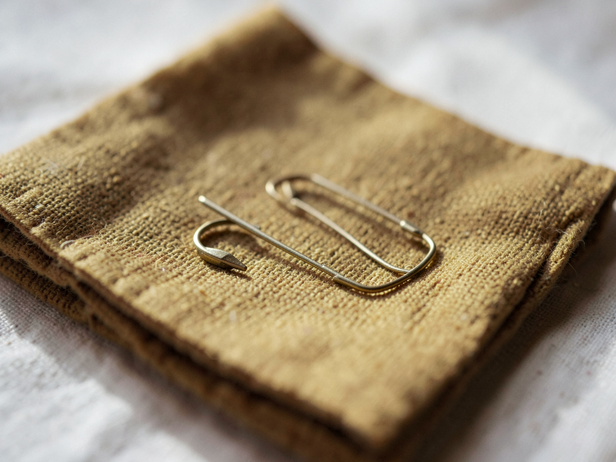
![Brass Pins on Mustard Fabric]()
Brass Pins on Mustard Fabric
Image credit : AI
Simple elegance: safety pins arranged for a touch of detail. Perfect for dupatta styling tips.
The Safety Pin Economy
The safety pin is the most honest object in Indian fashion. It exists entirely to solve a problem the garment creates. The dupatta pin, the brooch, the strategic tuck into the waistband, these are technologies of management, and every woman who wears a dupatta regularly has her own system. She developed it through trial and error, through the embarrassment of fabric trailing on a wet floor, through the specific anxiety of a dupatta near a moving vehicle or an open flame. The system works, mostly. It also requires knowing, at all times, whether the pin is holding. That low-level monitoring is attention. Attention is not free either.
What Shame Has to Do With It
The dupatta is rarely optional in the social contexts where it is most required. A wedding, a puja, a formal office in a conservative city, a visit to a family that is watching. In these spaces the dupatta is not a style choice, it is a compliance garment, and its slipping is a social event. A woman whose dupatta falls in the wrong room is not just adjusting fabric. She is managing the meaning of the adjustment, the eyes that noticed, the impression she is now correcting. This is a different kind of labour. It is emotional and anticipatory. She is not reacting to the slip; she has been preventing it for hours.
![Golden Dawn Temple Corridor]()
Golden Dawn Temple Corridor
Image credit : AI
I find the serene beauty of this temple corridor, a perfect backdrop for exploring dupatta styling tips India.
The Garments That Do Not Do This
A blazer stays where it is put. A kurta without a dupatta requires no management beyond dressing. A saree, once draped and pinned well, is remarkably stable. The dupatta in its modern avatar, a long rectangle worn over a salwar kameez, expected to sit on both shoulders or be draped across the chest, is the least structurally stable of the common forms. It has no fixed point. It relies entirely on the wearer's ongoing intervention to remain in place. This is not a design flaw in the sense that anyone made an error. It is a design choice whose cost was never counted, because the person bearing the cost was not the one deciding.