The front-facing camera was designed for brief check-ins. Nobody stress-tested what happens when a person spends eight hours a day watching their own face in a small rectangle, every expression visible, every asymmetry lit from above by a laptop screen. That experiment has now run for several years, on hundreds of millions of people, and the results are showing up not in clinical trials but in the way people talk about their faces.
The Mirror That Never Looks Away
A normal mirror is a quick transaction. You check, you leave. A video call is different: the image is live, continuous, and socially loaded. You are watching yourself be perceived while being perceived. Psychologists studying appearance-related self-focus describe this as a feedback loop that normal grooming behaviour was never designed to sustain. The more time spent watching a live image of your own face, the more granular the internal model of that face becomes, and the more that model drifts toward noticing deviation rather than registering the whole.
The angle makes it worse. A laptop camera sitting at desk height shoots slightly upward, compressing the jaw and pulling the face into proportions that no flattering photograph has ever used. Overhead office lighting flattens the nose and deepens the hollows under the eyes. The face you are watching for eight hours is not your face. It is a specific, unflattering optical construction of your face, and the brain learns it as the baseline.
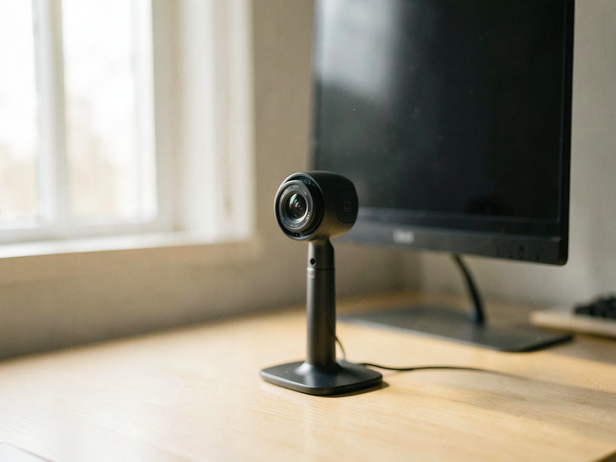
![Webcam at Eye Level]()
Webcam at Eye Level
Image credit : AI
My webcam is positioned at eye level, helping me manage video call appearance anxiety.
What Sustained Self-Scrutiny Builds Over Time
Dermatologists at major skin clinics in Mumbai and Delhi began reporting a pattern from around 2021: patients arriving with concerns about features that had not changed, jawline definition, undereye hollowing, forehead lines, but with a precision of complaint that suggested long, close observation rather than a sudden change. The phenomenon acquired a name in dermatology circles: Zoom dysmorphia, a term that describes the gap between how a person looks and how they believe they look after extended camera exposure.
The mechanism is not vanity. It is closer to what happens when you repeat a word until it stops meaning anything, except the word is your own face, and the repetition makes it mean too much. The brain's facial processing system is not built for this volume of self-input. It responds by sharpening attention to irregularities, the way a proofreader who has read the same page twenty times starts seeing errors that are not there.
Skin texture becomes a preoccupation. Pores, which are visible on every human face and serve a function, start reading as a problem. The slight asymmetry between left and right sides, present in every face on earth, produced by the way muscles develop and sleep positions accumulate, starts reading as a flaw requiring correction.
The Specific Things People Start Wanting Fixed
The requests that arrive at cosmetic clinics after extended video-call exposure tend to cluster around a few areas. Undereye hollowing, because the camera angle and overhead light deepen it. Nasolabial folds, because compression from below makes them more visible than they appear in real life or in well-shot photographs. Skin texture on the nose and cheeks, because a front-facing camera at close range renders pores with more definition than the human eye registers at normal social distance.
What is worth understanding: social distance, the distance at which another person actually sees your face in a room, is roughly 120 to 210 centimetres. At that distance, pore texture is invisible. Mild asymmetry is invisible. The fine lines that read clearly on a screen at 40 centimetres do not exist as a social reality. The camera is not showing you how people see you. It is showing you something no one else has ever seen.
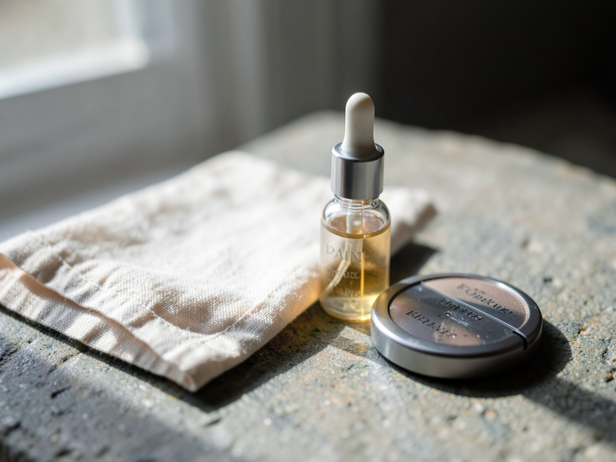
![Morning Glow Still Life]()
Morning Glow Still Life
Image credit : AI
My skin confidence is boosted by this simple morning routine, combating video call face fatigue.
What It Costs That Has Nothing to Do with Skin
The quieter cost is attentional. A person spending cognitive energy monitoring their own image during a conversation is spending less of it on the conversation. Research into self-focused attention during social interaction, work done well before video calls existed, studying people with social anxiety, consistently finds that turning attention inward during an interaction degrades performance in that interaction and increases the sense of having performed poorly afterward. The camera tile does this to people who have no history of social anxiety at all.
There is also the fatigue that accumulates differently from other kinds of work fatigue. Emotional labour researchers describe the cost of sustained self-presentation as distinct from task fatigue, it draws on a separate resource, one that does not recover the same way rest recovers physical tiredness. Eight hours of watching yourself be watched is eight hours of that resource being spent.
What Actually Helps
The most effective intervention is also the most obvious and the least used: hide the self-view. Every major video platform has this option. Turning it off removes the feedback loop without affecting how you appear to anyone else on the call. Studies comparing self-view-on and self-view-off conditions find measurable reductions in appearance-related distress and self-focused attention when the tile is hidden, and no reported effect on meeting outcomes.
Camera position matters more than most people adjust for. A camera at eye level, achieved with a monitor stand or an external webcam, eliminates the upward compression that makes the jaw appear heavy and the undereye area appear hollow. Soft light from the front, a lamp placed at face height in front of you rather than a ceiling light above, fills the hollows the overhead source creates. Neither change alters the face. Both change what the camera constructs from it.
For skin texture specifically: the camera renders pores more harshly on bare skin than on skin with a light diffusing layer. A tinted moisturiser or a skin-finish powder, not a full coverage foundation, reduces the optical definition of texture without the weight of a full makeup application. The goal is not to look different. It is to look on camera the way you look to a person standing in the same room.
The face you have been watching for eight hours is a camera artefact. The face other people see is something else entirely, and it has been fine this whole time.