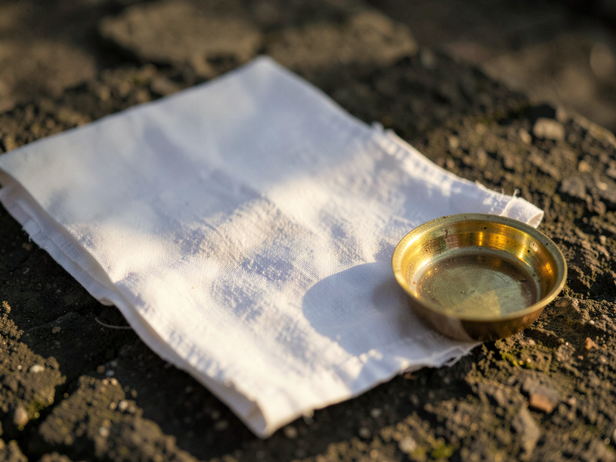
The cotton is not washed white to look clean. It is unstitched because a needle has not passed through it, because no tailor's hand has shaped it to a body, because the cloth arrives at the ghat in the same condition it left the loom. That is the point. The vrati who has kept the nirjala fast for thirty-six hours, no water, no grain, is not dressed for the occasion. She is undressed of everything that mediates between her body and the sun she is about to face.
The Logic of the Uncut Cloth
The idea of unstitched fabric as ritually pure runs through South Asian textile culture in ways that predate tailoring as a trade. A dhoti, a saree draped without a fall sewn in, a veil that is simply a length of fabric, these are not primitive alternatives to stitched clothing. They are a separate category. The loom produces a whole cloth. The needle produces a cut and reassembled cloth. In ritual contexts across the subcontinent, the whole cloth is considered closer to its original state, untouched by a blade, unaltered by craft. The logic is not about hygiene. It is about integrity in the older sense of the word: the thing remaining what it was.
![Dawn Ritual Fabric and Light]()
Dawn Ritual Fabric and Light
Image credit : AI
I observe the unstitched cotton cloth, a symbol of purity for Chhath Puja vrati dress, bathed in dawn's glow.
What Cotton Carries That Silk Cannot
The specific choice of cotton, not silk, not synthetic, not the embroidered fabrics a vrati might wear at every other festival, is its own argument. Cotton grown from the earth, spun, woven, and brought to the water without further intervention sits inside a logic of minimal transformation. Silk involves the death of the silkworm and carries its own ritual restrictions in many Hindu contexts. Synthetic fabrics are a chemical product of petroleum. Cotton, unstitched, undyed in the bright chemical sense, is as close to a field as a textile can be. When the vrati stands in the river at the time of the setting or rising sun, the cloth is not keeping her warm or modest in any social sense. It is completing a circuit: earth to body to water to sun.
A Single Seam and What It Would Break
A seam is a decision. It says: this cloth is now a garment shaped for this body. The moment a needle closes the fabric into a blouse or stitches a border to hold a fall in place, the cloth has been interpreted. It carries the shape of a human choice about how a body should look. The vrati in Chhath is precisely not making that choice. She is removing the body from its social presentation, no jewellery beyond what is customary to the vow, no stitched blouse under the saree in many traditions, no garment that announces her as a particular person of a particular station. The seam would not ruin the cloth. It would re-introduce the self. And the vow, at its core, is a temporary dissolution of the self in front of something much older.
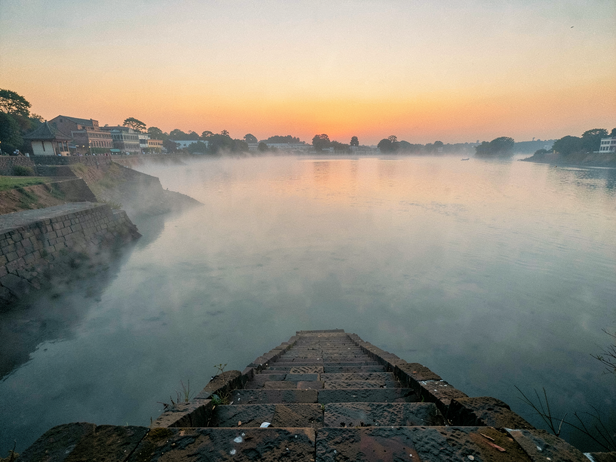
![River Ghat at Dawn]()
River Ghat at Dawn
Image credit : AI
The quiet river ghat awaits the dawn, a scene of ritual purity. Unstitched cotton is often used in Hindu fasting.
The Ghat as a Different Kind of Runway
Fashion operates on the principle of transformation: fabric becomes a garment, a garment becomes a statement, a statement becomes an identity. The ghat on Chhath reverses every step. The vrati arrives having eaten nothing, drunk nothing, slept perhaps very little. She wears cloth that has not been cut. She stands in water that has not been warmed. She faces a sun that does not negotiate. The unstitched cotton is not modest in the way that covered clothing is modest. It is exposed in the way that ritual exposure works, not the body on display, but the body stripped of its social armour, presented without a tailor's mediation to something that predates tailoring by several billion years. The fabric choice is, in this reading, the most radical fashion decision in the calendar. It refuses fashion entirely.