She has worn four different lehengas to four different weddings this year. She knows which colour photographs well under string lights, which fabric does not hold sweat through a three-hour baraat, which heels she can actually dance in. She has become, without meaning to, an expert in attending other people's love stories.
The Question Has a Texture
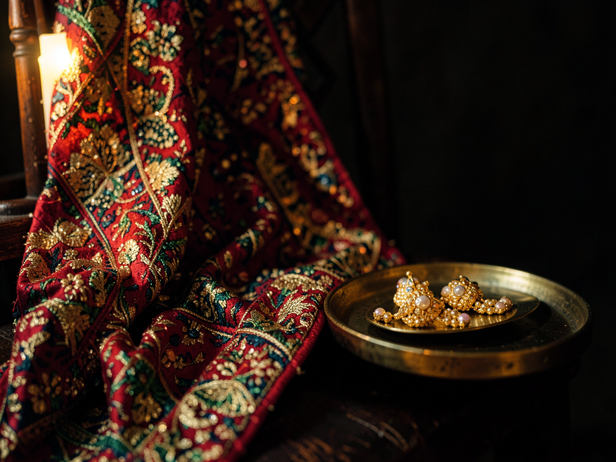
![Embroidered Dupatta and Jhumkas]()
Embroidered Dupatta and Jhumkas
Image credit : AI
Intricate embroidery and gold jhumkas, a moment of quiet anticipation for the wedding guest experience.
It does not always arrive the same way. Sometimes it is an aunty with a hand on her arm and a smile that means well. Sometimes it is a cousin her own age, already married, who asks it like a joke that is not entirely a joke. Sometimes it is a stranger at the buffet who has just learned her name and age and considers this sufficient basis for an inquiry into her romantic timeline. The words change. The shape of it does not. There is an assumption underneath every version: that she is at this wedding as a waiting room, not as a guest.
What She Is Actually Doing at This Wedding
She is watching the bride's mother cry during the vidaai and thinking about her own mother. She is calculating which table has the better view of the dance floor. She is genuinely happy for her friend, in the specific way you can only be happy for someone you have known since before either of you knew what you wanted. She is eating the gulab jamun without guilt because the gulab jamun is excellent. None of this registers for the person asking about her turn. They are not seeing her. They are seeing a category: unmarried woman, late twenties or thirties, present at a wedding. The category comes with a script.
The Outfit She Chose and What It Carries
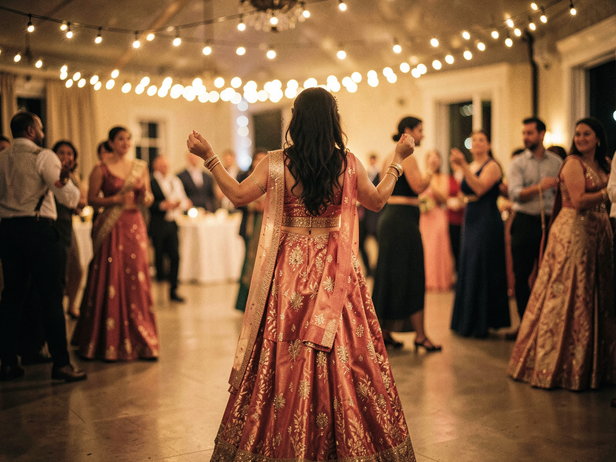
![Golden Wedding Dance]()
Golden Wedding Dance
Image credit : AI
A moment of quiet contemplation on the wedding dance floor, amidst the joyous celebration. The question of 'when is your turn?' often lingers.
She did not dress to signal availability. She dressed because she likes getting dressed. The embroidery on her dupatta took someone weeks to make. The colour is one she spent twenty minutes choosing under the store's daylight lamp because she wanted to get it right. She wore her mother's earrings, not because they are bridal, but because they are heavy in a way that feels like company. The effort she put into how she looks tonight was for herself, and for her friend, and for the occasion. It was not an audition. The question treats it like one.
What She Has Learned to Say, and What She Has Not Said Yet
She has a repertoire now. The light deflection. The subject change executed mid-sentence. The smile that does not reach the eyes but is warm enough to end the conversation. She has learned that engaging directly tends to make the asker feel attacked, which then becomes the story, not the question, but her reaction to it. So she smiles and pivots and moves toward the dance floor. What she has not said, and probably will not say, is that she thinks about it too. That the question lands somewhere even when she does not let it show. That she is not indifferent to her own life. She simply refuses to perform her feelings about it for someone she met forty minutes ago over seekh kebabs.
Why She Keeps Showing Up
Because she loves her friends. Because a wedding, underneath all the noise, is a person choosing to be witnessed at a moment that matters to them, and she takes that seriously. Because the food is good and the music is loud and there is something about a room full of people dressed beautifully and trying to be happy that she finds genuinely moving, even now, even on the eighth one. She shows up because her presence is not a concession. It is not proof that she is still waiting. It is what she does for the people she loves, in the outfit she chose, on her own terms. The question does not change any of that. It only interrupts it for a moment, and then she goes back to dancing.