Walk into any optical shop in India and the salesperson will hold three frames up to your face and call it done. It rarely is. The difference between a frame that looks placed on your face and one that looks like it belongs there comes down to one principle: contrast. Frames work best when their geometry counters the dominant geometry of the face, not echoes it.
Reading Your Face Shape Before You Buy
The quickest way to identify your face shape is to pull your hair back, stand in front of a mirror, and trace the outline with a dry-erase marker or lip liner. A round face has roughly equal width and length with soft, curved edges and no strong jawline. A square face has a wide forehead, a wide jaw, and a strong horizontal line across the cheekbones, the width and length are close to equal but the angles are sharp. A heart-shaped face is widest at the forehead, tapers sharply through the cheeks, and ends in a narrow, pointed chin. Knowing which of these you have cuts the number of frames worth trying by half before you pick one up.
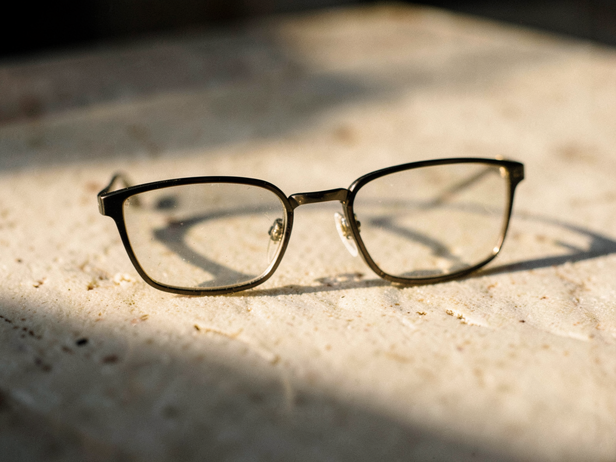
![Browline Spectacle in Golden Light]()
Browline Spectacle in Golden Light
Image credit : AI
Discover elegant spectacle frames for your face shape. This browline style offers a sophisticated look.
Frames for a Round Face
The goal is to introduce definition where the face offers none. Rectangular frames with a strong horizontal line, think classic wayfarers or a low-set browline, add the visual impression of length and pull the face out of its circular proportions. Angular frames with squared corners work for the same reason. Avoid anything round or oval: a circular frame on a circular face amplifies the softness rather than balancing it. Avoid small frames too; they get lost in the wider face and make it look fuller. The bridge matters here. A high-set bridge or a keyhole bridge draws the eye upward and creates the impression of a longer nose bridge, which adds vertical length to the face. In Indian optical shops, the Lenskart Hustlr rectangle and the Vincent Chase VC E10519 browline are reliable starting points for this shape.
Frames for a Square Face
A square face already has strong structure. Frames that add more geometry, sharp rectangles, heavy square rims, double down on the angularity and can read as severe. What works here is a frame with a curved upper rim or a soft oval shape that introduces roundness where the face has none. Round frames, oval frames, and cat-eye frames all soften the jaw and forehead without losing the face's natural definition. Rimless and semi-rimless frames also work because they reduce the visual weight on an already structured face. Avoid frames with sharp, angular corners at the temples, these mirror the jaw and make it appear wider. A thin metal frame in a warm gold or rose gold tone reads lighter than a thick acetate frame and suits the square face well. The Titan Eyeplus TR range carries several oval and round acetate options that work in this shape at accessible price points.
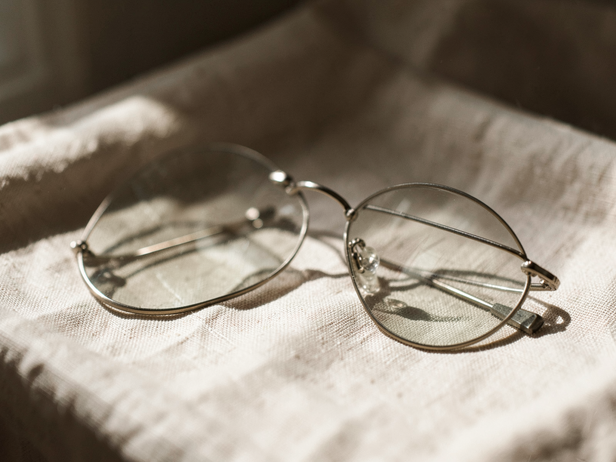
![Eyewear Still Life]()
Eyewear Still Life
Image credit : AI
Exploring spectacle frames for face shape, these classic designs rest on linen, highlighting their true-to-life brushed metal texture.
Frames for a Heart-Shaped Face
The heart-shaped face is top-heavy: a wide forehead and prominent cheekbones tapering to a narrow chin. The job of the frame is to redistribute visual weight downward. Frames that are wider at the bottom than the top, a reverse cat-eye, a round frame with a low-set bridge, or a D-frame, pull attention toward the lower half of the face and balance the taper. Light-coloured frames and rimless frames at the top with a heavier lower rim do the same work. Avoid cat-eye frames that flare upward at the outer edges: they add width at the top where the face already has it. Avoid very wide frames that extend beyond the cheekbones, the contrast between a wide frame and a narrow chin becomes exaggerated. A pilot or aviator frame works well here because its teardrop shape carries more glass at the bottom, which visually anchors the narrow jaw. The Ray-Ban RB3025 aviator in a 55mm width is one of the most consistent performers for heart-shaped faces across different nose bridge types common in South Asian faces.
What Indian Skin Tones Tell You About Frame Colour
Frame shape is the first decision; frame colour is the second, and it is worth making deliberately. Warm undertones, yellow, olive, or golden brown skin, are flattered by tortoiseshell, warm brown, gold, and earthy greens. Cool undertones, skin with pink, blue, or grey in it, work well with black, silver, navy, and jewel tones like deep plum or teal. If you are unsure of your undertone, look at the veins on your inner wrist in natural light: green-tinted veins suggest warm, blue or purple suggest cool. Most Indian skin sits in the warm-to-neutral range, which means tortoiseshell acetate is a reliable default and flatters across a wide range of face shapes. Avoid frames in a colour very close to your skin tone, they disappear into the face and make the frame look like an afterthought.
The frame that works is not the one the salesperson picks first or the one that looks striking on the display stand. It is the one that makes the face read as balanced when you look straight into a mirror at arm's length. Shape first, colour second, fit always, if the frame slides down your nose or pinches at the temples, no amount of geometry will save it.