Every brown-skinned person has at least one photo where they look like they have been dusted in chalk. The flash fires, the shutter clicks, and the warmth drains out of their face completely. It is not the angle. It is not the filter. It is a specific interaction between skin tone, light wavelength, and a technology that was calibrated, for most of its history, around lighter skin.
The Physics Behind the Wash-Out
When a camera flash fires, it emits a burst of broad-spectrum white light that bounces off the subject and back into the lens. The camera's metering system then decides how to expose the image based on how much light returns. Skin with lower melanin reflects a large portion of that light straight back. Skin with higher melanin, deeper brown and dark skin tones, absorbs more of the visible spectrum and reflects less back to the sensor.
The problem is that camera metering systems were historically calibrated using what the industry called an 18% grey card, a standard that assumed average reflectance values skewed toward lighter tones. When a camera reads a darker face, it often interprets the lower reflectance as underexposure and compensates by brightening the entire frame. The result: the background blows out, and the skin, now over-brightened, loses its undertone and reads as flat grey rather than warm brown.
![Amber and Blue Light Split]()
Amber and Blue Light Split
Image credit : AI
Exploring how light interacts with surfaces, I captured this sharp diagonal split of amber and blue. Understanding melanin and camera flash is key for accurate representation.
Why Melanin and Flash Light React This Way
Melanin is not a single pigment. Eumelanin, the dominant form in brown and dark skin, absorbs light across a wide range of wavelengths, including the blue and ultraviolet end of the spectrum that camera flashes are heavy in. The more eumelanin present, the more aggressively the skin absorbs those short wavelengths.
At the same time, the surface of skin, regardless of tone, has a thin layer called the stratum corneum that scatters light. On lighter skin, this scatter reads as luminosity. On darker skin, the scatter is still there, but the underlying absorption is so strong that the net effect photographed under harsh direct flash is a kind of optical flattening. The warmth that comes from the deeper layers of the dermis, the red and amber undertones, gets swallowed by the exposure correction the camera applies.
The grey cast is not actually grey. It is the warm undertone stripped out of a brown tone, leaving only the cool, desaturated surface scatter. Shoot the same person in golden-hour light with no flash and the warmth returns, because the light source is softer, warmer in colour temperature, and the camera does not need to compensate as aggressively.
The Historical Calibration Problem
Film stocks, and later digital sensor profiles, were developed and tested predominantly against lighter skin tones. Kodak's Shirley card, the reference print used by photo labs for decades to calibrate colour balance, depicted a white woman until the 1990s, when labs serving markets with more diverse clientele pushed for change. The consequence of that calibration history is baked into default camera settings, automatic white balance algorithms, and the way most on-camera flashes are tuned.
Smartphone manufacturers have begun addressing this more directly. Google's Real Tone initiative, developed with input from photographers who had spent years working around the problem, adjusted the HDR and face-detection algorithms in Pixel phones to better preserve undertone in darker skin. Apple has made similar adjustments in its computational photography pipeline. These are meaningful improvements, but they apply primarily to the processing layer, the underlying physics of flash and melanin absorption has not changed.
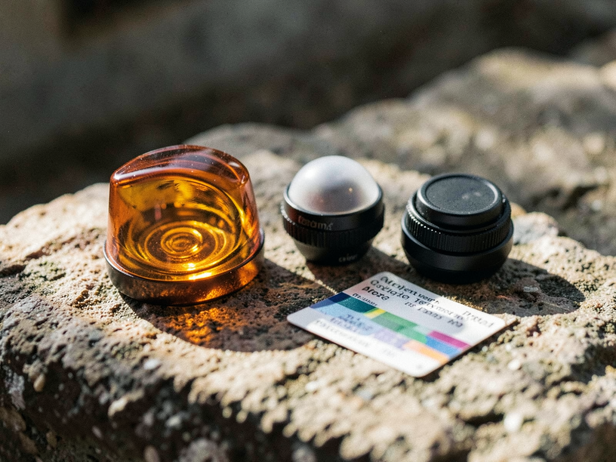
![Photography Gear on Stone]()
Photography Gear on Stone
Image credit : AI
Exploring how camera flash interacts with melanin, I arranged these accessories to study light.
What Actually Makes the Difference in a Photo
The most reliable fix is not a filter applied after the fact. It is changing what the camera sees in the first place.
Diffused flash, bouncing a flash off a ceiling or wall, or using a softbox, spreads the light source so it hits the face from a wider angle at lower intensity. The camera's metering reads a more even scene and does not overcorrect. The skin's undertone survives because the exposure is not being pushed to compensate for a harsh direct burst.
Colour temperature matters as much as intensity. A flash gel, a thin coloured filter placed over the flash head, can shift the light toward amber or gold, which counteracts the blue-heavy spectrum that strips warmth from brown skin. Warming gels cost almost nothing and are used routinely by photographers who shoot editorial work across a range of skin tones.
Exposure compensation, available on most cameras and many phone cameras, lets the photographer tell the sensor to expose for the subject rather than the scene average. Dialling in positive exposure compensation before the flash fires, then reducing flash power slightly, often produces a reading that holds the undertone.
Skincare also plays a role, though not in the way product marketing tends to imply. Flash reflects off the outermost surface of the skin. A heavy silicone-based primer or a thick setting powder, particularly one that contains titanium dioxide or zinc oxide, amplifies surface scatter and makes the grey cast worse. Both ingredients are highly reflective under flash. A light-coverage finish, or a setting spray rather than a powder, gives the flash less surface to bounce off and reduces the chalk effect. This is why photographers working with darker-skinned subjects often request that talent avoid heavy powder before a flash shoot.
Why This Still Matters Beyond the Technical
The grey-skin problem in flash photography is not a quirk or an edge case. It is a downstream consequence of an industry that built its defaults around a narrow slice of humanity and then shipped those defaults globally. Brown-skinned people in India have been handing cameras back to photographers at weddings and family events for generations, asking for another shot, not knowing exactly why the first one looked wrong but knowing that it did.
The gap is closing. Better algorithms, wider sensor calibration, and photographers who understand the physics are all part of that. But the person holding the phone at a birthday dinner does not have a warming gel or a softbox. What they have is the knowledge that the problem is in the light, not in their face, and that moving toward a window, stepping out of the direct flash range, or switching the phone to portrait mode with the flash off will almost always produce a truer result than any edit applied after the image is already flat.