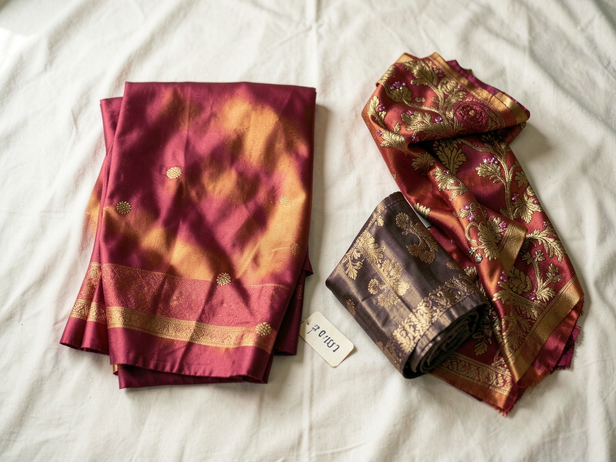
The lehenga has been dry-cleaned once since the wedding three years ago. The sherwani fits, technically, but no occasion has felt quite right for it. Multiply that by every adult in three connected households and you have a shared wardrobe worth more than most people spend on furniture, sitting in bags, on high shelves, doing nothing.
Festive clothes are built for this. A Banarasi silk weave does not degrade from being worn by a cousin. A chanderi kurta does not know whose cupboard it came from. What kills these pieces is storage: humidity, mothballs, and the slow yellowing of fabric left folded in the dark. Circulation is preservation.
Take Stock Before You Share Anything
Pull everything out. Every household lays its festive pieces on a bed, lehengas, sarees, sherwanis, anarkalis, bandhgalas, dupattas, mojris, and photographs each one against a plain surface in daylight. Note the fabric, the approximate size, and any existing damage: a loose hook, a faded border, a missing button. This photograph becomes the item's record in a shared folder, not a group chat where things get buried. A shared folder with one subfolder per household, each piece numbered, is the entire system. Do not overcomplicate it.
The audit also surfaces what nobody will actually lend. A bride's wedding lehenga is not in the pool. A piece with strong sentimental attachment to one person is not in the pool. The pool is everything else, which is usually most of it.
![Organized Festive Indian Attire]()
Organized Festive Indian Attire
Image credit : AI
Organizing my festive lehenga and silk saree for easy sharing. This system helps manage our Indian ethnic wear.
Set the Rules Once and Write Them Down
Three households means three different ideas of what counts as careful. Writing the rules once removes the conversation from every future loan. The rules that matter: who pays for dry-cleaning after each wear (the borrower, always), what counts as damage versus normal wear, how far in advance a piece must be requested, and what happens if two people want the same piece for the same occasion.
That last one is the only genuinely awkward scenario. The cleanest resolution is first-request priority, with the original owner having a quiet veto for occasions where the piece has obvious personal significance. A wedding anniversary is different from a colleague's reception. Most families can read that distinction without a written rule, but having it written means nobody has to say it out loud in a tense moment.
Blouses are the detail most people forget to address. A Kanjeevaram saree can fit three women; the blouse fits one. The pool works best when sarees travel without their blouses, or when the borrower knows to arrange their own. Write that in the rules too.
Match Fabric to the Occasion, Not Just the Calendar
Sharing works better when people borrow with intention rather than grabbing whatever fits. Organza and tissue silk are evening fabrics, they photograph beautifully but crumple in a long afternoon of sitting. Chanderi and cotton-silk blends survive a full day of a sangeet without looking destroyed by the time the lights come on. Velvet and heavy brocade are winter fabrics; worn in October heat they look wrong and feel worse.
Knowing the fabric of each piece in the pool means borrowers can match the garment to the occasion rather than the occasion to the garment. The photograph record should note fabric type for exactly this reason. A piece borrowed for the right occasion comes back in better condition than one forced into a setting it was not made for.
![Chanderi Kurta Care]()
Chanderi Kurta Care
Image credit : AI
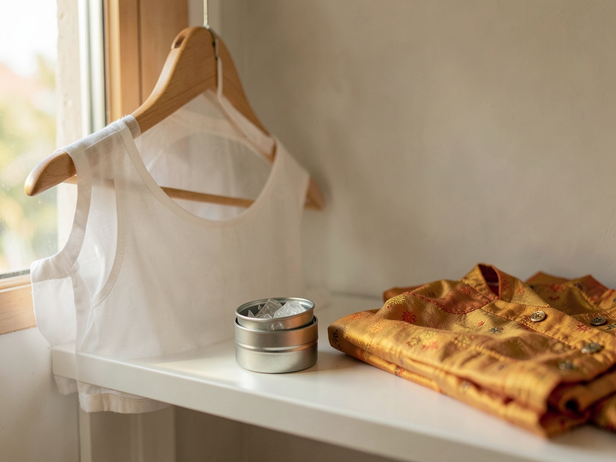
I ensure my chanderi kurta is protected with silica gel, ready for festive clothes sharing.
Care Is the Cost of Access
Dry-cleaning after every wear is not negotiable for silk, brocade, and zari-heavy pieces. For chanderi, cotton-silk, and lighter fabrics, a gentle hand wash in cold water with a mild detergent is fine, and often better than the heat and chemicals of a dry-clean cycle. The borrower returns the piece clean, on a hanger, with any minor repairs done: a hook reattached, a loose thread knotted, a missing button replaced with one from the spare set that came with the garment.
Storage across households should be consistent: breathable cotton covers, not plastic. Silica gel packets, not mothballs, naphthalene damages silk fibres over time and the smell takes weeks to leave a fabric. Pieces stored flat rather than folded on a sharp crease. These are not expensive habits. They are the difference between a lehenga that looks new at its fifth outing and one that looks tired at its second.
What the Pool Does to How You Buy
Once the pool is running, the way each household shops for festive clothes changes. A piece that will only ever be worn by one person in one household needs to justify its full cost alone. A piece that enters the pool is worn across three households, potentially many times a season, which makes a higher-quality fabric or a more considered cut worth the spend. The economics shift toward buying less and buying better.
It also creates a natural reason to diversify. If the pool already has two heavy Kanjeevaram sarees, the next purchase might be a lighter Maheshwari or a silk georgette, something the pool is missing. Three households with different taste and different budgets end up with a range that no single household would have assembled on its own. The festive wardrobe stops being a collection of one-time purchases and starts being something that actually gets used.