Velvet has a specific problem at Indian weddings: it photographs one to two shades darker than it looks on the hanger, and sometimes three shades darker under a photographer's flash. Buy a deep plum lehenga and the pictures return something closer to black. The reason is not the dye. It is the pile, and pile direction, fabric weight, and fibre content together determine whether your velvet reads the way you intend it to, both in the mandap light and in the album.
What Pile Direction Actually Does
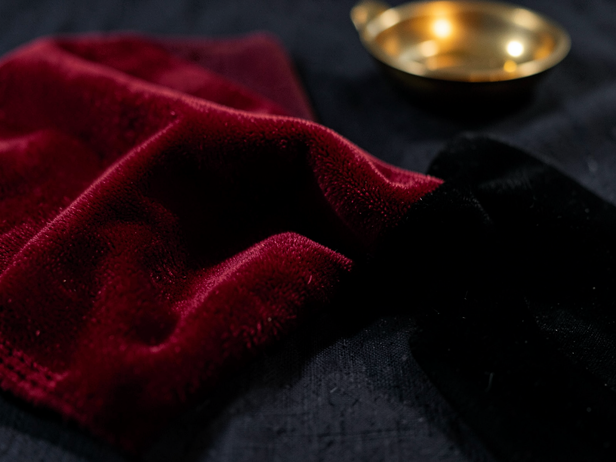
![Burgundy Velvet Texture Study]()
Burgundy Velvet Texture Study
Image credit : AI
Deep burgundy velvet, showcasing its luxurious pile direction. A hint of warm candlelight on this fabric, perfect for a winter wedding.
Velvet is a cut-loop fabric: thousands of tiny fibre loops are sheared to create an upright surface. When light hits those fibres from above, the direction of most overhead shaadi lighting and direct flash, it travels down into the pile rather than bouncing straight back. The result is colour absorption rather than reflection. Tilt the fabric so the pile leans toward the light source and the colour brightens visibly. Tilt it away and it deepens. This is why a single velvet dupatta can look two different colours depending on which end you hold up.
Pile direction is set during finishing. In standard cut velvet, the pile runs in one direction across the whole cloth. In crushed velvet, the pile is deliberately pressed in multiple directions before the fabric is set, which means different sections catch light at different angles simultaneously. This is what gives crushed velvet its shifting, liquid quality in candlelight, and what makes it unpredictable under a direct flash, because some sections will absorb and some will reflect at the same moment.
Fabric Weight and How It Affects Drape and Photography
Velvet for Indian occasion wear comes in three practical weight ranges. Lightweight velvet, typically a polyester or viscose base at around 200 to 280 gsm, drapes fluidly and works well for dupattas and full-flare skirts. It photographs with less depth because the pile is shorter and less dense. Mid-weight velvet at 300 to 380 gsm is the standard for lehenga panels and blouses. The pile is longer, the colour richer, and the fabric holds embroidery without puckering. Heavy velvet above 400 gsm, often with a silk or silk-blend base, is structured enough for a fitted anarkali or a heavily zardozi-worked bodice. It is the most light-absorbent of the three and the most likely to photograph significantly darker than it appears in the store.
The practical implication: if you are choosing a mid to heavy weight velvet in a dark shade, bottle green, burgundy, midnight blue, deep aubergine, go one step lighter than your instinct. The camera will find the depth you were looking for. If you are choosing a pale shade, ivory, blush, powder blue, mid-weight velvet is safer than heavy, because heavy velvet in a light colour can photograph with an uneven tone where the pile direction shifts.
Silk Velvet, Stretch Velvet and Velvet Georgette: Which to Choose
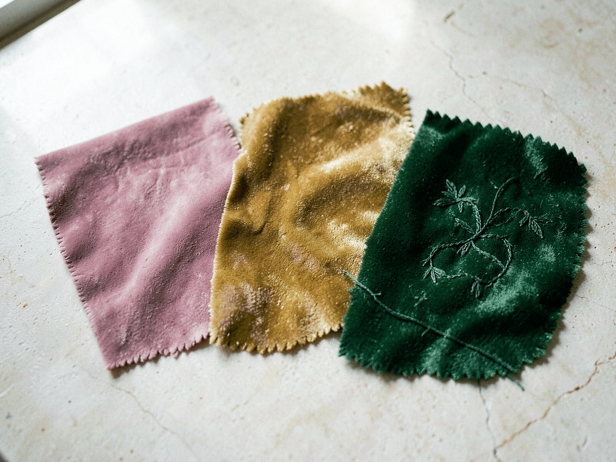
![Textured Velvet Swatches]()
Textured Velvet Swatches
Image credit : AI
Luxurious velvet textures in dusty rose, antique gold, and bottle green. Perfect for a winter wedding.
Silk velvet has a natural lustre that polyester and viscose cannot replicate. The silk base reflects a small amount of light even when the pile absorbs it, which is why silk velvet tends to photograph truer to its real colour than synthetic velvet of the same shade. It is also the most expensive and the least forgiving of moisture, a drop of water leaves a mark that requires professional finishing to remove. For a winter wedding where you will be outdoors for the pheras, this is a genuine consideration.
Stretch velvet has a knit base rather than a woven one. The pile is shorter and the fabric moves with the body, which makes it popular for fitted blouses and pre-stitched saree petticoats. Under camera flash it tends to show the stretch lines of the knit base if the fabric is pulled tight, relevant if your blouse is closely fitted. Velvet georgette is a sheer base with a velvet pile on one side only. It photographs with the most accurate colour of any velvet variant because the sheer base allows some light transmission rather than full absorption. It is too delicate for a structured lehenga panel but works well as an overlay or a dupatta.
Colour Choices That Hold on Camera
The colours that photograph closest to their real appearance in velvet are those in the mid-saturation range: dusty rose, sage, antique gold, rust, teal. Highly saturated darks, true red, black, deep navy, lose all internal variation on camera and read as flat. Highly saturated brights, fuchsia, electric blue, can blow out under flash and lose their velvet texture entirely, reading as a flat printed surface rather than a pile fabric.
Embroidery changes the equation. Zardozi and dabka work in gold or silver thread breaks up the pile surface and creates its own reflective points, which means a heavily embroidered dark velvet lehenga will photograph with more dimension than a plain one of the same colour. If you are choosing a very dark velvet with minimal embroidery, the album photographs are likely to lose the fabric's texture. If that matters, choose a medium shade or add surface work.
What to Tell Your Tailor and Your Photographer
When the lehenga is being cut, ask the tailor to ensure the pile runs in the same direction across all panels. Mismatched pile direction across a skirt, which happens when pieces are cut without checking the grain, means different panels photograph as different shades. On a dark velvet lehenga this reads as patchy in the final images.
Tell your photographer the fabric is velvet before the shoot, not on the day. A photographer who knows they are working with a high pile-absorption fabric will adjust flash angle and diffusion accordingly. Direct on-camera flash is the worst light for velvet. Bounced flash, off-camera flash with a softbox, or natural window light all allow the pile to show its depth rather than flattening it. For the outdoor pheras, the hour after sunrise and the hour before sunset give the most accurate velvet colour in photographs, the low-angle light travels along the pile rather than straight down into it.
Velvet's behaviour under light is not a flaw. It is what makes the fabric feel different from every other option at a winter wedding, that quality of shifting between rich and deeper-rich depending on where you stand. Understanding the mechanics means you can choose the weight, the colour, and the cut that works with the light you will actually be in, rather than discovering the difference between the store and the album three weeks later.