The steel almirah opens and the smell arrives before the saree does, camphor and something older underneath it, the particular mustiness of silk that has been folded in the same crease for two or three years. The saree that comes out first on the morning a wedding invitation lands is almost never the one bought for the occasion. It is the one that was already there.
Why the inherited saree survives every trend cycle
The saree your mother or mother-in-law folded away was woven when the handloom industry still had time. A Banarasi woven before the power-loom era dominated has a warp density that modern mill-produced versions rarely match, the zari, real or semi-real, was wound tighter, the silk threads per inch were higher, and the brocade pattern was punched on a Jacquard card that took weeks to set. That structural density is why the fabric drapes differently: it holds the pleat, it does not slip at the pallu, it photographs with a weight that synthetic georgette cannot fake. Age has done nothing to weaken it. If it was stored correctly, folded in muslin, not plastic; laid flat, not hung, the weave is intact and the colour has only deepened.
![Aged Zari Silk Saree]()
Aged Zari Silk Saree
Image credit : AI
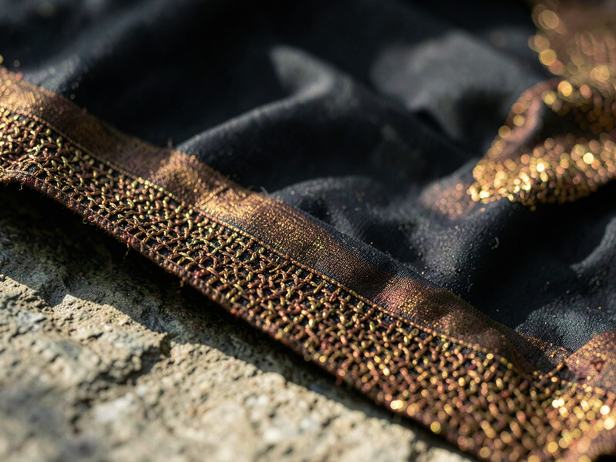
Discovering the beauty of an old saree from almirah, its aged zari border a testament to timeless elegance.
The zari question and what it tells you about the saree's age
Real zari, silver wire wrapped around a silk core and then gilded, tarnishes to a particular warm brown-gold that is not dullness but oxidation. If the zari on an old saree has gone that colour, it is almost certainly the real thing, and a jeweller's polishing cloth on a small corner will confirm it. Post-1980s sarees increasingly used copper-core zari, which tarnishes green at the edges when the gilding wears. Neither is a defect. Both are a date stamp. The saree that comes out for a wedding in a Kanjeevaram silk with copper-core zari in a colour that was fashionable in the late 1980s, the deep wine, the forest green, the burnt orange, is wearing its decade on its border, and the women in the room who know will notice and say nothing except something complimentary about the colour.
What the blouse situation actually is
The saree survives. The blouse almost never does. A blouse cut in 1992 for a body that was twenty-three years old is not the blouse that fits the body standing in front of the mirror now, and there is no version of this where pretending otherwise helps. The honest move is to take the saree to a tailor who works with silk, not a general alterations shop, and have a new blouse cut from either a matching piece or a deliberate contrast. A raw silk blouse in a colour pulled from the saree's border, cut in the current silhouette, does not fight the old fabric. It updates it. The saree is the heirloom. The blouse is the edit.
![Forest Green Kanjeevaram Silk]()
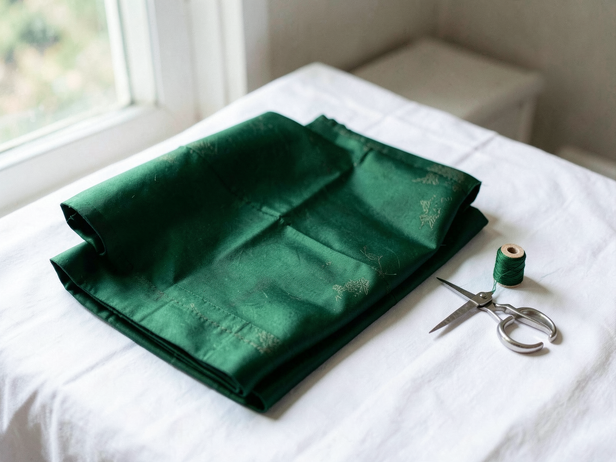
Forest Green Kanjeevaram Silk
Image credit : AI
Examining the intricate weave of this inherited silk saree, ready for styling.
The fabrics that age well and the ones that do not
Kanjeevarams, Banarasis, Paithani, and Chanderi with a silk warp age well because the fibre is protein-based and the weave is tight. Chiffon and georgette from the same era have usually not survived intact, the filament silk or synthetic used in those weaves degrades faster, particularly at the fold lines. Tissue sarees, the very fine ones woven with metallic weft, are fragile and often have stress splits along old creases; hold them to a window before assuming they are wearable. Cotton sarees, particularly Dhakais and Maheshwaris, age extremely well if they were stored dry; the fibre actually softens with time and the block-print colours mellow in a way that modern reactive dyes do not replicate. The test for any stored saree before a wedding is simple: unroll the full length on a clean bed in good light and look at every fold line. A split at a crease in silk is repairable by a skilled darner. A split in chiffon is not.
Why it is almost never new
A saree bought specifically for a wedding invitation carries the weight of having been chosen for that occasion, which means it will be compared to every other saree chosen for that occasion. The inherited one carries a different weight entirely. It was not chosen for this wedding. It was chosen for another one, decades ago, by someone who is now either older or gone, and wearing it to this wedding is a continuity that no boutique purchase can produce. The women who understand this, and at an Indian wedding there are always several, will ask about it. Where is it from. Whose was it. That question is the point. The saree is not just what you are wearing. It is the answer to that question.