The ghats fill before dawn. Devotees carry arghya thalis, barefoot on steps that have been submerged for hours, and the casualty registers at PMCH Patna and RIMS Ranchi start filling around the same time. The injuries are not random. They follow a pattern that repeats every year because the conditions that cause them repeat every year.
Wet Stone Slips on the Descent
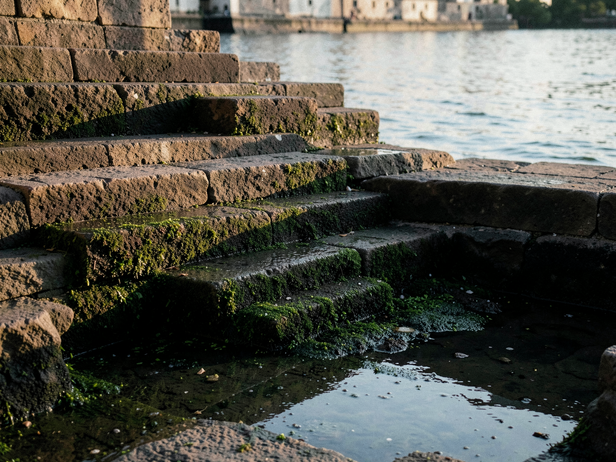
Algae-covered ghat steps hold water long after the tide recedes. The descent toward the waterline is where most falls happen, not the climb back up, because devotees are focused on reaching the water and moving quickly. A slip on a wet step typically produces wrist fractures from a bracing fall, or hip fractures in older pilgrims who cannot catch themselves in time. The Indian Orthopaedic Association has noted that festival-season fracture admissions spike sharply in districts along the Ganga and Sone river corridors during Chhath. Barefoot contact gives less grip than footwear on biofilm-covered stone, and carrying an offering plate removes one hand from any railing.
![Dawn on Wet Ghat Steps]()
Dawn on Wet Ghat Steps
Image credit : AI
I observed the empty, wet ghat steps at dawn, a scene that evokes a sense of quiet before potential Chhath Puja ghat injuries.
Diya and Earthen Lamp Burns
The arghya ritual involves holding lit diyas close to the body while standing in moving water. A stumble, a wave, or a crowd nudge can tip a burning lamp against skin or fabric. Cotton saris catch quickly. The burn pattern emergency physicians see most often is a partial-thickness burn on the forearm or wrist, the surface that instinctively shields the face. Synthetic fabric fused to skin is a more serious presentation and accounts for a portion of the burn ward admissions. Burn units at major referral hospitals in Bihar report a predictable seasonal load in the days immediately following Chhath.
Crowd Crush at Narrow Ghat Entrances
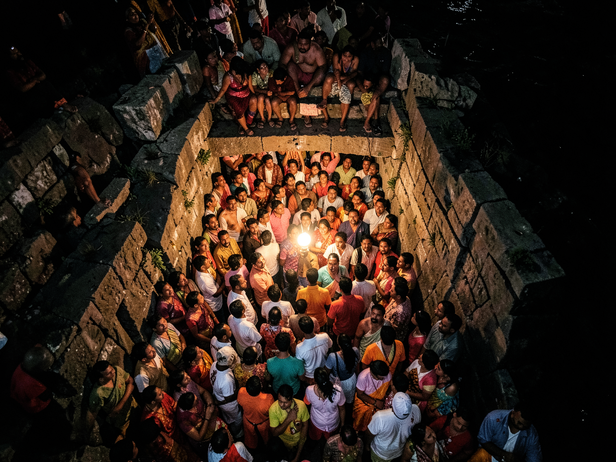
Most ghats have a bottleneck: a lane, a bridge, a single set of stairs. When lakh-scale crowds converge at the same arghya window, roughly thirty minutes around sunset on Sandhya Arghya and again at sunrise on Usha Arghya, the pressure at these pinch points builds faster than people realise. Crowd crush injuries are not caused by panic. They are caused by compressive force from bodies pressing in from multiple directions. Rib fractures, asphyxia from chest compression, and trampling injuries to the lower limbs are the presentations that reach casualty. Children and shorter adults are at highest risk because the force concentrates at chest height for an adult but face height for a child.
![Crowd surges through ghat arch]()
Crowd surges through ghat arch
Image credit : AI
I document the intense energy of a crowd at a ghat entrance, highlighting the potential for Chhath Puja ghat injuries due to the dense press.
Submersion and Near-Drowning
Standing waist-deep in a river while fatigued, fasting, and carrying weight is a combination that produces falls into deeper water. The Ganga, Gandak, and Kosi carry strong undercurrents in November that are invisible from the surface. NDRF teams are deployed at major ghats specifically because submersion events are expected, not exceptional. Non-swimmers who wade in to assist a fallen devotee account for a secondary cluster of incidents. Most near-drowning survivors who reach hospital in time have no lasting injury, but the window between submersion and retrieval is short in cold river water.
Hypothermia in Pre-Dawn Rituals
Usha Arghya begins before sunrise in November, when river-bank temperatures in Bihar and Jharkhand can fall to 10 to 14°C. Devotees who have fasted for thirty-six hours and stand in water for extended periods lose core temperature faster than they register discomfort. Hypothermia in this context presents first as confusion and shivering, then as loss of coordination, which feeds directly into the slip and fall category. Elderly pilgrims and those with cardiovascular conditions are at highest risk, and the mechanism is compounded by the fact that the ritual discourages early exit from the water.
Electrical Hazards from Temporary Lighting
Ghat illumination for night and pre-dawn rituals often involves temporary electrical installations run close to water. Exposed connections, extension leads laid across wet stone, and generator sets positioned near the waterline create electrocution risk. The injury pattern is a ground fault: current travels through wet stone or standing water and a devotee in contact with the ground becomes part of the circuit. These incidents are rare but disproportionately fatal when they occur, because the victim is often barefoot and standing in water, which eliminates every insulating layer.
Stampede-Related Head and Spinal Injuries
Falls in a dense crowd are different from ordinary falls. The person goes down and cannot get up because the crowd continues moving over them. Head injuries from being stepped on, and cervical spine injuries from the angle of the fall, are the presentations that require the longest hospital stays. The risk concentrates at exit routes after the arghya is complete, when the crowd is moving in the same direction and speed differentials create trip hazards. Footwear left at ghat entrances creates an additional tripping surface underfoot.
Exhaustion Collapse and Cardiac Events
The Chhath fast, nirjala for thirty-six hours, meaning no water, combined with physical exertion, temperature stress, and emotional intensity creates a physiological load that is significant for anyone with underlying cardiovascular or metabolic disease. Collapse from dehydration and electrolyte imbalance is the most common presentation. Cardiac events in middle-aged and older male devotees represent a smaller but serious cluster. The mechanism is not unique to Chhath, any combination of prolonged fasting, exertion, and thermal stress carries this risk, but the ritual structure makes it difficult to rest, eat, or leave before the arghya is complete.
The eight injury types above share one feature: they are predictable. The same steps, the same timings, the same crowd geometry produce the same outcomes every cycle. District health administrations in Bihar and Jharkhand have begun pre-positioning medical teams at major ghats, and NDRF deployment is now standard at riverine venues. The individual piece is knowing which minutes carry the highest risk, the descent to the water, the arghya window, the post-ritual exit, and treating those minutes with the attention the ritual itself receives.