The AQI widget on your phone pulls from a monitoring station that may be three kilometres away, elevated on a government building, and sampled hours before you stepped onto the stone steps. The ghat at dawn is a different microenvironment, and the gap between the forecast and the air in your chest is not a rounding error.
1. Temperature Inversions Trap Pollutants at Breathing Height
In winter, the ground and the river surface cool faster than the air above them overnight. This creates a temperature inversion: a warm lid sitting over cold air near the surface. Pollutants that would ordinarily rise and disperse instead stay compressed in the layer where you are standing and breathing. The Indian Meteorological Department documents inversion layers over the Gangetic Plain as a seasonal phenomenon from October through February. At a ghat, the river amplifies this because water retains heat differently than land, sharpening the temperature gradient right at the bank.
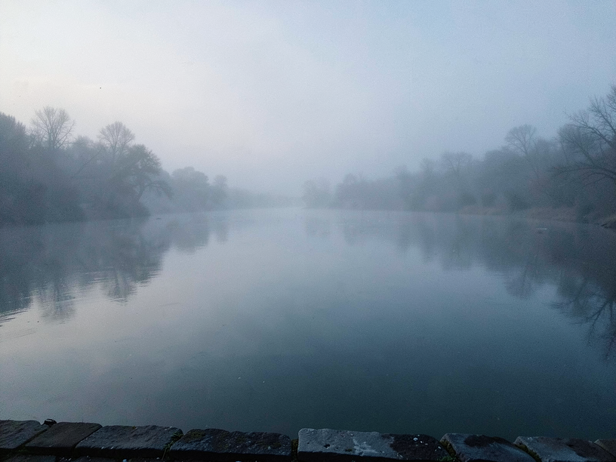
![Misty River Dawn]()
Misty River Dawn
Image credit : AI
I observe the cold, still water reflecting faint pre-sunrise light amidst dense winter fog, a common sight during North India winter air quality.
2. River-Surface Evaporation Carries Dissolved Pollutants Into the Air
The Ganga and Yamuna carry organic load, industrial effluent, and partially burned material from upstream cremations and ritual immersions. When the cold surface water meets slightly warmer air at dawn, fine aerosols lift off the water. These are not pure water vapour. Studies on river-proximate air quality conducted under the National Mission for Clean Ganga programme have found elevated levels of biological aerosols and particulate matter in the immediate riparian zone during low-wind, high-humidity mornings, exactly the conditions at a winter ghat before sunrise.
3. Incense, Diyas, and Ritual Fires Add Unmonitored Combustion
The morning aarti at ghats in Varanasi, Haridwar, Rishikesh, and Prayagraj involves sustained open-flame combustion: camphor, ghee lamps, agarbatti, and wood or cow-dung fuel in brass urns. Combustion of these materials releases fine particulate matter, carbon monoxide, and polycyclic aromatic hydrocarbons. The nearest AQI station captures none of this because the combustion is localised, intermittent, and happens in a zone the fixed monitoring grid was not designed to cover. The World Health Organization classifies household solid-fuel combustion as a major source of indoor and near-source PM2.5 exposure; the chemistry at an open-air ritual fire is similar.
![Brass Diya's Gentle Glow]()
Brass Diya's Gentle Glow
Image credit : AI
The gentle glow of a brass diya, its thin smoke rising, evokes a sense of peace. A quiet moment amidst the morning aarti.
4. Low Wind Speed at Dawn Means Pollutants Do Not Scatter
Wind speed is typically at its minimum in the hour before and after sunrise. This is not a North Indian peculiarity; it is a consequence of the diurnal cycle of atmospheric mixing. At a ghat, boats idling on diesel, the smoke from the fires above, and the aerosols rising off the water surface all accumulate in still air. By mid-morning, even a light breeze begins to dilute and carry these away. The worst window is the one that coincides with the most people being present for ritual bathing and prayer.
5. Boat Engine Exhaust Concentrates at Water Level
Wooden boats running two-stroke or older four-stroke diesel engines idle along ghats during the early morning hours for tourists and pilgrims. Two-stroke engines emit disproportionately high levels of unburned hydrocarbons and particulate matter relative to their size. Because the exhaust exits at water level and the inversion layer is holding everything down, the plume stays in the breathing zone rather than rising. You are standing on steps two to four metres above the waterline, directly in it.
6. Fog and Mist Are Not Clean Air
Winter fog over North Indian river towns is not the same as hill-station mist. In a polluted airshed, fog droplets form around particulate nuclei, they are, in effect, pollution made visible. The Central Pollution Control Board has noted that PM2.5 concentrations can be significantly higher inside a fog event than in clear air at the same location, because the fog suppresses vertical mixing while the particles that seeded it remain suspended. The aesthetic of a foggy ghat at dawn and the air quality of a foggy ghat at dawn are not the same thing.
7. Monitoring Stations Are Not Where You Are
India's Continuous Ambient Air Quality Monitoring Stations are placed according to population density and regulatory coverage logic, not according to microenvironmental hotspots. A station in Varanasi or Haridwar is typically sited away from the river bank, at a height that avoids ground-level interference, and averages readings over intervals that smooth out the sharp spikes that occur during the aarti or during peak boat traffic. The number on your phone is real data from a real instrument. It is just not measuring the air you are in. Hyperlocal monitoring research published under the ICMR's environmental health programmes consistently shows that near-source exposure at combustion and traffic hotspots can exceed the nearest fixed-station reading by a factor of two to four.
The ghat is worth going to. The dawn light on the river is real and the ritual is real. What is also real is that the air quality forecast is a population-level average drawn from instruments that cannot see what is happening at the steps. If you have asthma, a respiratory condition, or are bringing a child or an elderly person, the hour after the aarti ends and the boats thin out is a safer window than the peak itself, and that is a conversation worth having with a pulmonologist before the winter season rather than after it.