Most Indian households run an air purifier, keep windows shut against street pollution, and still wonder why someone wakes up with a scratchy throat. The answer is usually inside the room. Fine particulate matter, particles at or below 2.5 microns, small enough to bypass the nose and throat and settle in the lung's air sacs, is generated by several ordinary household activities. The World Health Organization classifies PM2.5 as a Group 1 carcinogen at sustained exposures, and indoor concentrations in Indian homes during cooking or incense burning have been measured in studies by the Indian Institute of Technology and the Central Pollution Control Board at levels that exceed India's own National Ambient Air Quality Standards for outdoor air.
Agarbatti and Dhoop
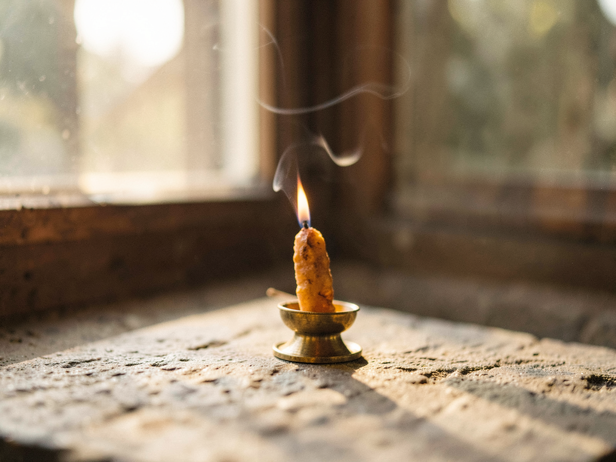
Burning one agarbatti stick releases a complex mixture of PM2.5, carbon monoxide, volatile organic compounds, and polyaromatic hydrocarbons. The smoke is chemically similar to cigarette smoke in its particulate composition. A study published in the journal Atmospheric Environment found that incense burning in an enclosed room can push PM2.5 concentrations above 200 micrograms per cubic metre within minutes, India's 24-hour outdoor standard is 60. The risk is not a reason to stop a practice that carries religious meaning for millions. It is a reason to burn agarbatti near an open window, use a single stick rather than several at once, and leave the room for ten minutes after lighting.
![Morning Agarbatti Smoke]()
Morning Agarbatti Smoke
Image credit : AI
A thin wisp of agarbatti smoke drifts into the morning light, highlighting a common source of indoor air pollution in Indian homes.
Mosquito Coils
A single mosquito coil burning through the night releases particulate equivalent to burning roughly 75 to 137 cigarettes, according to research published in Environmental Health Perspectives. The active ingredient, typically a pyrethroid, is the insecticide. The particulate comes from the combustion of the coil's filler, wood powder, starch, and binders. In a bedroom with the door closed, PM2.5 can remain elevated for hours after the coil burns out. Alternatives that produce no combustion particulate include plug-in liquid vaporisers and battery-operated fans with repellent pads. If a coil is the practical choice, burn it in a room before sleeping, ventilate, and do not burn it with a sleeping person present.
Cooking on a Gas Flame
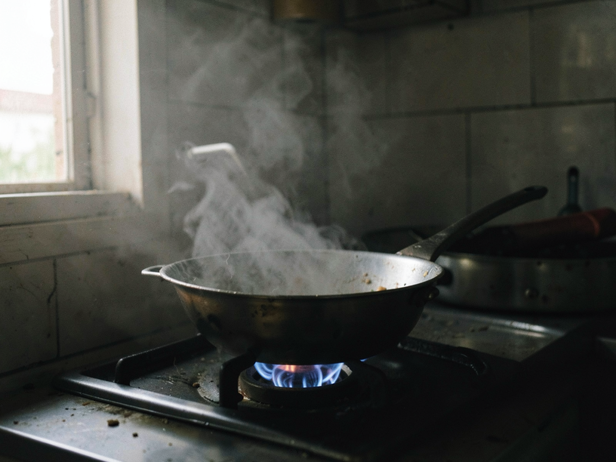
High-heat cooking on an LPG burner generates PM2.5 from two sources simultaneously: the gas combustion itself, which produces nitrogen dioxide and fine particulate as byproducts of incomplete burning, and the cooking process, oil heated past its smoke point, bread or roti on a tawa, tempering spices in hot oil. Mustard oil and coconut oil both have relatively high smoke points, but any oil produces ultrafine particles when it smokes visibly. The Central Pollution Control Board has recorded PM2.5 spikes of 300 to 500 micrograms per cubic metre in Indian kitchens during peak cooking without ventilation. A chimney exhaust hood venting outside reduces this substantially. A recirculating filter hood reduces it less, because it captures grease but returns particulate to the room.
![Kadai on Gas Flame]()
Kadai on Gas Flame
Image credit : AI
Cooking vapor rises from a kadai, a common sight in Indian homes and a source of indoor air pollution.
Pressure Cooker Steam and Cooking Vapour
Steam from a pressure cooker is water vapour and carries little particulate on its own. The issue is what happens when that steam condenses on cool surfaces and then dries: it leaves behind fine organic residue that re-enters the air. More significantly, the act of opening a pressure cooker releases a burst of aerosolised cooking liquid. This is a minor source compared with frying or incense, but in a small kitchen it contributes to cumulative PM2.5 load. Adequate ventilation during cooking, a window open on the opposite side of the kitchen from the stove creates cross-ventilation, handles most of this.
Candles, Especially Scented Ones
A plain paraffin candle in a draught-free room produces visible soot. Scented candles, which use a higher proportion of fragrance oils, produce more incomplete combustion and release additional volatile organic compounds alongside PM2.5. Beeswax and soy-wax candles produce less particulate than paraffin. A single candle in a ventilated room is a small exposure. Multiple candles in an enclosed room for an extended period, a common arrangement during Diwali or a spa-style bath, raise concentrations meaningfully. The same ventilation rule applies: a window ajar drops the accumulation.
Biomass Stoves and Chulhas
Households in semi-urban and rural India that still use wood, dung cake, or agricultural residue for cooking face a different order of magnitude. The WHO estimates that household air pollution from solid-fuel cooking kills approximately 3.2 million people globally per year, with South Asia carrying a disproportionate share of that burden. PM2.5 from biomass combustion includes fine carbon particles, tar aerosols, and polyaromatic hydrocarbons. The Pradhan Mantri Ujjwala Yojana scheme has expanded LPG access to reduce this exposure. Where a chulha is still in use, cooking outdoors or in a well-ventilated structure with a chimney opening reduces but does not eliminate exposure.
Synthetic Air Fresheners and Aerosol Sprays
Aerosol sprays, room fresheners, hairsprays, deodorant sprays, release propellant and fragrance as a fine mist. Propellant particles are in the PM2.5 range and remain suspended for several minutes. Synthetic fragrance compounds react with ozone present in indoor air to form secondary organic aerosol, adding to the particulate load. This is a smaller source than cooking or incense but is often used in enclosed bathrooms where ventilation is minimal. Pump sprays rather than aerosols, and opening a window immediately after spraying, reduce the exposure meaningfully.
The pattern across all seven sources is the same: combustion and aerosolisation in enclosed spaces without ventilation. No single source demands elimination, several are embedded in daily routine and cultural practice. What changes the exposure is airflow. A cross-ventilated kitchen, a window open during agarbatti, and a mosquito coil burned before rather than during sleep each reduce PM2.5 concentrations by more than any air purifier placed in a sealed room. The purifier handles residual. The window handles the source.