A 2023 report by the Nutrition Advocacy in Public Interest group tested 36 protein supplement brands available in India and found that several contained lead levels above permissible limits, with a handful also carrying arsenic and cadmium. Some contained caffeine or synephrine that appeared nowhere on the label. The products were not all obscure. Several were sold in gyms, pharmacies, and on major e-commerce platforms.
Where the Heavy Metals Come From
![Raw Plant Protein Powders]()
Raw Plant Protein Powders
Image credit : AI
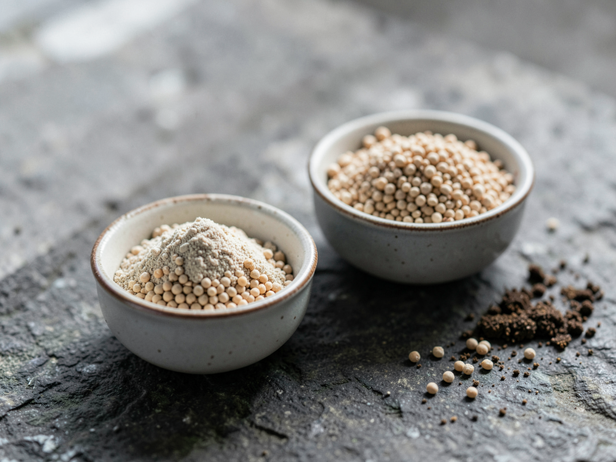
Raw pea and rice protein powders on stone. Ensuring protein powder safety India is paramount for consumers.
Heavy metals enter protein powders at the source, not in the factory. Whey is a byproduct of milk, and dairy cattle accumulate cadmium and lead through contaminated feed and groundwater. Plant proteins carry a higher risk: pea, rice, and hemp are grown in soil, and soil in many agricultural regions, including parts of India, carries naturally occurring arsenic and cadmium. The plant pulls these metals in through its roots alongside nutrients. Concentration happens at the protein extraction stage, when water and carbohydrates are stripped away and the metal-to-protein ratio rises.
Processing does not remove heavy metals. Filtration and ion-exchange techniques used in whey processing can reduce them, but the starting quality of the raw material sets the ceiling. A manufacturer sourcing cheap raw protein concentrate from a supplier with no heavy metal testing protocol has no reliable way to know what it contains until a finished batch is tested, and testing finished batches is not legally required in India before a product reaches a shelf.
Why Undeclared Stimulants Appear
Stimulants like synephrine, bitter orange extract, and high-dose caffeine turn up in protein powders through two distinct routes. The first is deliberate: a manufacturer adds them to make the product feel effective faster, a stronger pump, faster perceived recovery, a sharper training session. Declaring them on the label would trigger regulatory scrutiny, so they go unlisted. The second route is cross-contamination. Many supplement manufacturers in India run multiple product lines, pre-workouts, fat burners, and protein powders, on the same equipment. Without rigorous cleaning validation between runs, a batch of protein powder picks up residue from a stimulant-containing product made hours earlier.
Neither route is acceptable, but the second is harder to police because it does not require intent. A small contract manufacturer running six different clients' formulations on two sets of blending equipment has a structural contamination problem that good intentions alone will not fix.
The Regulatory Gap That Allows This
![Supplement Purity Still Life]()
Supplement Purity Still Life
Image credit : AI
Investigating protein powder safety in India. Lab report suggests third party tested protein powder India.
In India, protein supplements are classified under the Food Safety and Standards Act and regulated by the Food Safety and Standards Authority of India. FSSAI set specific standards for protein supplements under the Food Safety and Standards (Health Supplements, Nutraceuticals, Food for Special Dietary Use, Food for Special Medical Purpose, Functional Food and Novel Food) Regulations, 2022. These regulations require label declarations and set outer limits for certain contaminants. What they do not require is pre-market batch testing by an independent, accredited laboratory before a product is sold. A manufacturer self-certifies compliance. Enforcement is post-market: inspectors test products already on shelves, usually after a complaint or a media report triggers attention.
This is the gap. A product can move from blending to retail to a consumer's shaker bottle without a single independent test. The incentive to test voluntarily exists only for brands that have built a market position on quality claims and can afford to defend it. For a brand competing on price in a crowded market, testing is a cost with no immediate return.
What Independent Testing Has Found
The Nutrition Advocacy in Public Interest findings are not isolated. The Centre for Science and Environment tested protein supplements in an earlier round and found similar heavy metal issues. In both cases, the methodology followed US Pharmacopeia limits as a reference point because India had not yet published its own enforceable limits for heavy metals in this product category at the time of testing. FSSAI has since moved toward specifying limits, but the pace of enforcement has not matched the pace of market growth.
The Indian sports nutrition market has grown sharply over the past several years, driven by gym culture, fitness content, and e-commerce making imported and domestic brands equally accessible. Regulatory capacity has not scaled at the same rate. The result is a market where a consumer has no reliable way, at point of purchase, to distinguish a tested product from an untested one.
What a Buyer Can Actually Do
Third-party testing certification is the most reliable signal available. Certifications from NSF International, Informed Sport, or Labdoor indicate that a specific batch was tested by an independent laboratory for heavy metals, banned substances, and label accuracy. These certifications are not free for manufacturers to obtain, which is why they correlate reasonably well with brands that have decided testing is worth the cost. They are not a guarantee, certification covers the batch tested, not every future batch, but they represent a meaningfully different level of accountability than a self-certified label.
A protein powder with no third-party certification, no published test results on the brand's website, and a price point well below comparable certified products is carrying a risk the label does not disclose. That risk is not theoretical. It has shown up in lab results repeatedly, across price points and brand sizes, in a market where the burden of proof currently sits with the consumer rather than the seller. Asking a brand for its most recent certificate of analysis is a reasonable request. A brand that cannot produce one is telling you something.