Delhi's air turns grey by October. By November, the AQI in parts of the Indo-Gangetic Plain regularly crosses 300, a level the Central Pollution Control Board classifies as severe, where even healthy adults are advised to stay indoors. For a pregnant woman or a child under five, those months are not an inconvenience. They are a period of measurable biological exposure with consequences that outlast the season.
What PM2.5 Does During Pregnancy
Fine particulate matter, particles smaller than 2.5 micrometres, is small enough to pass through the lung lining and enter the bloodstream. During pregnancy, that bloodstream feeds the placenta. Research tracked by the Indian Council of Medical Research has found associations between high PM2.5 exposure in the first and second trimesters and increased rates of preterm birth, low birth weight, and impaired fetal lung development. The mechanism is not mysterious: particulates trigger systemic inflammation, and chronic low-grade inflammation disrupts the hormonal signals that regulate fetal growth and gestational length.
Low birth weight matters beyond the delivery room. Babies born lighter than 2.5 kg have smaller baseline lung capacity, and that deficit does not fully close in childhood. The lung they start with is the lung they build on.
![Botanical Elixir Still Life]()
Botanical Elixir Still Life
Image credit : AI
Raw botanicals and a dropper bottle, hinting at natural remedies. Protecting children from air pollution is vital.
How a Child's Lung Actually Develops, and Where Pollution Interrupts It
A child's lungs are not small adult lungs. The alveoli, the tiny air sacs where oxygen exchange happens, multiply rapidly from birth through age three, and lung capacity continues expanding until roughly the mid-twenties. During this window, repeated exposure to PM2.5 and nitrogen dioxide interferes with alveolar development, reduces the rate at which lung volume grows, and increases airway inflammation. The World Health Organization has classified outdoor air pollution as a Group 1 carcinogen, and its paediatric guidelines note that children breathe more air relative to their body weight than adults do, meaning the dose per kilogram of body weight is higher for the same ambient concentration.
A study published in The Lancet Planetary Health found that children living in high-pollution environments showed measurable reductions in forced expiratory volume, the amount of air they can push out in one second, compared to children in cleaner air. That reduction is a functional one: it affects how well a child can run, recover from a respiratory infection, and handle exertion into adulthood. Reduced lung function in childhood is one of the stronger predictors of chronic obstructive pulmonary disease decades later.
The Winter Specific Risk in Indian Cities
Winter compounds the baseline problem. Temperature inversions trap pollutants close to the ground. Crop residue burning in Punjab and Haryana adds a seasonal spike of particulates and carbon monoxide. Firecrackers during Diwali push single-night AQI readings to levels that would be considered an industrial accident in most regulatory frameworks. For a pregnancy that runs from September through February, a common window, the fetus is in its most developmentally sensitive period during the worst months of the pollution calendar.
Urban geography matters too. A family in a ground-floor flat on a busy road in Ghaziabad or Faridabad faces PM2.5 concentrations that can be two to three times higher than a family on an upper floor of a building set back from traffic, even within the same city. Indoor air is not automatically cleaner: cooking on a gas stove without ventilation, incense burning, and outdoor air infiltrating through gaps all contribute to indoor PM2.5 levels that regularly exceed outdoor readings in poorly ventilated homes.
![Hazy Winter Cityscape View]()
Hazy Winter Cityscape View
Image credit : AI
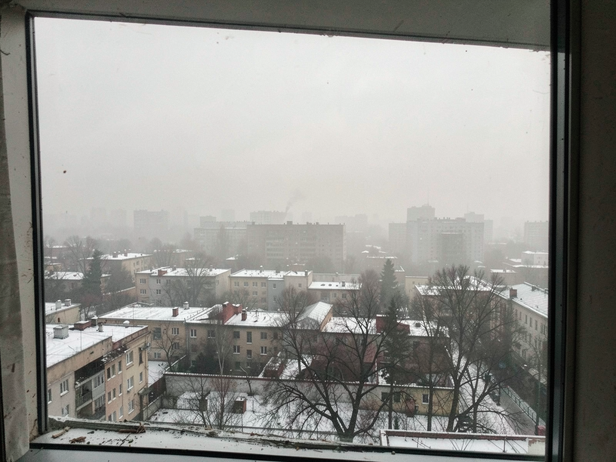
I see the impact of winter pollution on a city, a stark reminder of the risks like PM2.5 pregnancy risk.
What Families Can Actually Do
No consumer intervention eliminates the risk, and it is worth being honest about that. An N95 mask worn correctly, with a proper seal, not folded loosely over the nose, filters roughly 95 percent of PM2.5 particles and is the most evidence-supported individual measure available. It is also uncomfortable to wear for extended periods, and most children under two cannot wear one safely. A HEPA air purifier running continuously in the room where a pregnant woman or young child spends most of their time reduces indoor PM2.5 meaningfully, though the benefit depends on room size, filter quality, and whether windows are kept closed.
Timing outdoor exposure matters. AQI is typically lowest between 6 and 8 in the morning before traffic peaks, and highest in the late evening when inversions settle. Avoiding outdoor exercise during severe AQI days is not overcaution, it is the recommendation of both the Indian Paediatric Association and pulmonologists who work with high-risk populations. Prenatal care should include a conversation with an obstetrician about pollution exposure, particularly for pregnancies in the third trimester during peak winter months, when the fetal lungs are completing their surfactant development.
The structural answer, cleaner fuel, better urban planning, enforced stubble-burning bans, sits outside any individual family's control. The honest framing is that individual measures reduce exposure at the margins while the systemic problem persists. That reduction still matters: a smaller dose of PM2.5 across a pregnancy or a childhood is a meaningfully better outcome than an unmitigated one, even if it is not a clean one.