Most desk workers who lift assume the gym undoes the damage of sitting. For the shoulder, that logic only holds if the joint arrives at the gym with enough mobility to move the way pressing demands. When it doesn't, the overhead press stops being corrective and starts stacking load onto a joint that is already compensating.
What a Desk Does to Shoulder Position
Prolonged sitting with arms forward, keyboard, mouse, phone, shortens the pectoralis minor and the anterior shoulder capsule. The scapula tilts forward and downward, pulling the glenoid, the shallow cup the humerus sits in, into a position where it faces slightly down rather than straight out. The rotator cuff, specifically the supraspinatus, now has less room to pass under the acromion during arm elevation. This narrowing of the subacromial space is not a permanent structural change in the early stages, but it becomes the mechanical condition every overhead movement operates within.
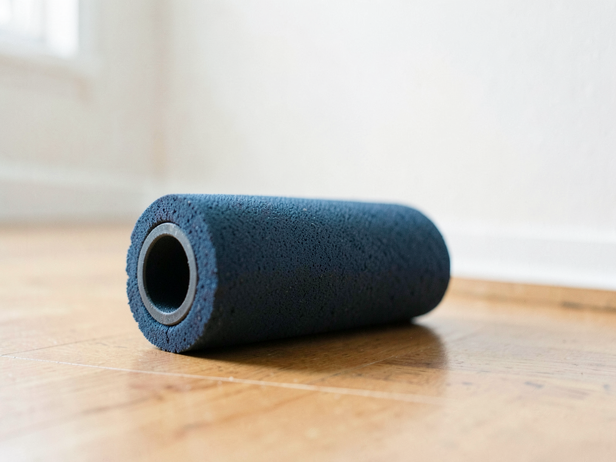
![Foam Roller on Wood Floor]()
Foam Roller on Wood Floor
Image credit : AI
My foam roller awaits, ready to ease desk worker shoulder pain. Essential for recovery.
What the Overhead Press Demands of That Shoulder
A strict overhead press requires the humerus to travel from roughly 90 degrees of abduction to full elevation, the scapula to upwardly rotate and posteriorly tilt, and the thoracic spine to extend enough to let the bar pass the ear without the lumbar spine picking up the slack. A desk-stiffened shoulder typically fails at two of those three. Scapular upward rotation is limited because the serratus anterior is underloaded and the upper trapezius is chronically tight in the wrong way, active but not coordinating. Thoracic extension is restricted because the mid-back has spent hours in flexion. The body solves the problem the only way it can: it extends the lumbar spine excessively, lets the shoulder shrug through the top of the movement, and internally rotates the humerus to clear the acromion. Each of those compensations shifts load away from the intended muscles and toward tissue that was not designed to bear it repeatedly.
Where the Load Goes When the Movement Pattern Is Wrong
When the scapula cannot upwardly rotate fully, the supraspinatus tendon passes through a narrower channel on every rep. Over enough sets and sessions, this produces the kind of low-grade mechanical irritation that the American Academy of Orthopaedic Surgeons classifies as impingement syndrome, not a tear, initially, but chronic tendon stress that degrades tissue quality over time. Separately, if the glenohumeral joint is internally rotated at the top of the press because thoracic extension is unavailable, the posterior capsule and the infraspinatus take shear load they are not designed to handle in that position. The discomfort, when it arrives, is often felt at the front of the shoulder or deep inside the joint, which is why many lifters assume the problem is the anterior deltoid and keep pressing through it.
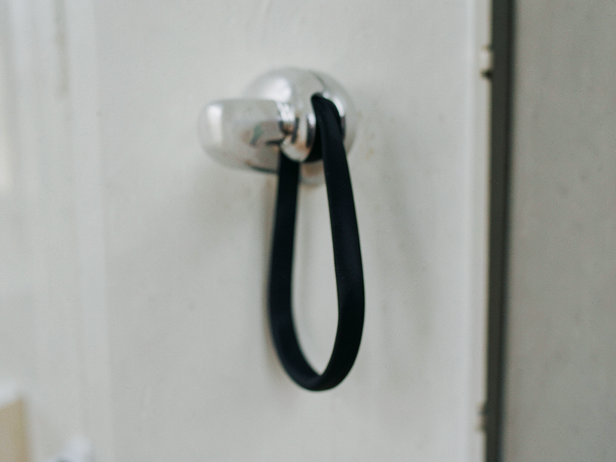
![Resistance Band on Door]()
Resistance Band on Door
Image credit : AI
Preparing for safe overhead pressing exercises, even for desk workers. This setup aids shoulder impingement recovery.
What to Address Before Loading Overhead
Two things need to change before the overhead press is safe for a shoulder that sits all day. First, the thoracic spine needs to move. Thoracic extension mobilisation, a foam roller placed perpendicular to the spine at mid-back, arms crossed, five to ten slow extensions over several segments, restores some of the range the desk removes. It takes under five minutes and changes what the shoulder can access immediately. Second, the serratus anterior needs to be activated before it is loaded. Wall slides, where the forearms press flat against a wall and slide upward while the lower back stays neutral, train the scapular upward rotation pattern without loading the supraspinatus in a compromised position. Neither of these is a cure. They are the preparation that makes overhead pressing a different movement than it would be without them. Anyone experiencing pain at the front or top of the shoulder during or after pressing should have the joint assessed by a physiotherapist or sports medicine doctor before continuing to load it. Pain is the shoulder reporting that the compensation has reached its limit, not a cue to push through.
A Safer Progression for Desk Workers Who Want to Press
The landmine press is the most forgiving starting point. Because the bar is anchored at an angle, the pressing path is diagonal rather than strictly vertical, which allows the humerus to stay in a more neutral position and demands less thoracic extension. It trains the same pushing pattern with a fraction of the joint stress. From there, a half-kneeling dumbbell press, one knee down, which prevents lumbar extension from compensating, teaches the shoulder to stabilise overhead without the spine cheating. Full overhead pressing with a barbell is a reasonable goal, but it is the last step of the progression, not the first. The shoulder that sits at a desk all day is not broken. It is adapted to a position that the overhead press directly contradicts. The gap between those two things is the work.