On a bad smog day in Delhi or Mumbai, the visible haze is mostly PM2.5, particles smaller than 2.5 micrometres. They are light enough to stay suspended for hours and small enough to bypass the nose and throat and settle deep in the alveoli, the tiny air sacs where oxygen crosses into the bloodstream. That is the threat. The mask question is really one question: does this material stop a particle that small?
What PM2.5 actually is and why size is everything
PM2.5 is not a single substance. It is a size category. Particles below 2.5 micrometres include combustion byproducts from vehicles and power plants, construction dust, crop-burning smoke, and secondary aerosols formed when gases react in the atmosphere. Their danger is not just chemical, it is physical. Particles above 10 micrometres are caught by nasal hair and mucus. Particles below 2.5 micrometres are not. The respiratory tract has no reliable mechanical filter for them. They reach the alveoli and stay. Over time, repeated exposure is linked by the World Health Organization to increased risk of cardiovascular disease and chronic lung damage. The mask's job is to intercept them before inhalation.
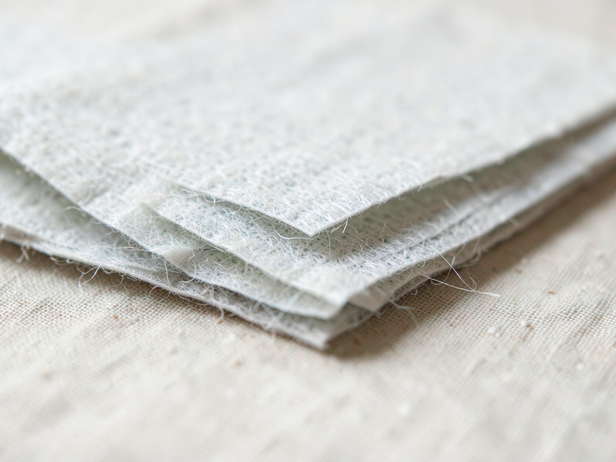
![Macro Filter Fabric Texture]()
Macro Filter Fabric Texture
Image credit : AI
Examining the fine fibers of a filter, crucial for PM2.5 mask filtration.
How an N95 works, and why filtration is not just about pore size
The N95 rating, set by the US National Institute for Occupational Safety and Health, means the mask filters at least 95 percent of airborne particles at 0.3 micrometres, the hardest size to catch, because particles at that diameter are too large for diffusion to work well and too small for inertial impaction to work well. The filter medium is a layer of electrostatically charged polypropylene fibres. Particles do not simply have to fit through a hole smaller than themselves. They are drawn toward the charged fibres and stick. This is why a material that looks loosely woven under a microscope can stop particles far smaller than its apparent gaps. India's BIS standard IS 9473 covers the equivalent N95-class respirator; masks certified under it meet the same filtration threshold. The fit matters as much as the filter: an N95 with a gap at the nose bridge lets unfiltered air bypass the medium entirely. Press the metal strip flat against your nose every time.
What a surgical mask actually does
A surgical mask was designed to protect a patient from the wearer's respiratory droplets during a procedure, not to protect the wearer from the environment. Its filtration efficiency for sub-micron particles sits between 10 and 40 percent in most independent tests, depending on the brand and how it is worn. More critically, surgical masks are not sealed to the face. Air follows the path of least resistance. On a face with any gap at the sides or bridge, which is almost every face, a substantial fraction of inhaled air bypasses the mask material entirely. For large droplets in a clinical setting, this is acceptable. For PM2.5 in outdoor smog, it is not. The mask provides psychological reassurance without proportionate physical protection.
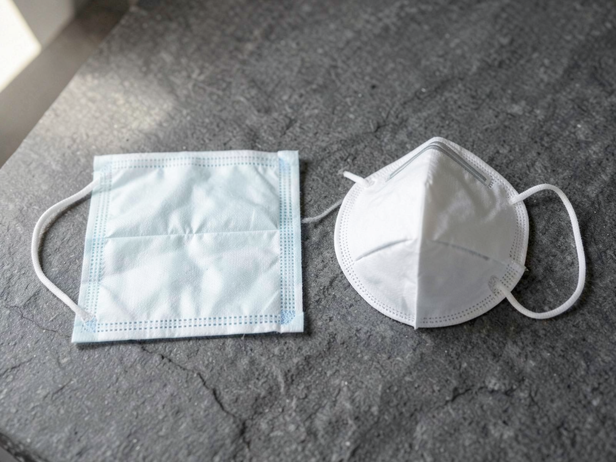
![Masks on Stone Surface]()
Masks on Stone Surface
Image credit : AI
Comparing a surgical mask vs N95 mask for pollution protection on a matte grey surface.
Cloth masks and the layering question
A single-layer cotton cloth mask stops very little PM2.5. Multiple layers improve filtration somewhat, and some studies of tightly woven fabrics with a non-woven filter insert have shown efficiencies above 50 percent for larger particles. For particles at 0.3 micrometres, even multi-layer cloth masks rarely approach 70 percent under real wearing conditions, and fit losses apply here too. In a city where AQI regularly crosses 300 during winter months, a cloth mask is better than nothing in the same way that a raincoat with holes is better than no raincoat, true, but not the honest answer to the question. The honest answer is that for high-pollution outdoor exposure, cloth and surgical masks are not adequate substitutes for a properly fitted N95 or equivalent respirator.
Practical use and when to see a doctor
An N95 worn correctly, seal checked, metal strip pressed down, straps snug, gives real protection during a commute through heavy smog or a walk on a high-AQI day. Reusability varies by brand; most manufacturers rate them for 8 hours of cumulative use, and a mask that has become damp or visibly soiled should be replaced. People with existing respiratory or cardiovascular conditions should speak with a chest physician or general practitioner before relying on any mask as their primary mitigation, the increased breathing resistance of an N95 is not trivial for someone with compromised lung function, and their exposure management may need to go beyond mask choice. Children's sizing matters: an adult N95 that does not seal on a child's face provides little benefit.