Every year, the same pattern: a family arrives at the ghat well before sunset, finds a spot, sets down the thali, and turns all attention toward the sun. The water is secondary, it is the medium, not the point. That inversion is where the danger lives.
Check the Riverbed Slope Before Anyone Wades In
A ghat that looks shallow from the bank can drop sharply two or three steps out. Silt deposited by monsoon flow shifts the bed geometry each year, and last season's safe wading depth is not this season's. Before the family enters the water, one adult should wade in slowly to knee depth and probe forward with a foot, not a step, to feel for the drop. If the bottom falls away faster than expected, that is the wading limit for children and non-swimmers. Mark it with a piece of cloth tied to a nearby post or handed to someone on the bank.
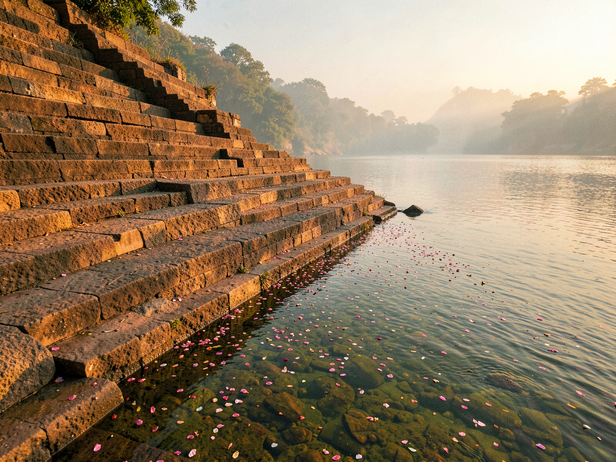
![Golden Hour River Ghat Serenity]()
Golden Hour River Ghat Serenity
Image credit : AI
I find peace at the river ghat, watching petals float on the water. Practicing water safety is crucial, especially during festivals like Chhath Puja.
Read the Current Before the Crowd Arrives
Rivers with a visible festival ghat often have a deceptively calm surface near the bank, while a mid-channel current runs fast. Throw a leaf or a small flower, something already in the water, and watch it. If it moves more than a body-length downstream in five seconds, the current at wading depth is strong enough to pull a child off their feet. This check matters most at ghats where the bank curves, because the outer edge of a river bend accelerates flow. If the leaf moves fast, keep children at ankle depth only and position an adult downstream of them, not beside them.
Identify the Crowd Crush Points
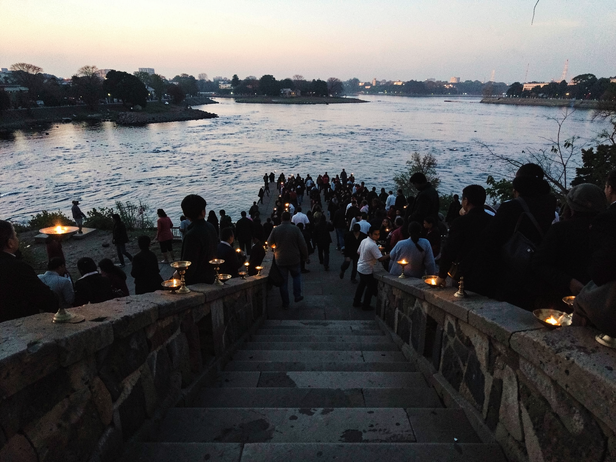
At a packed ghat, the water is not always the first hazard. Steps that narrow toward the waterline create a funnel. When thousands of people are moving in both directions on the same staircase, a stumble near the water's edge becomes a pile-up. Before the crowd peaks, walk the full staircase and note where the width narrows to less than two people across. Plan your family's descent to use the widest section. Agree on a single exit route before you go down, because choosing it while being pushed from behind is too late.
![Dusk River Staircase Crowd]()
Dusk River Staircase Crowd
Image credit : AI
Navigating crowded ghat safety is crucial, especially during festivals. I observe the flow of people on these steps.
Check for Submerged Offerings and Debris
Ghats used for ritual immersion accumulate submerged offerings, clay idols, flower garlands, wire frames, coconut shells, that settle on the riverbed within a day or two of a major festival. A foot coming down on a wire frame or a broken clay edge in murky water causes lacerations that are easy to miss until you are back on dry land. Before wading, scan the entry point. If the water is opaque and the bottom is not visible, shuffle your feet rather than stepping. Closed footwear, rubber sandals that grip, is better than bare feet at any ghat that has hosted immersions in the past week.
Assign a Designated Watcher Who Does Not Enter the Water
The most common family configuration at a ghat is everyone in the water together. This is also the configuration in which no one is watching from outside. Designate one adult, not an older child, whose role is to stay dry and watch the group. This person stands on the step above the waterline, faces the water, and does not participate in the ritual until everyone is back on the bank. Their job is to count heads every thirty seconds and to be the one who can move quickly and call for help without already being in the water. Rotate the role if the ritual is long; never leave it empty.
Locate the Nearest Help Before You Need It
Most major ghats during festival season have NDRF or State Disaster Response Force personnel stationed nearby, along with boat operators who know the water. Before the family descends, spend two minutes identifying where they are. If there is a police post, note it. If there are rescue boats moored, note where they are tied. If there is a lifeguard ring or rope, note which pillar it hangs from. This is not pessimism, it is the same logic as knowing the fire exit before the film starts. When something goes wrong at a crowded ghat, the first thirty seconds are spent looking for help. You want to have already found it.
Have a Separation Plan That Children Can Execute
A child separated from their family at a crowded ghat at dusk, with noise and movement in every direction, will not make good decisions without a plan rehearsed in advance. Before leaving home, tell children: if you cannot see any of us, walk up the steps, not along the bank, and stand next to the largest lamp or the tallest flag you can find. Do not walk toward the water. Do not follow a stranger. Stay in one place and call out. Practice saying the parent's phone number aloud. At the ghat itself, point out the landmark you have chosen. A child who has a plan panics less. A child who panics less stays where they can be found.
The ritual takes minutes. The preparation takes ten. Most of these checks are done once, on arrival, before the thali is set down, and they do not interrupt the evening at all. The families who skip them are not careless; they are focused on the right thing at the wrong moment. The water does not wait for the arghya to be over.