The smog that settles over the Indo-Gangetic Plain between October and January is not generic pollution. It is a dense mix of PM2.5 from stubble burning in Punjab and Haryana, vehicular exhaust, construction dust, and cold-air inversions that trap everything at breathing height. A purifier built for a European apartment or a coastal city may run all night and change almost nothing in that air. The numbers that actually matter are CADR, filter type, and the honest area coverage, and none of them appear prominently on the box.
The One Number That Decides If the Purifier Can Keep Up
CADR stands for Clean Air Delivery Rate, measured in cubic metres per hour. It tells you how fast the machine pushes clean air into the room, not how powerful the motor sounds or how many stages the filtration claims to have. For a standard 150-square-foot bedroom with a 9-foot ceiling, you need a CADR of at least 200 m³/hr to turn the air over enough times per hour to matter during heavy smog. Most budget purifiers sold under ₹5,000 in India carry a CADR between 80 and 120 m³/hr, enough for a small study, not a bedroom where two people sleep. The spec is usually buried in the product manual or the manufacturer's website. If a brand does not publish it, treat the absence as an answer.
![HEPA Filter Texture Detail]()
HEPA Filter Texture Detail
Image credit : AI
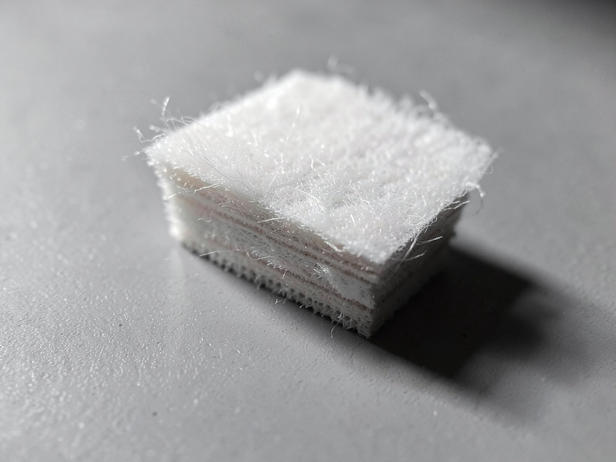
Examining the fine fibrous texture of a HEPA filter, crucial for air purifier for smog season India.
Filter Grade Is Not the Same as Filter Marketing
The filter inside the machine does the actual work. The label to look for is H13 True HEPA, which captures 99.97 percent of particles at 0.3 microns, the size range where PM2.5 is most dangerous and hardest to trap. Many purifiers sold in India use HEPA-type or HEPA-like filters, which are not the same standard and can let a meaningful fraction of fine particles through. Check whether the brand specifies H13 or H14 in the filter documentation, not just in the marketing headline. For smog season in North India, an activated carbon pre-filter matters too: it handles the NO₂ and SO₂ that come with winter pollution and that a HEPA filter alone cannot touch. A purifier with a thin carbon layer bonded to the main filter is better than one with no carbon at all, but a separate, thick carbon stage handles gases more reliably.
Area Coverage Claims Are Usually Optimistic by Half
Manufacturers calculate coverage under ideal lab conditions: a sealed room, a single air change per hour, and clean starting air. In a real North Indian home, with gaps under doors, windows that do not seal properly, and AQI that may be 350 outside, the effective coverage is closer to half the stated figure. A purifier rated for 400 square feet will realistically clean a 180- to 200-square-foot room adequately during peak smog. Size down your expectations, not up. If the room is large, two mid-range purifiers placed at opposite ends will outperform one premium unit in the centre.
![Living Room Air Purification]()
Living Room Air Purification
Image credit : AI
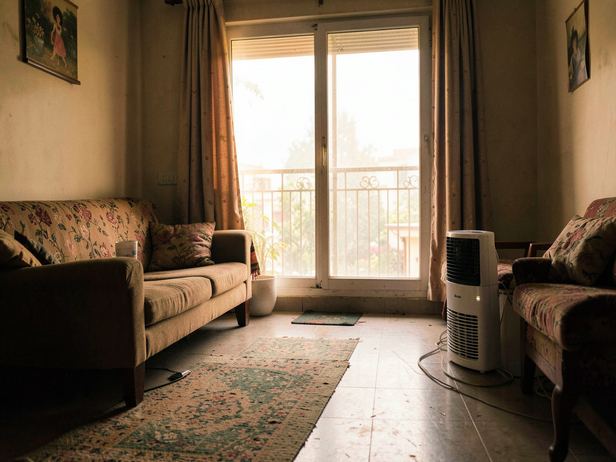
My living room's defense against the Delhi NCR pollution. These air purifiers are essential for cleaner air.
Where Filter Replacement Cost Eats the Savings
The upfront price of the machine is rarely where the money goes. A purifier with a ₹6,000 filter that needs replacing every six months costs more over three years than a machine priced ₹3,000 higher with a ₹1,500 filter on a twelve-month cycle. Before buying, find the replacement filter price on the brand's India website, not a third-party listing, and check whether it is actually in stock. Several international brands sell machines readily in India but import filters on long lead times, which means running a clogged filter through the worst weeks of smog season. Brands with local filter manufacturing or reliable domestic distribution include Blue Star, Dyson (filters available but expensive), Xiaomi's Mi Air Purifier line, and Coway, though stock availability changes. Verify before you commit, not after.
The Settings Most People Never Change
Auto mode on most purifiers responds to the onboard sensor, which typically sits inside the machine and reads the air it has already partially cleaned. In a room with an open kitchen or a door that opens to a corridor, the sensor may read clean while the far corner of the room stays polluted. Run the purifier on medium or high manually for the first two hours after closing the room for the night, then let auto mode maintain it. Sleep mode, which most people switch on immediately, drops fan speed to reduce noise, useful for light sleep, but it cuts CADR by 40 to 60 percent at the moment when the room air is still being brought down from outdoor levels. The filter indicator light is also worth checking monthly rather than waiting for it to trigger: in a high-pollution city during smog season, a filter rated for twelve months under normal use can saturate in five or six.
A purifier that matches the room's actual volume, carries a verified H13 HEPA and a real carbon stage, and comes with a filter you can replace without a two-week wait will outperform a premium brand running an undersized machine with a proprietary filter on backorder. The smog season in North India is predictable. The purifier decision does not have to be made in a panic when AQI hits 400.