The line outside a Gurdwara on Gurpurab morning stretches long before the sun is fully up. If you've never been inside one, the rhythm of what happens, and when, and why, is not obvious from the outside. Get the sequence right and the experience opens up. Miss a step and you spend the first ten minutes feeling like you've walked into the middle of a conversation.
What to Carry
A dupatta, stole, or large cotton handkerchief if you don't own a chunni, something that covers your head completely, not just the crown. Men need the same: a rumal or any clean square of cloth works. Most Gurdwaras keep spare cloth at the entrance for visitors who arrive without one, but having your own is simpler. Carry socks. The langar hall and the main hall both require bare or socked feet, and the marble floors in winter are cold. A small amount of cash for the golak (the donation box) is customary but never compelled, whatever feels right, nothing is the floor. Leave leather belts and leather bags in the car if you can; some Gurdwaras ask for this, others don't, but it avoids an awkward moment at the door. Leave your phone on silent before you join the queue, not at the entrance.
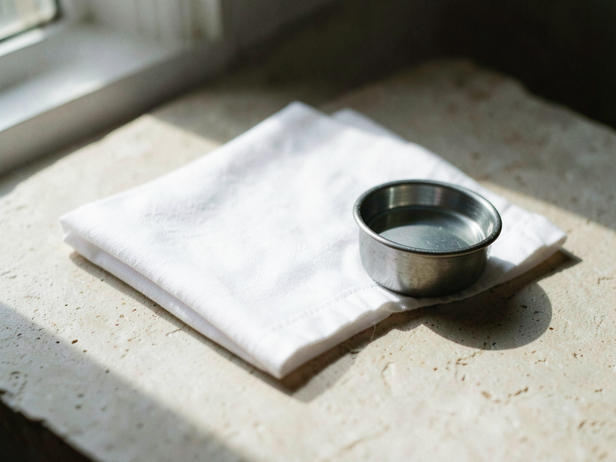
![Serene Morning Still Life]()
Serene Morning Still Life
Image credit : AI
Preparing for a Gurpurab etiquette guide, this serene scene evokes peace and reflection.
The Sequence at the Gate
Cover your head before you step onto the Gurdwara premises, not inside the door, outside, in the open. Remove your shoes at the joda ghar, the shoe counter, and collect a token or remember your rack number. Wash your hands and feet at the sarovar or the foot-wash channel at the entrance to the main hall; this is the step most first-time visitors skip because it looks optional. It isn't. Step over the threshold of the darbar sahib with your right foot first. Walk toward the Guru Granth Sahib, the holy scripture installed on a raised platform called the takht, and bow until your forehead touches or nearly touches the floor in matha tekna. This is the central act of a Gurdwara visit. Rise, take a step back, and sit on the floor facing the Guru Granth Sahib. Men and women typically sit on opposite sides of the central aisle, though this varies by Gurdwara.
Inside the Darbar Sahib
The Granthi, the reader, recites from the Guru Granth Sahib continuously. The kirtan, devotional music sung by the ragis, runs alongside. You are not expected to follow along or to know the words. Sitting quietly and listening is participation. On Gurpurab the hall will be full; if there is no floor space near the front, sit wherever you can see the takht. Avoid pointing your feet toward the Guru Granth Sahib, tuck them under you or to the side. If you need to move through a seated crowd, do it with a slight bow and a hand gesture of apology, not by stepping over people. Karah Prasad, a warm, dense halwa made from equal weights of flour, ghee and sugar, is distributed during or after the ardas, the congregational prayer. Hold both hands out, cupped together, to receive it. Eat it there; don't pocket it to take home.
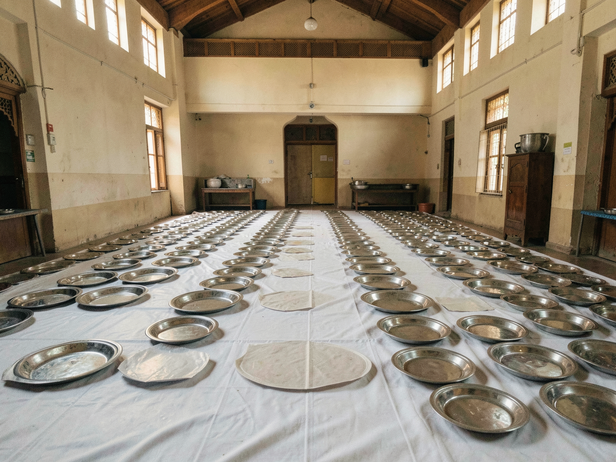
![Empty Langar Hall Awaits]()
Empty Langar Hall Awaits
Image credit : AI
Preparing the langar hall for service. This space is central to the Gurdwara experience, offering a meal to all.
Langar: The Free Kitchen
Langar is the community meal served in a separate hall, free to everyone without exception. On Gurpurab it runs for hours and the variety is wider than on ordinary days. Sit in a row on the floor with everyone else, this is the point of langar, that no seat is higher than another. Sewadars, volunteers, will come down the row with dal, sabzi, roti and sometimes kheer. Hold your thali steady and accept what is offered; you can decline a dish with a small wave of the hand. Do not waste food. Return your thali to the washing station when you finish. Staying to do seva, washing dishes, serving food, sweeping the langar hall, for even twenty minutes is welcomed and not unusual for a first-time visitor.
Before You Leave
Return to the darbar sahib for a final matha tekna if the programme is still running, or simply stand at the threshold for a moment before you go. Collect your shoes, replace your token. The rumal or stole you brought in stays with you; it is not left behind. If you received a hukamnama printout, the day's scripture reading distributed at some Gurdwaras on Gurpurab, keep it. On Gurpurab specifically, the nagar kirtan procession may still be moving through the streets when you leave; if it passes, stop and let it go by. That sequence, stop, let it pass, is the one piece of etiquette that happens outside the Gurdwara walls and is just as observed as everything inside them. The visit has a shape: cover, wash, bow, sit, eat, return. Follow the shape and the rest takes care of itself.