The overhead light in most Indian homes does one thing: flood the room with a flat, shadowless brightness that makes every corner look the same. A table lamp does the opposite. It pools light, creates depth, and, depending on how you use it, can shift your mental state more reliably than a scented candle or a motivational poster ever will.
Colour Temperature Is the Variable Most People Ignore
Light is measured in Kelvin, and the number on your bulb box changes the entire character of a room. Bulbs between 2700K and 3000K produce a warm amber tone that slows the nervous system down. The brain reads this wavelength as late evening, which is exactly what it is in nature, the hour when cortisol drops and melatonin begins to rise. Bulbs between 4000K and 6500K push blue-white light that keeps you alert, which is useful at a work desk and actively counterproductive in a bedroom. Most homes in India default to cool-white tube lights and then wonder why sleep feels difficult. A single 2700K bulb in a table lamp, switched on an hour before bed, does more for sleep onset than most sleep hygiene advice. The mechanism is not mystical: blue-spectrum light suppresses melatonin production, and warm light does not.
![Contrasting Lightbulb Glow]()
Contrasting Lightbulb Glow
Image credit : AI
I explore how lighting affects mood with these warm vs cool light bulbs, creating a serene atmosphere.
Placement Changes the Room's Geometry
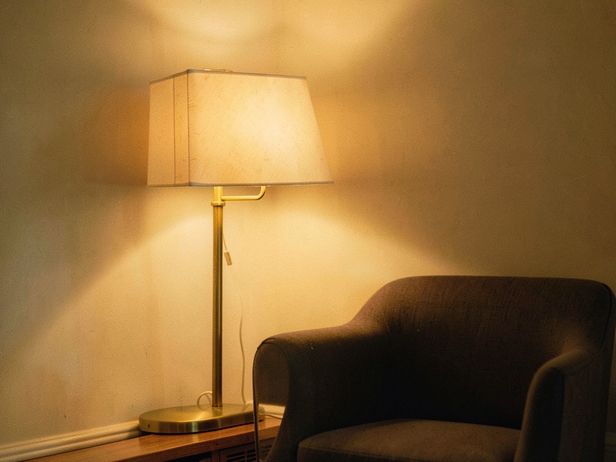
A lamp placed at eye level or below creates horizontal layers of light that make a room feel wider and more intimate at the same time. A lamp placed above eye level flattens the space back toward overhead-light territory. The practical rule: set the lamp base so the shade's lower edge sits roughly at shoulder height when you are seated. This keeps the light source out of your direct sightline, which eliminates glare, and it throws a warm wash across the wall behind it rather than straight down onto a surface. In a small apartment, the kind that makes up most of urban Mumbai, Bengaluru, or Delhi, this single placement decision can make a 250-square-foot room feel like it has corners worth sitting in.
Shade Material Is Not a Style Choice Alone
A white or cream fabric shade diffuses light evenly and produces the softest, most flattering spread. A dark or opaque shade concentrates the beam downward and creates a reading-pool effect, useful at a desk, too dramatic for a living room unless that is deliberate. A metallic or glass shade bounces light in unpredictable directions and tends to create hot spots. If a room feels harsh despite a warm bulb, the shade is usually the reason. Linen and cotton diffuse better than synthetic fabrics, which can yellow unevenly over time. The shade is not a finishing touch. It is the lens.
![Warm Light Ambiance]()
Warm Light Ambiance
Image credit : AI
This lamp placement enhances the room's mood with warm vs cool light bulbs India.
The Chanakya Principle of Purposeful Placement
Chanakya wrote in the Arthashastra about the deliberate arrangement of a space to serve the function performed in it, a principle that applies as cleanly to light as it does to governance. Every lamp should answer one question before it is placed: what activity happens here, and what quality of attention does that activity need? A lamp beside a reading chair needs a focused, slightly cooler bulb and a shade that directs light onto the page. A lamp on a console table near the entrance needs warmth and diffusion, its job is to set a tone, not to illuminate a task. A lamp on a bedside table needs the warmest bulb in the house and a shade that keeps light from reaching the eyes directly. One lamp doing the wrong job is more disruptive than no lamp at all.
Using Multiple Lamps to Layer Light
A single overhead source creates one plane of light. Two or three table lamps at different heights and positions create what lighting designers call layered light, multiple overlapping pools that give the eye somewhere to travel and the room a sense of depth. The practical version for a living room: one lamp at the far end of a sofa, one on a side table or console, and the overhead either dimmed or switched off entirely. The result is a room that looks larger in photographs and feels quieter to sit in. This is not an interior design luxury. It is the difference between a space that is technically lit and one that is actually pleasant to be in for more than twenty minutes.