M Visvesvaraya once designed an automatic flood gate system for the Khadakwasla reservoir that would shut itself before engineers could even reach the control room. He did not wait for a flood to prove the need. The gates were his answer to a question most people had not yet thought to ask: what happens when there is no time to react?
The Block System: Write Down What Can Go Wrong
Visvesvaraya kept detailed notebooks throughout every project. Before construction began on the Krishna Raja Sagara dam, he mapped dependencies, what had to be true for each stage to proceed, and what would break if it was not. He called this kind of structured thinking his block system: break the work into units, assign conditions to each unit, and check the conditions before moving forward.
The same structure applies to decisions far smaller than a dam. Before committing to a plan, write down three things that have to hold for it to work. Then ask whether each one is currently true. If it is not, you have found the problem before it finds you. Most people skip this step because it feels like pessimism. Visvesvaraya treated it as the only form of optimism worth having.
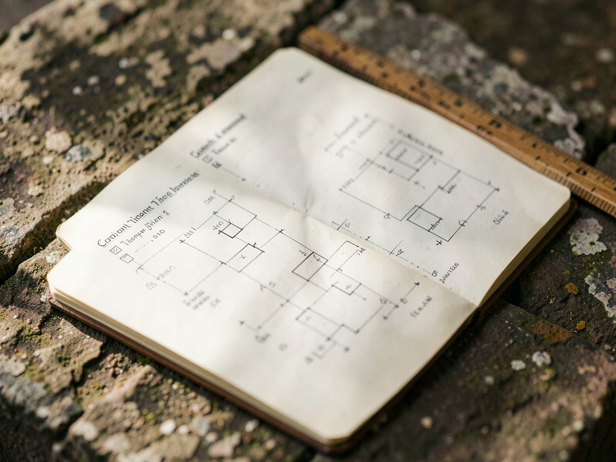
![Planning Notebook, Morning Light]()
Planning Notebook, Morning Light
Image credit : AI
My proactive thinking techniques are visualized in this planning notebook, ready for action.
The Chanakya Principle Underneath the Method
Chanakya wrote in the Arthashastra that a king who attends to the present without preparing for the future will be overwhelmed by both. The line survives because it describes a real failure mode. Reactive thinking feels efficient, you solve what is in front of you. But each solved problem generates two new ones that were waiting behind it, and you never get ahead.
Visvesvaraya's engineering career was a long argument against reactive thinking. The Moka Delta works in Andhra Pradesh, the sanitation improvements in Hyderabad, the Bhadravathi Iron and Steel Works, each involved designing for conditions that did not yet exist. He was not predicting the future. He was removing the reasons the future could catch him by surprise.
The 48-Hour Rule for Personal Decisions
One practical extraction from Visvesvaraya's method is a simple delay. Before any decision with consequences that extend beyond a week, take 48 hours and write down what you are assuming. Not what you know, what you are assuming. Assumptions are the flood gates you forgot to install.
A job change assumes the new role is what it appears to be. A purchase assumes the price is the full cost. A commitment assumes the other party understands it the same way you do. Writing these down does not make you cautious. It makes you fast, because when one assumption breaks, you already know which part of the plan it affects and what the fallback is.
![Time and Planning]()
Time and Planning
Image credit : AI
I examine the Visvesvaraya planning method, a proactive approach to decision making before problems arise.
Maintenance as a Strategy, Not a Chore
Visvesvaraya inspected infrastructure that was already working. This confused people. The usual logic is that you inspect what is broken. His logic was that you inspect what is working precisely because you cannot afford to find out it has stopped working at the moment it matters most.
Applied to daily life, this means scheduling a review of things that are currently fine. A relationship going well. A habit holding. A financial arrangement that has not caused trouble. The review is not a search for problems. It is a confirmation that the conditions you assumed are still true. If they are, you spend five minutes and move on. If they are not, you have found the problem at a point when you still have options.
Visvesvaraya's real lesson is not about engineering. It is about the difference between the cost of attention and the cost of repair. Attention is cheap and can be scheduled. Repair is expensive and arrives without warning. He spent his career choosing attention, and left behind infrastructure that is still standing.