Vinoba Bhave completed the Bhoodan movement on foot. Between 1951 and 1964, he walked through villages across India, and landowners gave away more than four million acres. No legislation, no coercion. The walking was the argument.
Most people know the headline. Fewer sit with what it asks of them personally: if a man with nothing but sandals and a walking stick could redistribute land by showing up, what does that say about what the rest of us owe the places we live in? Three habits from Bhave's practice answer that question at street level, without requiring anyone to give away their property.
Walk the Same Ground Until You Know It
Bhave did not campaign from a vehicle. He walked the same terrain his audience walked, at the same pace, in the same heat. By the time he sat down with a village, he had already shared the road with them.
The habit here is deliberate, repeated walking of the same route. Not exercise walking with earphones in. Walking the street you live on as an act of attention: who is out at what hour, which shopkeeper opens late, which corner floods in the rain, which family has been there thirty years and which arrived last month.
Bhave wrote in his collected letters that the act of walking with someone dissolves the distinction between the one who gives and the one who receives. The walker is also given to. The street teaches back.
In practice: pick one route, walk it at the same time three or four mornings a week, and leave the phone in your pocket. The knowledge that accumulates is not sentimental. It is the basis for everything else on this list.
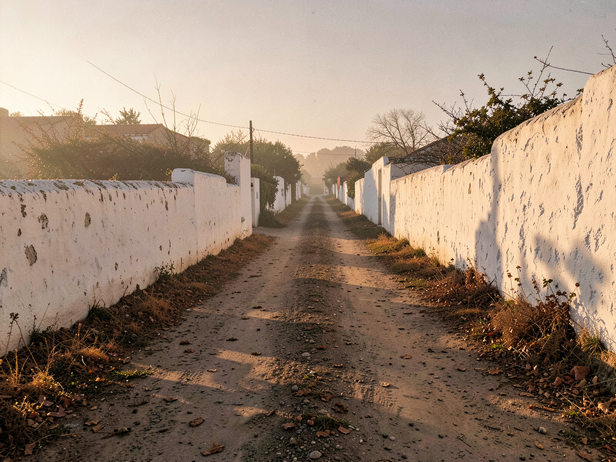
![Golden Hour Village Lane]()
Golden Hour Village Lane
Image credit : AI
I observe the quiet beauty of a village lane, reflecting on how to contribute to your community daily.
Give Before You Are Asked, and Give What Costs You Something
The Bhoodan asks were not collection drives. Bhave would arrive, speak about the principle that land belongs ultimately to the community that works it, and then wait. The gift had to come from the giver's own reckoning, not from social pressure in the moment.
The Arthashastra, which Chanakya composed as a treatise on statecraft, draws a line between dana given from calculation and dana given from understanding. Bhave lived on the second side of that line. He was not interested in what people could spare. He was interested in what people understood they owed.
The habit: identify one thing on your street that you are positioned to give before anyone asks. It might be time, a skill, access to something you own, or simply consistent presence. The condition Bhave set, that the gift must cost the giver something real, is not punitive. It is what distinguishes a contribution from a disposal. Giving away what you no longer want changes nothing about how you understand your relationship to a place.
This is harder than it sounds. Most neighbourhood generosity is reactive and comfortable. Bhave's model asks you to arrive at the gift through your own accounting, not through a request that makes it easy.
Treat Continuity as the Practice, Not the Outcome
Bhave walked for thirteen years. He did not walk until the acreage target was met and then stop. The walking was not instrumental to the giving. The walking was the practice, and the giving was what the practice produced.
This is the habit most difficult to translate and most worth translating. Most acts of neighbourhood involvement are event-shaped: a cleanup drive, a collection, a meeting. They have a start and an end. Bhave's model is different. It is a practice that has no natural stopping point because its purpose is not a deliverable. Its purpose is to keep the relationship between a person and a place alive and honest.
In concrete terms: commit to something on your street that has no finish line. Showing up to the same corner at the same time. Knowing the name of the person who sweeps the pavement outside your building. Checking in on the same neighbour every week, not because there is a crisis, but because that is what sustained presence looks like.
Bhave's Bhoodan did not succeed by the measure of its stated goal. The land that was given was often poor land, and much of it was never distributed as intended. But the movement changed how millions of people thought about what they held and what they owed. That shift happened because one man kept walking long after any reasonable person would have stopped.
The street you live on is not waiting for a movement. It is waiting for someone to show up to it the way Bhave showed up to every village: on foot, without a deadline, and with the understanding that the showing up is already the gift.