A surgeon at Brigham and Women's Hospital once asked why trained professionals keep making the same preventable mistakes. Atul Gawande's answer, laid out in The Checklist Manifesto, was not incompetence, it was complexity. When a task has too many steps, memory alone fails even the most careful person. The household runs on exactly this kind of complexity: dozens of recurring tasks, split across people, with no single person holding the full picture.
Why Memory Alone Cannot Run a House
Gawande identifies two failure types. Errors of ignorance happen when we do not know something. Errors of ineptitude happen when we know but still get it wrong. Almost every household failure is the second kind. You know the car needs a service. You know the water filter needs a change. You forget anyway, not because you are careless, but because the trigger for remembering never arrives at the right moment.
The pre-flight checklist that Gawande studied did not teach pilots new skills. It gave them a trigger at the moment the action was required. That distinction matters. A note on the fridge is a reminder. A checklist tied to a specific event, leaving the house, starting the week, the first of the month, is a trigger.
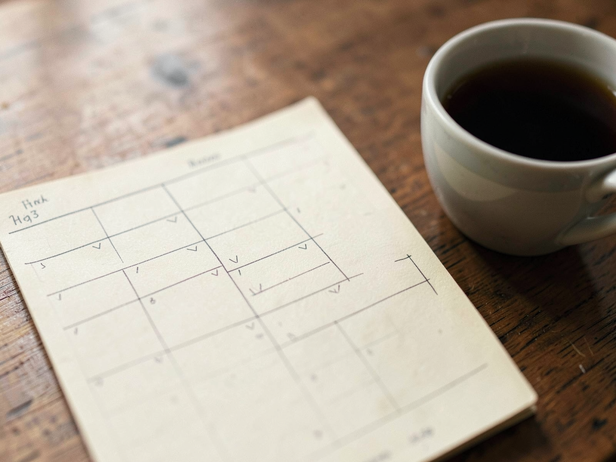
![Hand-Drawn Weekly Planner]()
Hand-Drawn Weekly Planner
Image credit : AI
Organizing my weekly home management checklist with a warm cup of tea. A simple way to stop forgetting household tasks.
The Pause Point: Where the Checklist Lives
Gawande's surgical checklists work at three fixed pause points: before anaesthesia, before the first incision, before the patient leaves the theatre. Each pause is tied to an irreversible transition. The household equivalent is any moment after which something becomes harder to fix: before you leave for work, before the weekend ends, before the month turns.
The Sunday evening review is the most transferable of these. Ten minutes, a fixed list, the same order every week. Cylinder level. Medicines running low. School fee due dates. Pending bank transfers. Subscription renewals. The point is not to solve anything on Sunday evening, it is to surface what needs solving before Monday morning makes it urgent.
The before-you-leave-the-house checklist is the second. Gawande found that surgical teams who read their checklist aloud, even when they felt it was unnecessary, caught failures they would otherwise have missed. The same applies to a door checklist. Reading it aloud, or ticking it physically, forces a pause that silent memory skips.
Build It for the Weakest Link, Not the Strongest
One of Gawande's findings cuts against the instinct to make a comprehensive list. Long checklists fail. Pilots use between five and nine items at each pause point. More than that, and the check becomes mechanical, eyes move down the list without the brain engaging.
A household checklist should carry only the items that have actually failed in the past three months. Not what could go wrong. What has gone wrong. Start there, and keep the list to seven items or fewer per pause point. If a task has never slipped, it does not belong on the checklist, it belongs in habit.
In a shared household, Gawande's surgical model adds one more element: a read-back. The surgeon states the plan; the team confirms it. In a household, this is the five-minute Sunday conversation where both partners confirm who owns what for the week. The checklist is the script; the conversation is the confirmation. Without the confirmation, ownership stays ambiguous and the task slips between people.
![Organized Index Card Stack]()
Organized Index Card Stack
Image credit : AI
My daily routine organisation tips are on these cards. Keeping track of household tasks is simple.
The Monthly Reset and the Annual Audit
Gawande updated his checklists after every major incident, a near-miss or a failure that the existing list did not catch. The household equivalent is a monthly reset: look at what slipped in the last four weeks, add it to the relevant checklist, and drop anything that has not caused a problem in six months.
Once a year, run the longer audit. Insurance renewals. Passport expiry dates. Appliance warranties. Vehicle documents. These are the items that fail silently and expensively. A single annual checklist, reviewed in the same week every year, catches them before they become emergencies.
The method asks nothing about discipline or motivation. It assumes you are already trying and still failing, because the system has no trigger. The checklist is the trigger. Everything else follows from that.