Sant Tukaram never worked in a temple. He ran a small shop, lost his family to famine, went into debt, and wrote poetry in the gaps. That context matters when reading his abhangs on work, they were not written from a position of spiritual leisure. They came from someone who knew what it meant to show up to something ordinary and find a way to mean it.
Abhang 1: The Weaver's Thread as Devotion
Tukaram draws on the image of a weaver passing the shuttle back and forth, the same motion, hundreds of times a day, and argues that the repetition is not the obstacle to attention but the structure of it. The abhang reads the loom as a form of japa: the rhythm of work becomes the rhythm of remembrance. What he is describing is not mysticism attached to labour. He is describing what happens when a person stops waiting for the work to become interesting and starts watching what the work actually does to the mind. The weaver who counts threads is already counting. The question is only what the counting is for.
![Morning Light on Clay Lamp]()
Morning Light on Clay Lamp
Image credit : AI
Finding meaning in ordinary job, this lamp's steady glow illuminates the quiet beauty of simple objects.
Abhang 2: The Farmer Who Plants Without Knowing the Rain
One of Tukaram's most direct abhangs on effort separates the act of planting from the outcome of harvest. The farmer prepares the field and puts the seed in the ground. Whether rain comes is not his. Tukaram's point is not resignation, he is not telling the farmer to stop caring about the crop. He is saying that the preparation and the planting are complete acts in themselves, not rehearsals for the harvest. Applied to an ordinary job, the argument runs like this: the quality of the work done today is not contingent on whether it is noticed, rewarded, or remembered. The Arthashastra makes a parallel argument about effort and result, Chanakya wrote that a man who acts only when success is guaranteed will act very rarely. Tukaram arrives at the same place from a different direction: the planting is the thing, not the proof of the planting.
Abhang 3: The Merchant Who Weighs Honestly
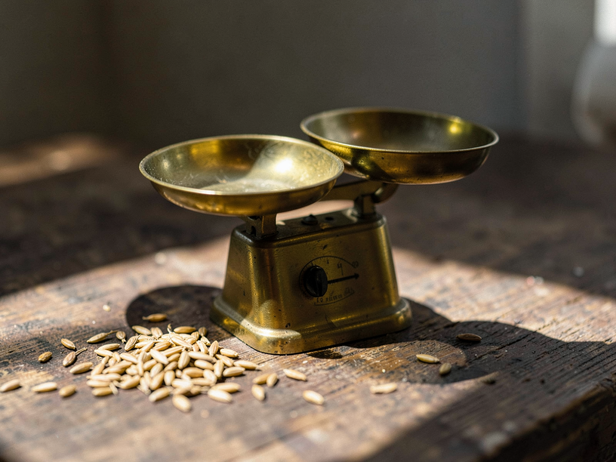
Tukaram was himself a trader, and one of his abhangs uses the image of the merchant at the scale, the daily, transactional, entirely unromantic act of honest measurement. He frames the honest weight as an act of the same order as prayer. Not symbolically. Not as a metaphor for spiritual integrity. He means the actual scale, the actual grain, the actual customer. The argument is that the place where a person's values meet the world is almost always a small, unremarkable moment: a number written correctly, a shortcut not taken, a measurement not shaved. These moments do not accumulate into a dramatic transformation. They accumulate into a person. Tukaram's merchant is not doing sacred work. He is doing ordinary work in a way that does not contradict what he believes, and Tukaram treats that as sufficient.
![Brass Scale, Morning Light]()
Brass Scale, Morning Light
Image credit : AI
Finding meaning in ordinary jobs, like this scale measures grain. Sant Tukaram abhangs offer wisdom.
What the Three Abhangs Share
None of these abhangs promise that work will become fulfilling if approached correctly. Tukaram is not a productivity writer. What the three share is a refusal to locate meaning somewhere other than the act itself, not in the outcome, not in the recognition, not in the nature of the task. The weaver's shuttle, the farmer's seed, the merchant's weight: all three are unglamorous and all three are complete. The reframe Tukaram offers is not that your job is secretly sacred. It is that the attention you bring to it is the only part of it that is entirely yours.
Tukaram's abhangs were written in Marathi for people who had no access to Sanskrit scholarship and no leisure for formal practice. That is still most people. The argument he made in the seventeenth century, that the site of practice is wherever you already are, has not aged because the ordinary job has not aged.