The Ramcharitmanas was written for people who had stopped believing things would change. Tulsidas composed it in Awadhi, not Sanskrit, precisely because he wanted it read by the person who works hard and sees nothing happen. That context matters before any career advice is extracted from it, because the patience he describes is not the decorative kind, it is patience under pressure, with no guarantee of outcome.
The Doha on Bearing Fruit in Season
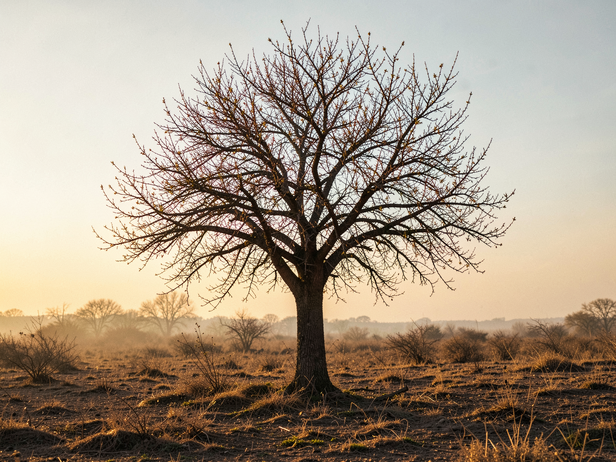
In one of the most cited dohas from the Bal Kand, Tulsidas uses the image of a tree that does not flower before its time regardless of how much it is watered. The line is often quoted as comfort. It functions better as a structural argument: the conditions for an outcome may not yet exist, and effort applied before those conditions are present does not accelerate them, it simply exhausts the person applying it. For someone stuck in a role where the next step requires an opening that has not appeared, this reframes the waiting. The tree is not failing. The season has not arrived. The question becomes what the tree does with the time before flowering, which the doha answers implicitly: it roots deeper.
![Dawn's Solitary Tree Awakens]()
Dawn's Solitary Tree Awakens
Image credit : AI
My patience in career growth is like this tree, waiting for the dawn's light to bring new buds.
Hanuman's Patience as Active Preparation
Tulsidas spends considerable space in the Sundar Kand on Hanuman's crossing to Lanka, but the crossing is preceded by a long period in which Hanuman is present, capable, and doing nothing visible. He waits on the shore. He watches. He assesses. The Ramcharitmanas frames this not as hesitation but as intelligence gathering that makes the crossing possible. The patience here is not absence of action. It is refusal to act before the right moment, while spending the waiting time in preparation that no one around you can see. Careers that feel stuck often look identical from the outside whether a person is drifting or preparing. Tulsidas draws the distinction internally: one is passive, the other is purposeful.
The Verse on Effort Without Attachment to Outcome
Tulsidas draws on the Gita's karma-yoga framework without quoting it directly, he translates it into narrative. Ram's years in the forest are not presented as punishment endured. They are presented as a period in which Ram continues to act according to his nature regardless of the absence of reward or recognition. The Chanakya Niti, separately, makes a compatible point in the Arthashastra: that a person who abandons their work because the result is delayed has misunderstood the relationship between effort and outcome. Tulsidas makes the same point through character rather than aphorism. Ram does not stop being Ram because the throne is unavailable. The career equivalent is continuing to build the skill, the relationship, the body of work, regardless of whether the title or the pay has caught up.
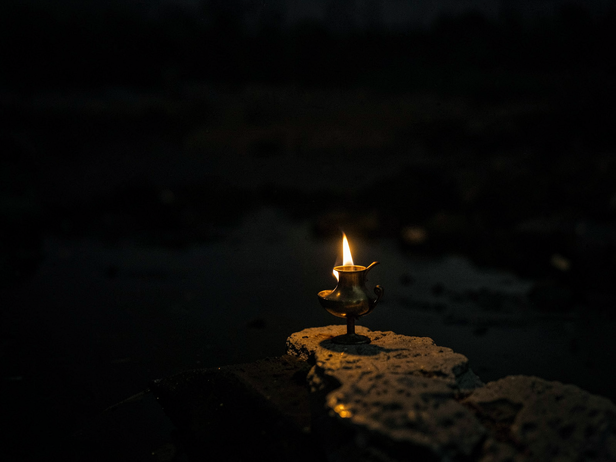
![Steady Flame, Deep Shadow]()
Steady Flame, Deep Shadow
Image credit : AI
My lamp's steady flame offers a moment of reflection, a reminder of patience in career growth.
What Tulsidas Does Not Say
He does not say that patience guarantees outcome. The Ramcharitmanas is not a self-help text and it does not promise that the deserving are eventually rewarded. What it does say, repeatedly, is that the quality of how a person moves through a difficult period shapes what they become during it, and that what they become during it is the thing that matters, independent of the external result. This is a harder position than most motivational frameworks offer, and it is more honest. A career can stay stuck for reasons entirely outside a person's control. Tulsidas does not pretend otherwise. He asks only what the person does with themselves while it is stuck.