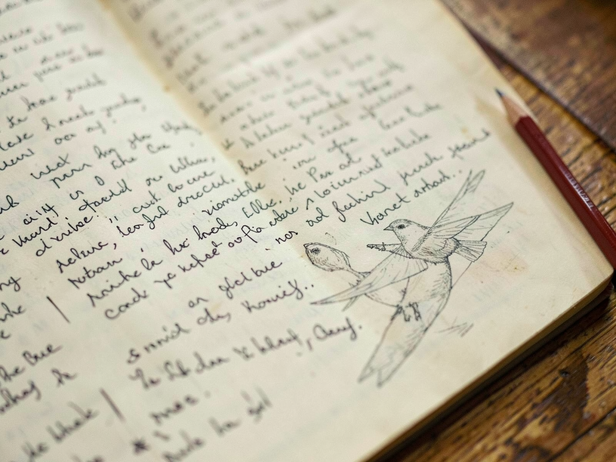
Salim Ali carried a small notebook into every field survey he ever ran. Not a beautiful leather-bound journal. A working notebook, pages dense with abbreviations, quick sketches, wind direction, the exact call of a bird he had not yet named. He was not writing for posterity in those moments. He was writing against forgetting, which arrives faster than anyone expects.
The Science of Why Memory Dissolves So Quickly
![Field Notes and Sketches]()
Field Notes and Sketches
Image credit : AI
A glimpse into dedicated note-taking habits, featuring a field notebook filled with observations and sketches. The art of writing things down.
Memory consolidation, the process by which a short-term impression becomes something retrievable, requires time and the absence of interference. The Arthashastra notes that knowledge not acted upon is knowledge lost, and modern cognitive research on working memory supports the same intuition: new information competes with incoming stimuli for the same limited buffer. A birdcall heard in the field is displaced by the walk back to camp, the conversation at dinner, the decision about tomorrow's route. By morning, the specific detail, the exact rhythm of the call, the precise angle of the wing, is gone, leaving only a vague impression that something interesting happened. Salim Ali understood this not as a personal failing but as a fact about attention, and he designed his practice around it.
What a Field Notebook Actually Is
Ali's notebooks, now archived at the Bombay Natural History Society in Mumbai, are not elegant. They are functional. Entries are terse. Dates and locations anchor every observation. Sketches are rough, enough to jog the memory, not enough to hang in a gallery. The handwriting shifts with conditions: neat in a hide at dawn, cramped and slanting in rain. What they share across decades of fieldwork, from the Andamans to the Himalayas, is immediacy. Every entry was made at or near the moment of observation, not reconstructed hours later from a general impression. That gap, between the moment and the reconstruction, is where specificity dies.
The Chanakya Principle Behind the Habit
![Nature's Study Surface]()
Nature's Study Surface
Image credit : AI
A quiet moment for note-taking habits, amidst nature's gentle light. The simple act of writing.
Chanakya wrote in the Arthashastra that a minister who does not record his deliberations will find them scattered by the next crisis. The principle is not about bureaucracy. It is about the cost of trusting memory to do work that a written record can do better and permanently. Ali applied the same logic to natural history. A sighting unrecorded is a sighting that cannot be compared, cannot be challenged, cannot contribute to anything beyond the moment it occurred. The notebook transforms a private perception into a durable fact. That transformation is the whole point.
How to Build the Habit Without Becoming a Naturalist
The field notebook habit works for any domain where observation matters: a conversation with a difficult colleague, a recipe adjustment that worked, a moment with a child that you know you will want to remember. The conditions Ali imposed on himself translate directly. Write at the moment, or within minutes of it. Use the fewest words that preserve the specific detail. Date every entry. Do not edit before you have captured, editing is a later act and it kills the impulse to write at all. A phone's notes app works. A small paper notebook works better for most people because opening it is a distinct physical act that signals capture rather than consumption. The tool is secondary. The timing is everything.
What Gets Lost When You Wait
Ali described, in his autobiography The Fall of a Sparrow, the frustration of returning from a survey with vivid memories that, when he tried to write them up formally, had already lost their edges. The colour of the iris. The precise habitat, was it the edge of the scrub or ten metres inside it? These details seem trivial until they are the difference between a confirmed record and an anecdote. In everyday life the stakes are lower, but the mechanism is identical. The insight from a meeting that felt clarifying at the time becomes a vague sense that something was resolved. The observation about your own pattern that felt revelatory on the commute home is gone by the time you sit down to dinner. Writing it down in the moment is not a productivity trick. It is the only way to keep it.