Pull hard enough on a leash attached to a collar and you are pulling on a dog's trachea, thyroid gland, and the network of nerves running along the neck. For most healthy, large-bodied dogs on a loose leash, this is low-stakes. For others, it is a recurring injury in slow motion.
What Happens Inside the Neck When a Collar Pulls
The trachea is a tube held open by C-shaped rings of cartilage. Sustained or repeated pressure from a collar can deform these rings over time, a condition called tracheal collapse, where the rings weaken and the airway flattens during breathing. The dog produces a distinctive honking cough, struggles on exertion, and in severe cases cannot get enough air even at rest. Tracheal collapse is progressive. Once the cartilage degrades, it does not rebuild. Beyond the trachea, collar pressure compresses the jugular veins, briefly raising intracranial pressure with each hard pull. Research published in the Journal of the American Animal Hospital Association found elevated intraocular pressure in dogs restrained by neck collars compared to those in harnesses, a finding relevant for any dog with or at risk of glaucoma. The vagus nerve, which runs close to the surface on both sides of the neck, can also be irritated by repeated collar pressure, producing a reflex that slows the heart rate.
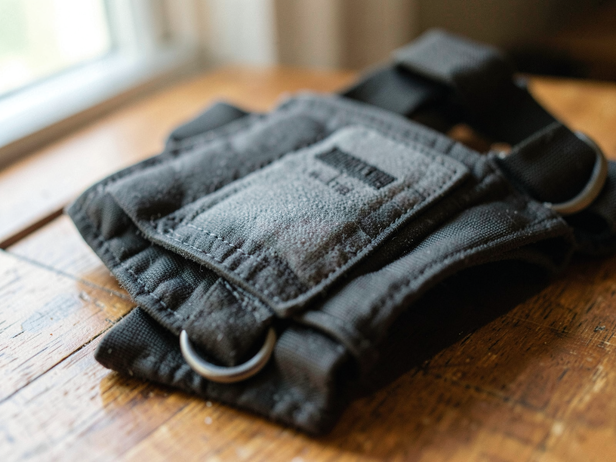
![Padded Dog Harness Detail]()
Padded Dog Harness Detail
Image credit : AI
I showcase the padded chest panel and front-clip ring of this dog harness, emphasizing its comfort for dogs who shouldn't wear a collar.
The Breeds That Should Not Wear a Collar for Walking
Brachycephalic breeds carry the highest risk. Pugs, French Bulldogs, English Bulldogs, Shih Tzus, Pekingese, and Boston Terriers already have compressed airways by anatomy: shortened nasal passages, an elongated soft palate, and a narrowed trachea relative to body size. Adding collar pressure to an airway already working harder than average is a compounding problem, not a minor inconvenience. Toy breeds face a different but equally real vulnerability. Yorkies, Chihuahuas, Pomeranians, and Maltese have naturally smaller tracheal diameter, and tracheal collapse is documented at much higher rates in these dogs than in medium or large breeds. A Chihuahua pulling against a collar for ten minutes on a morning walk is doing something physiologically different from a Labrador doing the same thing. Dogs that have had any neck surgery, cervical disc disease, or a prior tracheal collapse diagnosis belong in a harness without exception. So do dogs with hypothyroidism, because the thyroid gland sits directly in the collar's pressure zone.
When a Harness Is the Better Tool
A well-fitted harness distributes pulling force across the chest and shoulders, structures built for load-bearing. The neck is out of the equation. For brachycephalic and toy breeds, this is not a lifestyle upgrade, it is the appropriate equipment. Front-clip harnesses, where the leash attaches at the dog's chest rather than the back, have the added effect of redirecting a pulling dog toward the handler rather than forward, which reduces the force generated in the first place. Back-clip harnesses are comfortable but do nothing to discourage pulling; they are better suited for dogs that already walk calmly. A harness does introduce its own fit considerations. An ill-fitting harness that sits across the point of the shoulder can restrict the natural forward extension of the front leg, altering gait over time. The harness should sit behind the shoulder blade, with two fingers of space under every strap, and should not shift or rotate during a walk.
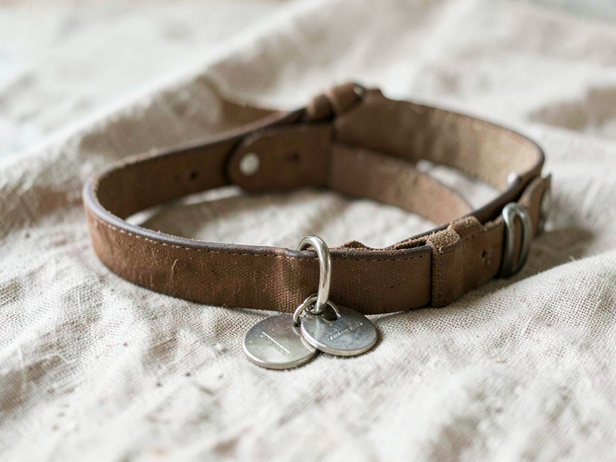
![Dog Gear on Linen]()
Dog Gear on Linen
Image credit : AI
Exploring collar vs harness for dogs. This setup highlights the gear without distraction.
What Collars Still Do Well
A flat collar is the right place to carry ID tags and registration. It stays on all day, it is easy to grab in an emergency, and for dogs that do not pull and do not belong to a vulnerable breed, it works fine as a walking tool. The problem is not collars. The problem is using a collar as the primary restraint point for a dog that pulls hard, belongs to a high-risk breed, or has any existing neck or airway condition. Martingale collars, which tighten to a fixed limit when the dog pulls, are sometimes recommended for sighthounds like Greyhounds and Whippets whose narrow heads can slip a standard collar, but they are still collar pressure on the neck and carry the same tracheal risks for vulnerable dogs. Choke chains and prong collars apply deliberate pressure as a correction mechanism. The pressure is the point. For any dog with tracheal vulnerability, these are contraindicated regardless of training philosophy.
The collar-versus-harness question is usually framed as a training debate. The anatomy makes it a health question first. A dog's breed, body type, and any existing airway or neck condition should determine the equipment before anything else does. A vet who knows the dog's history is the right person to confirm which category applies.