A blowfly can detect the chemical signature of death from several kilometres away. Within minutes of an animal or human dying, the first female lands, finds a moist cavity, and lays a clutch of eggs. She is not acting on instinct alone in any vague sense, she is responding to a precise blend of volatile compounds, primarily putrescine and cadaverine, that the body begins releasing as cellular membranes break down. What follows her arrival is not chaos but a tightly ordered biological sequence that forensic scientists have spent decades learning to read.
The First Wave: Blowflies and What Their Eggs Reveal
The family Calliphoridae, the blowflies, dominates the earliest stage of decomposition. In India, Chrysomya megacephala and Chrysomya rufifacies are among the most forensically significant species, arriving at a fresh body within minutes to hours depending on temperature, season, and whether the body is indoors or out. The female lays between 150 and 200 eggs in a single batch, typically in natural openings: the eyes, nostrils, mouth, or wounds. Those eggs hatch into first-instar larvae in as little as eight hours at 30°C.
The larvae pass through three instars before entering a pupal stage, and the duration of each stage is temperature-dependent in a way that is mathematically predictable. Forensic entomologists use accumulated degree hours, a measure that combines temperature and time, to calculate how old the oldest larvae at a scene are. That age, subtracted from the moment of discovery, gives the minimum postmortem interval: the earliest the death could have occurred. A maggot mass is not evidence of disorder. It is a biological clock that has been running since the moment the first egg was laid.
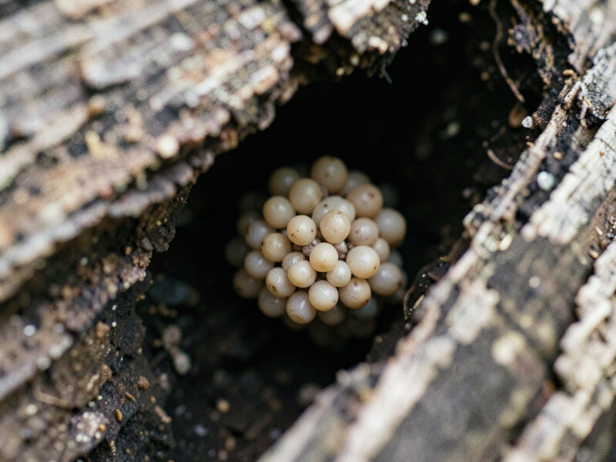
![Tiny Eggs in Wood Crevice]()
Tiny Eggs in Wood Crevice
Image credit : AI
I document these tiny eggs, a crucial element in understanding insect succession on carrion.
The Succession: Who Arrives Next and Why
As blowfly larvae consume soft tissue, the body's chemistry shifts. Ammonia and fatty acids accumulate. The moisture content changes. Each chemical shift is a signal that draws a different set of insects, and they arrive in a sequence that is consistent enough across climates to have its own name: insect succession.
Flesh flies of the family Sarcophagidae typically arrive in the second wave, depositing live larvae rather than eggs. They are followed by hide beetles, particularly species in the family Dermestidae, which are drawn to the drier tissue that remains after the blowfly larvae have finished. Rove beetles and clown beetles arrive not to feed on the body itself but to prey on the larvae already there, making them secondary indicators. Each species has a known arrival window tied to the decomposition stage, and the presence or absence of a species at a scene can confirm or contradict a suspected timeline.
What Carrion Beetles Add to the Picture
The burying beetles of the genus Nicrophorus are among the more behaviourally complex insects in this succession. On small vertebrate carcasses, a mouse, a bird, a mating pair will actually bury the body, removing it from competing blowflies, and then tend the resulting brood in a way that is unusual for insects: both parents feed the larvae directly and defend the carcass against competitors. This behaviour makes Nicrophorus species useful forensic indicators on smaller carcasses, and their presence or absence can tell an investigator whether a body was moved after death, since burying beetles need loose soil and a carcass of a specific size range to complete their behaviour.
Larger carrion beetles, including species in the family Silphidae, are drawn to more advanced decomposition and feed on both the tissue and the fly larvae present. Their arrival stage is well-documented enough that finding a Silphid beetle at a scene, in the absence of blowfly pupae, suggests either that the body was exposed in conditions that slowed blowfly colonisation, extreme cold, submersion, burial, or that something disrupted the normal sequence. Disruptions are themselves data.
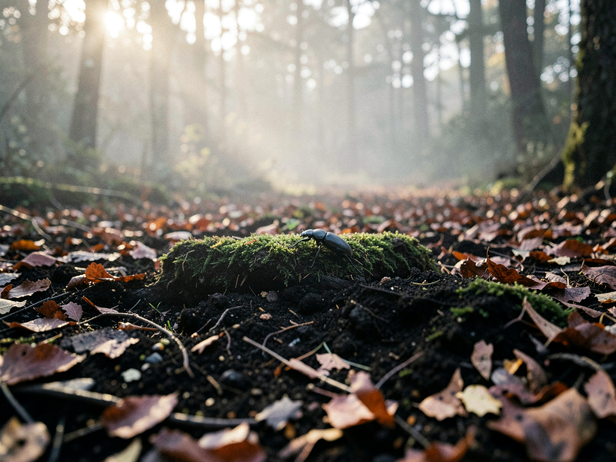
![Dawn Forest Floor Beetle]()
Dawn Forest Floor Beetle
Image credit : AI
I focus on the forest floor's dawn mist, noting a black beetle on a mossy log, a detail relevant to forensic entomology.
How the Evidence Is Collected and Interpreted
A forensic entomologist arriving at a scene collects insects at every life stage: eggs, larvae of each instar, pupae, empty pupal cases, and adult beetles. Larvae are preserved in hot water first, then ethanol, to fix their size at the moment of collection, a larva that continues to develop in a vial becomes useless as a time marker. Adults are pinned and identified to species level, often requiring microscopy.
The analysis that follows draws on reference data built from controlled decomposition studies, including work done in India to account for local species assemblages and the country's wide temperature range. A body decomposing in Chennai in October is colonised by a different community of insects, on a different timeline, than one found in Shimla in January. Regional reference data matters, and Indian forensic institutions including the Central Forensic Science Laboratory have contributed to building it. The interpretation is not a single number but a range, and a competent entomologist presents it as such in court: the postmortem interval is between these two points, and here is what would move it in either direction.
When the Clock Has Been Tampered With
The succession breaks down in predictable ways when a death has been concealed, and those breaks are themselves readable. A body stored in a freezer and then moved outdoors will show a blowfly colonisation that began days after death, not minutes, the oldest larvae will be far younger than the actual postmortem interval. A body wrapped in plastic will show delayed colonisation and an unusual species mix, since some blowfly species penetrate wrapping and others do not. Burial slows the succession dramatically and selects for different species entirely, including coffin flies of the genus Conicera, which are capable of reaching buried remains that other insects cannot.
In several documented cases, the mismatch between entomological evidence and a suspect's account of when and where a death occurred has been the decisive point. The insects were not confused by the concealment. They simply recorded what they found when they found it, and a trained reader could see the gap.
The succession from blowfly egg to carrion beetle to hide beetle is not a spectacle of decay. It is a relay, each species handing off a body transformed by the one before it, each arrival logged in the biology of the insects themselves. The clock does not need to be wound. It starts the moment death does.