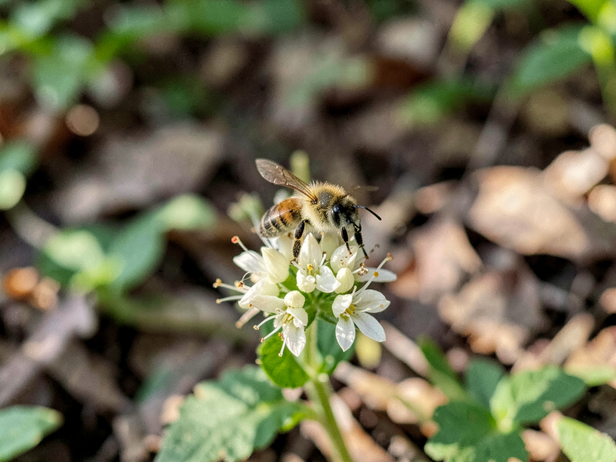
Cardamom flowers open for roughly six hours. In that window, the pollen has to move. The bee that does it most reliably in the cardamom gardens of Idukki and Coorg is not the honeybee most people picture, it is a small, fast, largely unnamed solitary bee that nests in soil and leaf litter at the forest edge, travels no more than a few hundred metres, and has never appeared on any farm inventory.
What Wild Bees Do That Managed Hives Cannot
Cardamom belongs to the genus Elettaria, and its flower architecture is awkward by design. The reproductive parts sit at an angle that requires a bee of a specific body size to brush them in the right sequence. Apis mellifera, the European honeybee introduced into Indian commercial hives, is too large and too generalist in its foraging to reliably trigger that contact. Studies conducted in Kerala's High Range have recorded significantly higher capsule set, the number of pods that actually form, in plots within 200 metres of intact forest compared with plots further away, even when managed hives were present in both locations. The difference traces to the community of smaller native bees: Trigona species, Lasioglossum, Nomia, and several stingless bee species in the genus Tetragonula that nest in hollow wood and earthen cavities along the forest margin.
![Bee on Cardamom Bloom]()
Bee on Cardamom Bloom
Image credit : AI
A wild bee, vital for cardamom pollination in India, rests on a delicate bloom. Its presence underscores the importance of native bees.
Coffee's Dependence on a Pollinator Nobody Planted
Coffea arabica is partially self-fertile, which led to a long assumption that pollinators were a bonus rather than a requirement. The data from Kodagu, one of India's largest coffee-growing districts, complicated that assumption considerably. Research across shade-grown arabica estates found that open-pollinated flowers, those accessible to wild visitors, produced heavier beans with higher oil content than bagged flowers that self-pollinated in isolation. Yield increases attributable to wild bee visitation have been estimated at between 20 and 25 percent in some Karnataka estate surveys, though the figure varies by altitude, canopy cover, and the density of surrounding forest. The bees responsible are largely the same community: small ground-nesters and cavity-nesters that depend on the understorey of the Ghats for both food and shelter across the seasons when neither cardamom nor coffee is flowering.
The Biology Behind the Dependency
Wild bees in the Western Ghats are not a single species doing one job. They are a guild, a collection of species with overlapping but distinct roles, body sizes, foraging ranges, and seasonal timing. Stingless bees in the Tetragonula genus are active year-round and tolerate the monsoon better than most. Solitary ground-nesters like Nomia bees emerge in drier months and are among the most effective pollinators of flowers with exposed anthers. Carpenter bees, large and loud, work the bigger blooms and carry pollen distances that smaller species cannot manage. This diversity is the system's resilience. When one group declines because of a dry spell, a pest, or a habitat loss event, another group partially compensates. A monoculture of managed honeybees has no such buffer. One varroa mite outbreak, one pesticide application, one bad queen season, and the service collapses entirely.
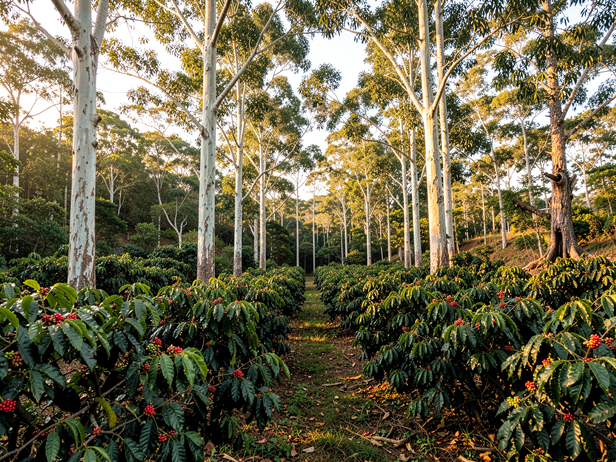
![Kodagu Coffee Estate Afternoon]()
Kodagu Coffee Estate Afternoon
Image credit : AI
I capture the dappled light on coffee plants, a scene vital for wild bees in the Western Ghats.
What Threatens the Bees That Sustain the Crop
The pressures on wild bee communities in the Western Ghats are not exotic. Conversion of forest margin to monoculture removes the nesting habitat and the floral diversity that sustains bee populations between crop-flowering seasons. Pesticide drift from estates into adjacent forest patches affects ground-nesting species whose larvae develop over weeks in the soil. Shade removal, a common response to the pressure for higher short-term yields, eliminates the hollow trees and exposed root systems where cavity-nesters establish colonies. Climate shifts that alter the timing of forest flowering can decouple the seasonal cycle that keeps wild bee populations at the density needed when cardamom and coffee open. None of these pressures is invisible. All of them are measurable in the yield data that estate managers already collect, if anyone looks for the correlation.
What the Yield Data Actually Shows
The practical argument for forest conservation in the Ghats has often been made in terms of watershed protection or biodiversity for its own sake. The pollination data adds an economic line that estate owners can read directly. Cardamom fetches between ₹1,200 and ₹2,500 per kilogram depending on grade and season. A 15 to 20 percent yield difference between a plot with intact forest margin and one without is not an ecological abstraction, it is a calculable loss per hectare per season. The bees producing that difference cost the farmer nothing. They require no feed, no veterinary attention, no hive management. They ask only that the forest at the edge of the estate remain standing, diverse, and largely undisturbed. The crop yield is, in a precise biological sense, a service fee the forest has been collecting without anyone noticing.