Every November, the Spot-billed Pelican arrives at Kokkarebellur carrying a wingspan of roughly 1.8 metres and no particular concern for the humans below. The birds settle into the Barringtonia and Portia trees that line the village's main street, build nests the size of bicycle wheels, and proceed to raise their young directly above the rooftops, the courtyards, and the daily routines of around 500 families who have shared this arrangement for as long as anyone in the village can remember.
What Makes This Village Different From Every Other Nesting Site
Spot-billed Pelicans, Pelecanus philippensis, are colonial nesters. They choose a site and return to it year after year, which means a colony that finds safety somewhere will keep coming back until the safety disappears. Most pelican colonies in India nest in trees at the edge of wetlands, away from human settlement. Kokkarebellur, about 130 kilometres south of Bangalore near Mandya, is the exception: the nesting trees are not beside the village, they are inside it. The birds land on branches that shade the same streets where children walk to school. The noise during breeding season, a low, guttural clacking from hundreds of birds at once, fills the village from dawn. The droppings whiten the ground beneath every nest tree. And the villagers, by a practice that has become one of the more documented examples of community-led wildlife conservation in Karnataka, do not disturb the birds. They do not cut the nest trees. They do not chase the pelicans during the breeding season. They have not done so for generations.
![Pelicans in Tropical Canopy]()
Pelicans in Tropical Canopy
Image credit : AI
I witness Spot-billed Pelicans nesting in the dense tropical canopy, a testament to community wildlife conservation.
The Biology Behind the Spectacle
The Spot-billed Pelican is distinguished from the Great White Pelican by the blue or purple spots on the upper mandible of its bill, visible at close range, and by its grey-brown plumage rather than white. It is listed as Least Concern on the IUCN Red List, but its total global population is estimated at somewhere between 13,000 and 18,000 individuals, making a single functioning colony significant. Kokkarebellur hosts several hundred breeding pairs of pelicans alongside Painted Storks, Mycteria leucocephala, which nest in the same trees during the same season. The two species appear to tolerate each other's proximity without conflict, a coexistence that ornithologists studying the site have noted as one of its more unusual features. Pelicans are tactile nesters: both parents incubate the eggs using the webs of their feet rather than a brood patch, pressing the eggs against the warm skin of the foot. Chicks hatch blind and helpless and are fed by regurgitation directly into the parent's pouch, which the chick reaches into headfirst.
Why the Village Protects Them
The explanation most often given by Kokkarebellur's residents is not ecological awareness in the formal sense. It is older than that. The birds are considered auspicious. Their arrival is read as a sign of a good agricultural season. The village sits in the Cauvery basin, where paddy farming has structured life for centuries, and the pelicans have nested through droughts, floods, and the slow changes of the last hundred years without the relationship breaking. The Karnataka Forest Department recognised Kokkarebellur as a Community Reserve under the Wildlife Protection Act in 2004, one of the first such designations in the state, which gave the arrangement a legal structure it had previously held only through custom. The designation did not create the conservation, it formalised what the village was already doing.
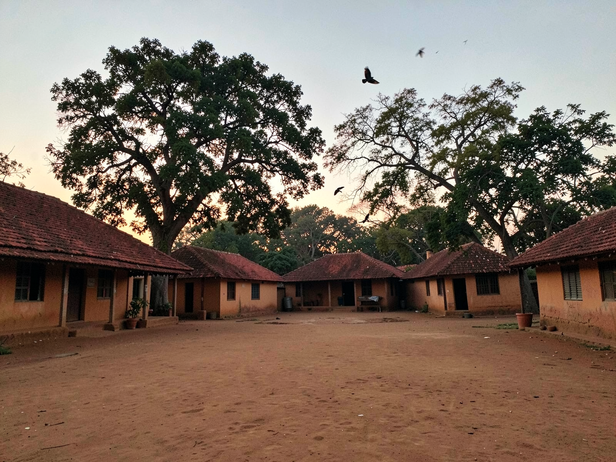
![South Indian Village Dawn]()
South Indian Village Dawn
Image credit : AI
I observe the serene dawn in a South Indian village, with birds gracing the trees. This scene evokes the spirit of community wildlife conservation.
What a Visit Actually Looks Like
The breeding season runs roughly from November through February, which is when the colony is at its most active and most visible. The best time to be in Kokkarebellur is early morning, before the heat flattens the light and the birds settle into midday stillness. The nest trees are not behind a fence or at a viewing distance. They are in the village. A visitor walks the same street the birds nest above, which means the scale of the colony becomes apparent immediately, there is no prepared vista, no interpretive board at a distance. The closest railway station is Mandya, from which Kokkarebellur is about 15 kilometres. The village has no formal accommodation; most visitors come as a day trip from Mysuru or Bangalore. The Forest Department has placed a small interpretation centre at the site, and local guides from the village are available, though not always formally organised. Going with a guide from the village is worth the effort: the families who live under the nest trees have a specificity of observation about individual birds and nesting pairs that no field guide carries.