Every day, roughly 750 million litres of Kolkata's untreated sewage flows east through a network of canals into a landscape that looks, from a distance, like an ordinary floodplain. It is not ordinary. The East Kolkata Wetlands are a 12,500-hectare system of sewage-fed fishponds, vegetable farms, and open water that has been running continuously for over a century, managed almost entirely by a community of fishers called bheries. In 2002, Ramsar designated it a Wetland of International Importance, one of the few sites on that list that is simultaneously a working sewage treatment system, a commercial fishery, and a significant bird habitat.
The biology that makes it work
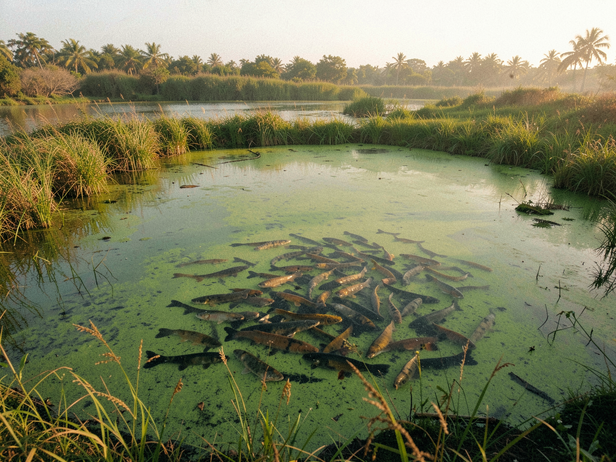
Sewage entering the bheries is rich in nitrogen and phosphorus, nutrients that, in a closed pipe, are pollutants. In open, shallow, sunlit water, they are fertiliser. Phytoplankton blooms on the nutrients. Zooplankton feeds on the phytoplankton. Fish, predominantly rohu, catla, and mrigal, all members of the cyprinid family, feed on the zooplankton. Sunlight drives the whole chain while simultaneously breaking down pathogens through UV exposure and raising the water's pH through photosynthesis. The fish harvest removes the accumulated nitrogen and phosphorus from the system in protein form. What leaves as sewage re-enters the city as food. The fishers who manage this understand the biology empirically: they regulate water depth, stocking density, and canal flow with a precision that took generations to calibrate.
![Golden Hour Fishpond Bloom]()
Golden Hour Fishpond Bloom
Image credit : AI
Golden hour light bathes a phytoplankton-rich fishpond, revealing a dense shoal of fish. This scene evokes the vibrant life of the East Kolkata Wetlands.
Over 200 bird species and what draws them
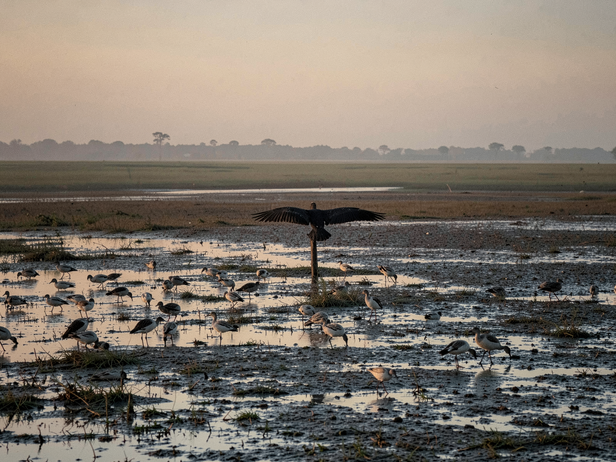
The wetlands sit on the Central Asian Flyway, one of the major migratory routes connecting Siberia and Central Asia to the Indian subcontinent. Open water, shallow mudflats, and a reliable food supply make the bheries a staging and wintering ground for species that have travelled thousands of kilometres. Recorded visitors include the northern pintail, the garganey, the bar-headed goose, and the Eurasian wigeon. Resident species include the purple heron, the pheasant-tailed jacana, and the bronze-winged jacana, the last two notable for reversed sexual roles, where the male incubates eggs and guards chicks while the female defends territory. The site also supports significant populations of the oriental darter, a cormorant relative that lacks waterproofing in its feathers by design: it dives deeper than waterproofed birds can, then spreads its wings to dry in the characteristic pose that makes it unmistakable at distance.
The pressures narrowing the system
The wetlands have shrunk by an estimated 30 to 40 percent since the 1980s, as urban expansion converted bheries into housing colonies and industrial plots. The Kolkata Metropolitan Development Authority and the West Bengal government have both declared conservation intentions, and the Ramsar designation provides international visibility, but enforcement has been inconsistent. A second pressure is chemical: as Kolkata's industrial effluent mixes increasingly with domestic sewage, the nutrient balance the fishers have managed for a century becomes harder to hold. Heavy metals do not cycle out through the food chain the way nitrogen does, they accumulate. Studies conducted by Jadavpur University researchers have detected elevated levels of certain heavy metals in fish tissue from some bheries, a finding that complicates the system's image as a clean ecological loop without invalidating the loop itself.
![Dawn Wetland Feeding Frenzy]()
Dawn Wetland Feeding Frenzy
Image credit : AI
I witness a mixed flock feeding at the water's edge in the East Kolkata Wetlands at dawn.
What the wetlands demonstrate that engineering cannot replicate
Conventional sewage treatment plants remove biological oxygen demand through mechanical and chemical processes. They do not produce food, they do not create habitat, and they do not self-regulate through a community of practitioners with a financial stake in the system's health. The East Kolkata Wetlands do all three simultaneously. Ecologists studying resource recovery from wastewater have cited the bheries as a model for what integrated waste management can look like when it evolves organically rather than being designed from the top down. The fishers' knowledge, which ponds to stock in which season, how to read the colour of the water, when to open and close sluice gates, is not written down anywhere. It is the system's operating manual, and it is not backed up.