A street dog curled on a footpath in December is burning through energy reserves faster than it does in July. Thermoregulation, the biological process of maintaining core body temperature, is metabolically expensive, and for an animal with no shelter and no guaranteed next meal, what goes into its bowl can determine whether it shivers through the night or holds steady.
How Animals Generate Body Heat
Dogs and cats are endotherms, meaning they produce their own body heat through metabolic activity rather than absorbing it from the environment. In cold weather, the body ramps up its basal metabolic rate to compensate for heat lost to the air. This process draws primarily on dietary fat and, secondarily, on protein. Carbohydrates provide quick energy but contribute little to sustained thermogenesis, the internal heat-production process that keeps core temperature stable over hours. A dog fed only plain rice on a cold night has a full stomach. Its body still has to find the fuel for heat somewhere, and it will pull from its own muscle mass if dietary fat is not available.
![Morning Meal on Stone]()
Morning Meal on Stone
Image credit : AI
Nourishing street animals in winter with wholesome food. This meal helps maintain body heat.
What Actually Helps Hold Heat
Fat is the most thermogenic macronutrient available in a street feeder's practical toolkit. A tablespoon of ghee or mustard oil mixed into a meal meaningfully increases the caloric density and gives the animal's metabolism something to burn slowly through the night. Eggs, whole, boiled, and given with the yolk, are one of the most bioavailable protein-and-fat combinations a feeder can carry. The yolk contains fat-soluble nutrients including vitamin D, which plays a role in immune function that cold weather already stresses. Cooked chicken with skin left on delivers both protein for muscle maintenance and fat for heat generation. Cooked mutton or liver, given in moderate amounts, adds iron and B vitamins that support red blood cell function, relevant because circulation is how the body distributes heat to the extremities. For cats especially, animal protein is non-negotiable: cats are obligate carnivores and cannot synthesise taurine or arachidonic acid from plant sources, making a meat-based meal the only one that serves their physiology.
What Only Fills Them Up
Plain boiled rice, plain chapati, and plain bread are the most common things fed to street animals across Indian cities. They are not harmful in small amounts, but they are predominantly carbohydrate. The body digests them quickly, blood glucose rises and falls, and the animal is left with no slow-burning fuel for the hours between midnight and dawn when temperatures drop lowest. Biscuits, including the glucose and Marie varieties, are high in refined sugar and offer almost nothing a cold animal needs. Milk is a separate problem: most adult dogs and cats are lactose-intolerant to varying degrees, and loose stool in cold weather accelerates dehydration and heat loss simultaneously. Sweet foods of any kind should be avoided entirely; xylitol, found in some packaged foods, is acutely toxic to dogs.
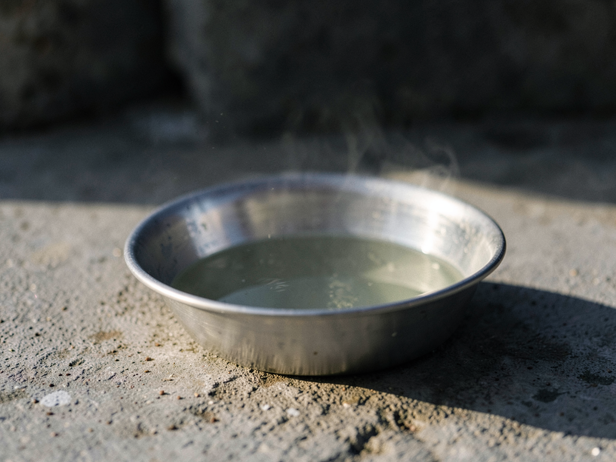
![Winter Water Bowl]()
Winter Water Bowl
Image credit : AI
Providing essential hydration for street animals in winter is crucial. This bowl offers a lifeline.
Water: The Need Feeders Forget
Cold air is dry air, and animals lose moisture through respiration even when they are not visibly panting. Dehydration thickens the blood and makes the cardiovascular system work harder to circulate warmth. Fresh water, ideally slightly warm rather than cold from a tap, is as important as the food placed beside it. An animal that eats well but has no water access is still physiologically stressed. If you feed at a fixed spot, a second bowl of water costs nothing and addresses a gap most winter feeding routines miss.
Practical Choices for Regular Feeders
A meal that helps a street animal hold heat in winter looks like this: a base of cooked rice or roti kept small, with cooked chicken or egg as the main component, a spoonful of ghee or oil mixed through, and a bowl of fresh water alongside. For cats, skip the grain base and go straight to meat. Quantities depend on the animal's size and condition, but the principle holds across breeds and body weights: fat and protein do the thermal work, carbohydrate alone does not. If you are feeding a group of animals regularly through winter, rotating egg and chicken days with plain days still leaves the animals better off than a plain-only routine. The biology does not change because the weather is only a little cold. A street animal's thermoregulatory burden begins the moment ambient temperature drops below its thermal comfort zone, roughly below 7 to 10 degrees Celsius for most dogs, though thin-coated and underweight animals feel it sooner. What you put in the bowl on those nights is not just kindness. It is fuel.