Each October, the sky above Khichan fills with the calls of Demoiselle Cranes arriving from Mongolia, Kazakhstan, and the high plateaus of Central Asia. At peak season, between 25,000 and 30,000 birds descend on a single feeding ground, a walled enclosure called the chugga ghar, where the local Jain community has laid out grain since the mid-1970s. No government programme built this. A single family started it, and a village sustained it.
The Smallest Crane, the Longest Journey
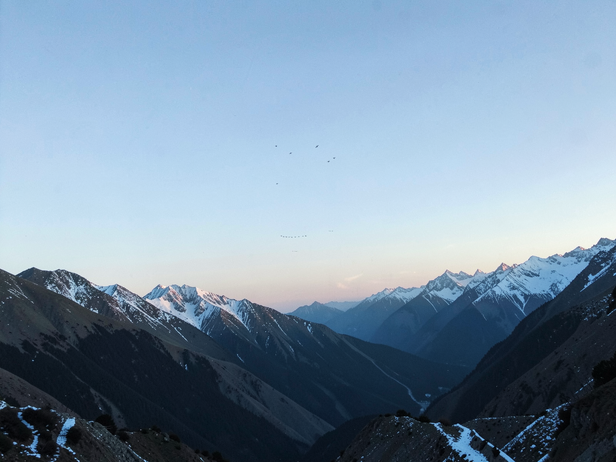
At just 90 to 100 centimetres tall and weighing under three kilograms, the Demoiselle Crane (Anthropoides virgo) is the smallest of the world's fifteen crane species. Its slender build belies the distance it travels: the Central Asian population crosses the Himalayas twice each year, navigating passes above 5,000 metres in flocks that can number in the hundreds of thousands. Mortality during the crossing is significant, raptors, exhaustion, and sudden weather account for a measurable share of each season's birds. Those that reach Rajasthan have already earned their winter.
![Himalayan Dawn Pass]()
Himalayan Dawn Pass
Image credit : AI
I observe the vastness of a Himalayan pass at dawn, a testament to nature's grandeur. The air is crisp and clear.
How Khichan Became the Gathering Ground
In the 1970s, a Jain merchant named Ratanlal Maloo began leaving grain outside his home for the cranes that rested near the village. The Jain principle of ahimsa, non-harm to living beings, gave the act its moral weight, but the scale was modest at first. Over the following decade, as word spread among the birds in the way that migratory species learn reliable food sources across generations, the numbers grew. The community formalised the effort, building the chugga ghar and funding the daily grain supply through local donations. By the 1990s, Khichan had become the largest known wintering concentration of Demoiselle Cranes in the world. The Bombay Natural History Society documented the site's significance, and it has since drawn ornithologists and wildlife photographers from across India and abroad.
What the Birds Actually Do There
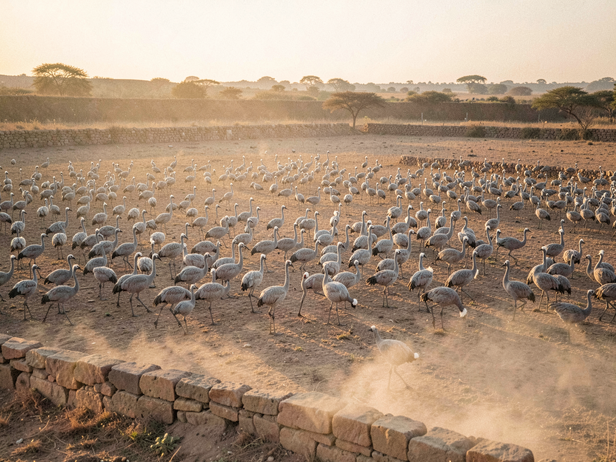
The cranes do not roost at the chugga ghar. They spend their nights at Kheechan Lake and surrounding agricultural fields, arriving at the feeding enclosure in waves through the morning hours. The spectacle of thousands of birds descending simultaneously, wings spread, calls overlapping, lasts roughly two hours. Demoiselle Cranes are highly social outside the breeding season and forage in large groups, but they maintain individual spacing and will displace smaller birds from a feeding patch without hesitation. Their diet at Khichan is primarily bajra and jowar supplied by the community, supplemented by gleaning in nearby fields. Studies of crane foraging behaviour show that access to predictable, high-energy grain sources during winter significantly improves body condition scores ahead of the spring migration, the birds that feed well in Rajasthan cross the Himalayas in better shape.
![Rajasthan Desert Crane Gathering]()
Rajasthan Desert Crane Gathering
Image credit : AI
I witness the incredible Demoiselle Cranes at Khichan, Rajasthan, a breathtaking sight in the early morning light.
A Conservation Model Built Without a Conservation Budget
Khichan operates without formal wildlife reserve status. The land is privately held and community-managed. The annual grain cost, which runs into several lakhs of rupees, is covered entirely by donations from the local Jain community and visiting tourists. The cranes have no legal protection specific to the site, they are protected under the Wildlife Protection Act of 1972 as a Schedule IV species, which prohibits hunting but does not mandate habitat preservation. What keeps Khichan functioning is social continuity: the same families that started the feeding programme still run it, and younger members have taken on the logistics. That fragility is also the site's most interesting feature. It demonstrates that a migratory species with a range spanning twelve countries can be meaningfully supported by a single community's sustained decision to keep showing up with grain.