Canine osteoarthritis is not a disease that arrives all at once. It is a slow erosion of cartilage, the dense connective tissue that cushions the ends of bones inside a joint, and by the time a dog starts limping visibly, that cartilage has usually been thinning for months or years. The good news is that the three biggest drivers of that erosion are environmental, not genetic. Floor surface, body weight, and the daily mechanical load from jumping and climbing are all things an owner controls. Changing them does not reverse arthritis, but it measurably slows the rate at which a joint wears.
What Cartilage Actually Needs to Survive
Cartilage has no blood supply of its own. It feeds through a process called diffusion, drawing nutrients from the synovial fluid that surrounds it. That fluid only moves and refreshes when the joint is loaded and unloaded rhythmically, in other words, when the dog walks at a moderate pace on a surface that lets the limb move through its natural range of motion. Hard, slippery floors disrupt this. On polished marble or glazed tile, a dog with joint pain shortens its stride and stiffens its gait to avoid slipping. That compensatory movement pattern reduces the pumping action that keeps synovial fluid circulating, and the cartilage gets less nutrition precisely when it most needs more. Studies in veterinary orthopaedics have consistently identified gait compensation as a secondary driver of joint deterioration in dogs with osteoarthritis, the dog protects the painful joint by loading a different one, and that joint begins to degrade in turn.
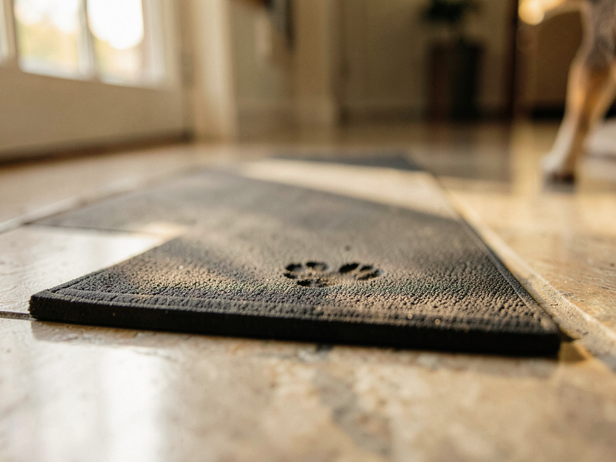
![Paw Print on Mat]()
Paw Print on Mat
Image credit : AI
A gentle reminder of my dog's presence, even as we manage canine osteoarthritis naturally. This mat offers comfort.
The Floor Surface Problem
The safest surface for an arthritic dog is one that gives traction without being so soft that it destabilises the joint. Rubber-backed yoga mats, interlocking foam tiles, and low-pile carpet runners placed along the dog's regular routes, between the sleeping spot, the water bowl, the door, provide grip without requiring the dog to grip. The difference this makes is visible within days. A dog that has been mincing across tile will lengthen its stride on a grippy surface, and that longer stride is the joint working the way it is supposed to. Outdoor surfaces matter too. Grass and compacted earth are forgiving. Concrete is not. If your dog's main toilet area is a concrete yard, a strip of rubber matting from the door to the grass is worth the effort. Gravel and loose stone are the worst option, they require constant micro-corrections from the paw and ankle, which translates directly to extra load on the knee and hip.
Body Weight and the Arithmetic of Joint Load
Every kilogram of body weight a dog carries places roughly two to three kilograms of force on each hip and knee joint during normal walking, because of the mechanics of how a quadruped distributes load through its limbs. For a dog already five kilograms overweight, that is ten to fifteen kilograms of extra force on joints whose cartilage is already compromised. The Indian Veterinary Association and veterinary nutrition bodies internationally have both identified obesity as the single most modifiable risk factor for the progression of osteoarthritis in dogs. The target is a body condition score of four or five on a nine-point scale, you should be able to feel the ribs without pressing, and the dog should have a visible waist when viewed from above. Reaching that score through diet alone is safer than exercise-based weight loss in an arthritic dog, because high-impact exercise to burn calories accelerates the very joint wear you are trying to slow. Reduce the caloric load first; add low-impact movement, swimming, short leash walks on soft ground, once the weight is moving in the right direction.
![Brass Scales Beside Dog Bowl]()
Brass Scales Beside Dog Bowl
Image credit : AI
Examining the weight of a beloved companion's well-being, perhaps considering arthritis in old dogs.
What Ramps and Steps Actually Do to a Joint
The moment a dog jumps down from a sofa, a car boot, or a bed, the landing force on its front legs is roughly five times its body weight, absorbed in a fraction of a second. For a ten-kilogram dog, that is fifty kilograms of impact, channelled through the carpus, elbow, and shoulder in sequence. For a twenty-kilogram dog with hip dysplasia, the rear-leg version of that landing, getting down from a raised surface by pushing off and dropping, is the mechanical equivalent of a small collision, repeated dozens of times a day. A ramp with a gentle gradient, typically no steeper than one vertical unit for every four horizontal units, eliminates that impact entirely. The dog's joints load and unload progressively as it walks the slope, which is exactly the rhythmic diffusion cycle that cartilage needs. Ramps are not a luxury item for pampered pets. They are a mechanical intervention with a direct effect on how much force passes through a compromised joint each day. The same logic applies to stairs. If your home has an internal staircase and the dog uses it freely, a baby gate that limits stair access and redirects the dog to a ramp route reduces cumulative joint loading more than most pharmaceutical interventions.
Putting It Together
Arthritis management in dogs is usually framed around pain medication and supplements, and those have their place, but the floor under a dog's paws, the number on the scale, and whether it has to jump to get where it is going are upstream of all of that. A dog on the right surface, at a healthy weight, using a ramp, needs less pain relief to stay comfortable, moves more freely, and places less compensatory load on the joints that are still healthy. The cartilage that remains is worth protecting. The conditions that protect it are largely within reach.