A dog that freezes, snaps, or has to be muzzle-restrained at every appointment is not a bad dog. It is a dog that was never taught what to expect or given any way to say slow down. Cooperative care is a structured training method that addresses exactly this, not by forcing tolerance but by building it, one small repetition at a time.
What Cooperative Care Actually Means
![Calm Dog, Gentle Touch]()
Calm Dog, Gentle Touch
Image credit : AI
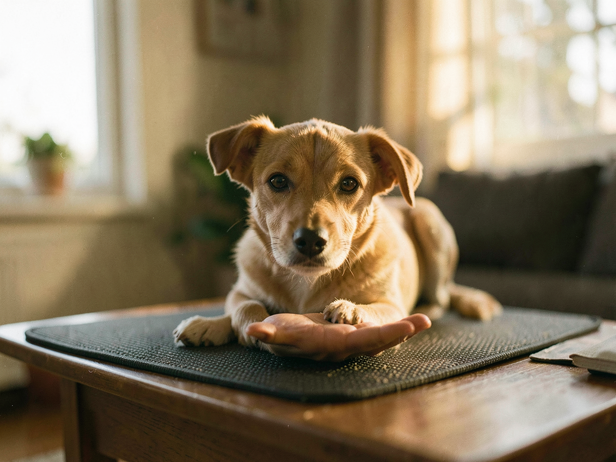
Building trust through cooperative care dog training. A moment of calm during gentle handling.
Dogs handled without preparation learn one thing: restraint ends eventually if they fight hard enough or go limp. Cooperative care teaches something different. The dog learns that staying still during handling is a behaviour it chooses, and that choosing it produces something good. The foundation is a concept called a chin rest or a stationary behaviour, the dog rests its chin on your palm or on a surface and holds it there. As long as the chin stays down, handling continues. The moment it lifts, handling stops. This gives the dog a functional off switch, and that changes everything about how it experiences being touched.
The Chin Rest: Where to Start
Hold your flat palm in front of your dog at nose height. Wait. When the dog sniffs your hand and its chin makes contact, mark the moment with a quiet yes or a clicker and deliver a small treat from your other hand. Do not move your palm toward the dog, let the dog come to you. Repeat until the dog is deliberately placing its chin and holding it. This typically takes ten to twenty short repetitions across two or three sessions for most dogs, though individual pace varies. Once the chin rest is solid, begin touching the dog lightly on the shoulder with your free hand while the chin stays down. Mark and reward. Gradually move to the ears, the paws, the muzzle, the places a vet or groomer will actually go. Each new location starts as a brief, light touch and builds only when the dog is holding the chin rest without tension in its body.
Reading the Dog's Body During Training
![Calm Dog at Vet Clinic]()
Calm Dog at Vet Clinic
Image credit : AI
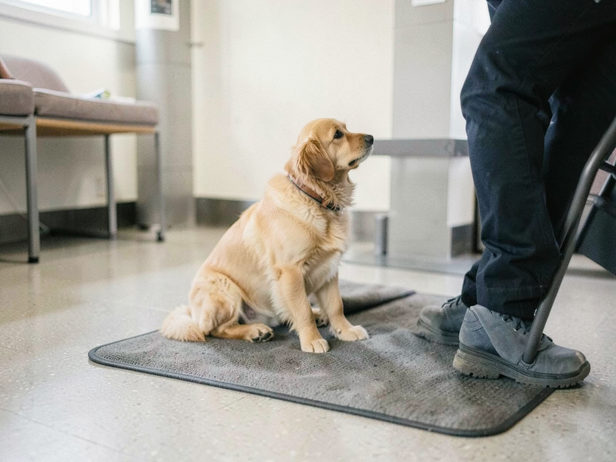
A dog's calm demeanor during a vet visit, showcasing cooperative care dog training principles. Peaceful waiting area.
Canine stress signals during handling are well documented in veterinary behaviour literature. Watch for lip licking, yawning outside of tiredness, a sudden loss of interest in food, whale eye, where white shows at the edge of the eye, and a stiff, slow tail wag rather than a loose one. Any of these means the dog is at or past its threshold. Stop the session, let the dog move freely, and next time begin at an easier step. Food refusal is the clearest signal: a dog that was eating readily and then stops taking treats has crossed into a stress state where learning cannot happen. Pushing through this does not build tolerance; it builds a dog that associates handling with feeling trapped.
Preparing Specifically for the Vet Clinic
The clinic environment carries its own triggers, the smell of antiseptic, the sound of other animals, the texture of the exam table. Dogs that have only practised cooperative care at home may struggle when those cues appear. Practise on a non-slip mat placed on a table at home so the surface is familiar. If your clinic allows it, bring the dog in for a single visit where nothing medical happens, the dog walks in, gets treats from the receptionist, gets weighed, and leaves. Many veterinary clinics in India now offer fear-free or low-stress handling consultations; ask whether yours does. Calling ahead to describe your dog's history with handling also helps, a vet who knows a dog is working through handling anxiety can adjust their approach, slow down, and support the training rather than undo it.
When to Involve a Professional
Cooperative care handles the majority of handling anxiety when started early and practised consistently. It is not the right first tool for a dog that has already bitten during handling, that shows extreme panic responses, or that has a medical condition requiring urgent examination. These dogs need a veterinary behaviourist or a certified clinical animal behaviourist involved before training begins, not because the method fails, but because the dog needs a safety plan and possibly medication support before it can learn. A general trainer without a behaviour qualification is not the same as a veterinary behaviourist, and the distinction matters for dogs with a bite history. If your dog's fear at the vet has escalated to the point where examination is impossible, that conversation with your vet is the starting point, not a training video.