The sangai deer does not walk on land. It walks on water, or close enough. In Loktak Lake, Manipur's largest freshwater lake, decomposing organic matter, soil, and vegetation have compressed over centuries into thick floating mats called phumdi. The sangai, Cervus eldi eldi, has evolved hooves splayed wide enough to distribute its weight across these spongy surfaces. Remove the phumdi, and the deer has nowhere left to stand.
What Phumdi Actually Is
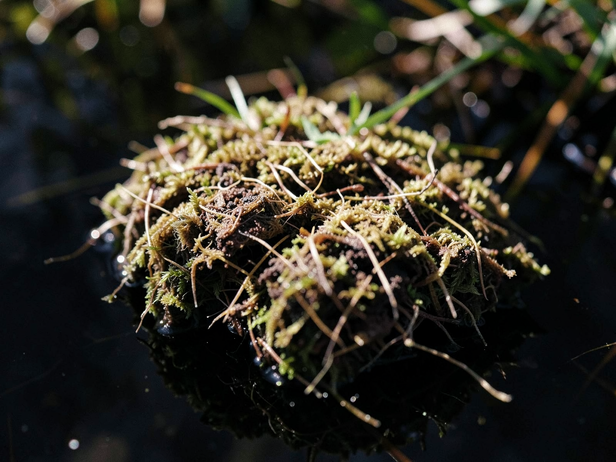
Phumdi is not algae and it is not a raft. It is a heterogeneous mass of soil, humus, and vegetation in various stages of decomposition, held together by root systems that bind the layers into something dense enough to support a deer's weight. The mats range from a few centimetres thick to nearly two metres deep in the oldest sections. They are buoyant because decomposing organic matter traps gas. They move with wind and current, which is why the lake's surface looks different from one season to the next. The phumdi at Keibul Lamjao National Park, the world's only floating national park, covers roughly 40 square kilometres and represents the most significant remaining habitat for the sangai. This park exists on the lake itself, not beside it.
![Floating Mat Cross-Section]()
Floating Mat Cross-Section
Image credit : AI
I examine the intricate texture of a phumdi floating island, a vital habitat for the Sangai deer.
The Sangai's Physical Adaptation
The sangai is one of three subspecies of Eld's deer. The Manipur brow-antlered deer, as it is formally called, carries antlers that curve forward in a continuous bow from brow tine to main beam, a shape distinct from both the Indochinese and Thai subspecies. Its legs are longer relative to body size than those of most deer, and its hooves are wider and more flexible, an adaptation documented in zoological studies of the subspecies that allows it to walk across unstable, waterlogged surfaces without sinking. The deer feeds on the grasses and sedges that grow within and around the phumdi. It rests on the mats. It gives birth on them. Its entire life cycle is calibrated to a floating surface that most other large mammals cannot navigate.
How Close the Sangai Came to Disappearing
By the early 1950s, the sangai was considered functionally extinct. Hunting pressure during and after the Second World War, combined with habitat encroachment around Loktak Lake, had reduced the population to a number so small that surveys found no confirmed individuals for years. A 1953 sighting by wildlife officer E.P. Gee brought the subspecies back to scientific attention. Keibul Lamjao was declared a wildlife sanctuary in 1966 and elevated to a national park in 1977. The current population, monitored by the Manipur Forest Department and the Wildlife Institute of India, stands at roughly 260 animals, a figure that represents the entire global population of the subspecies. Every sangai alive today lives in or around Loktak Lake.
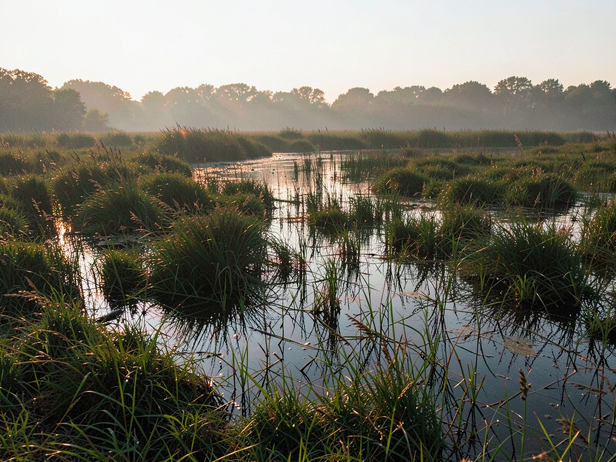
![Golden Hour Flooded Grassland]()
Golden Hour Flooded Grassland
Image credit : AI
I witness the tranquil beauty of a flooded grassland at dusk, a habitat for the endangered Sangai deer.
The Threats That Remain
The Ithai Barrage, constructed in 1983 on the Manipur River to generate hydroelectric power, raised the water level of Loktak Lake permanently. Higher water causes phumdi to submerge or break apart rather than consolidate. Thicker, older mats survive; younger, thinner mats, the ones most useful as grazing ground, do not. Invasive water hyacinth spreads across open water, altering the chemistry and light penetration of the lake. Fishing communities have traditionally lived on phumdi platforms on the lake, and their presence, though culturally significant, brings pressure on the same ecosystem the sangai depends on. The Loktak Development Authority and conservation organisations have worked on phumdi restoration and water-level management, but the barrage remains operational, and the tension between power generation and habitat preservation has not been resolved. The sangai's survival is not secured. It is managed, carefully, inside a set of constraints that have not gone away.