Delhi's winters can push overnight temperatures below 4°C, and a newborn street puppy born into that cold has no insulation layer, no ability to shiver effectively for its first two weeks of life, and a thermoregulation system that will not function independently for nearly a month. That biological reality shapes almost every decision the mother makes from the moment she chooses a whelping site.
How Adult Street Dogs Read a City for Warmth
Street dogs in North Indian cities are not sheltering randomly. Studies on free-ranging dog behaviour, including field observations conducted by the Animal Welfare Board of India in urban settings, show that dogs map thermal resources across their territory with the same consistency they apply to food sources. A dog that sleeps against a transformer box in October will return to it in December. The warmth is real: electrical infrastructure, exhaust vents from commercial kitchens, the underside of parked trucks whose engines were recently running, and the residual heat that rises from asphalt after a day of winter sun all register as meaningful heat differentials of 3°C to 6°C above ambient air temperature.
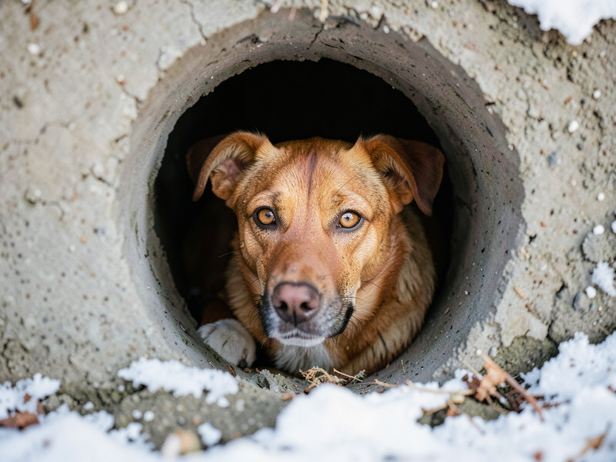
Drainage culverts offer something different: wind block. North India's winter cold is made significantly more dangerous by the dry, cutting wind that moves across the plains from the northwest. A dog curled inside a concrete culvert is not warmer in absolute terms, but it is sheltered from convective heat loss, which for a resting animal matters more than the surface temperature beneath it. Temple courtyards and railway platform overhangs serve the same function, they break the wind without requiring the dog to go underground.
Pack sleeping is the other mechanism. Free-ranging dogs that maintain loose daytime territories will consolidate at night in winter, with three to six individuals sleeping in contact. The shared body heat is physiologically significant. A single dog sleeping alone on open ground in 5°C air loses heat from its exposed flank continuously. A dog sleeping pressed between two others loses heat from one surface only.
![Winter Shelter for a Street Dog]()
Winter Shelter for a Street Dog
Image credit : AI
A street dog finds a temporary shelter in a concrete culvert, a common sight for stray dogs North India winter shelter.
Where Pregnant Dogs Choose to Whelp in Winter
A female street dog approaching term in November or December faces a specific problem: the sites that keep adult dogs warm are often exposed, trafficked, or too shallow to protect a litter. She needs depth, enclosure, and darkness, not just warmth. What she finds, across North Indian cities, follows a recognisable pattern.
Construction sites are the most commonly used whelping sites in urban North India during winter, because they offer what no other urban feature combines: loose rubble that can be arranged, deep enclosed spaces in partially built structures, and relative freedom from human disturbance at night. A female will spend two to three days investigating a site before committing. She is assessing airflow, ground moisture, and the frequency of human entry, not warmth alone.
The underside of parked tempos and trucks is a secondary site, used when construction cover is unavailable. It is less safe, the vehicle can move, but the combination of a low ceiling, a warm engine above, and a surface shielded from wind makes it thermally attractive enough that females return to the same vehicle on consecutive nights during late pregnancy.
In smaller cities like Varanasi and Mathura, temple back walls and the narrow gaps between old havelis and boundary walls are used consistently. These stone structures retain daytime heat longer than modern concrete and cool more slowly after sunset, giving a narrow but real thermal advantage through the early hours of the night when temperatures fall fastest.
The Biology of a Cold-Born Puppy
Neonatal puppies are altricial, born in a physiologically immature state that requires external heat to survive. Their thermoregulatory axis, governed by the hypothalamus, does not begin functioning meaningfully until approximately two to three weeks of age. Before that point, a puppy's core body temperature tracks its environment. If the environment drops, the puppy drops with it.
Hypothermia in a neonatal puppy suppresses the suckling reflex before it kills. A puppy that has become too cold will stop nursing, which means it stops taking in the calories it needs to generate any metabolic heat at all, a spiral that moves quickly. Veterinary research on neonatal canine survival puts the lower safe ambient temperature for a newborn puppy without maternal contact at around 21°C to 24°C. A North Indian winter night offers 4°C to 12°C. The mother's body is the only bridge between those two numbers.
This is why the mother's behaviour in the first two weeks is almost entirely nest-bound. She leaves to eat and drink in the shortest windows she can manage, and she will accept food brought to her location far more readily than she will move to a food source. People who feed street dogs in winter and notice a female eating quickly and returning immediately to a fixed point are almost certainly watching a nursing mother managing this thermal equation.
![Newborn Pups Seek Warmth]()
Newborn Pups Seek Warmth
Image credit : AI
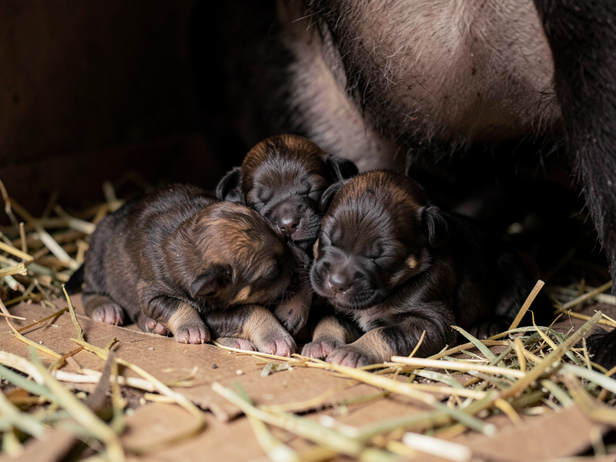
These vulnerable newborn pups are seeking warmth, a crucial element for survival in cold weather.
What Kills Puppies Born in the Cold Months and What Doesn't
The mortality rate for street dog puppies born between November and February in North Indian cities is significantly higher than for those born in the post-monsoon warm months, but cold alone is rarely the proximate cause of death. The actual killers are the conditions that cold enables.
Fading puppy syndrome, a catch-all term for neonatal failure to thrive, has hypothermia as its most common trigger in winter litters, but the death is recorded as starvation or infection, because those are the final events. A puppy that is cold cannot suckle effectively, becomes malnourished, and then cannot mount an immune response to the bacterial load it encounters from birth.
Parvovirus and distemper, both endemic in India's unvaccinated street dog population, hit winter litters harder not because the viruses are stronger in cold weather but because the puppies are immunologically weaker from the start. A puppy born to a well-fed mother who remained warm through gestation receives more immunoglobulins through colostrum than one born to a mother who spent her pregnancy managing cold stress. The margin is not enormous, but in a population where baseline survival is already precarious, it is the difference that shows up in litter survival rates.
Puppies that survive the first three weeks, past the point where they can shiver, past the point where their suckling reflex is robust, have crossed the most dangerous threshold. From there, the risks shift to the ones that apply year-round: traffic, disease, and the availability of food for the mother, which directly determines how long she can sustain lactation.
What People Near Street Dogs Can Do in Winter
The interventions that make the most measurable difference to winter street dog survival are the simplest. A gunny sack or old blanket placed in a sheltered corner, not in the open, but against a wall or under a ledge, will be used. Street dogs are not suspicious of bedding; they assess it for scent and then use it. Cardboard laid on cold ground matters more than a blanket placed on top of nothing, because ground conduction pulls heat from a resting dog faster than cold air does.
For a nursing mother specifically, the most useful thing a person can do is bring food to her location rather than expecting her to come to a feeding point. High-fat food, egg yolk, a small amount of ghee mixed into rice, chicken skin, is more useful in winter than plain carbohydrate, because fat yields more than twice the metabolic energy per gram and the mother is running a significant caloric deficit while lactating in the cold.
Reporting a whelping site to a local animal welfare organisation, not to relocate the mother, but to flag her location for monitoring, gives a litter the chance of intervention if the mother is injured or the litter begins to fail. Organisations like Friendicoes in Delhi and similar groups in Lucknow and Kanpur have winter protocols specifically for neonatal litters. Knowing where a litter is makes the difference between a puppy that gets a second chance and one that doesn't.
The thermal logic a street dog applies to a North Indian winter is not desperation, it is precision. The same animal that seems to be sleeping randomly against a wall has mapped that wall's heat retention across weeks of observation. The puppies born into that cold are not unlucky accidents of timing; they are the outcome of a female who found the best available site and is now holding the line between ambient temperature and survival with nothing but her own body heat. That line holds more often than people expect, and it holds more often when the humans nearby understand what it costs to hold it.