The rosette of water hyacinth, Eichhornia crassipes, can double its surface area in two weeks under warm, nutrient-rich conditions. That single biological fact explains why a few clumps at the edge of a lake in June can become an unbroken green mat by August, and why that mat changes everything living underneath it.
How a Plant Suffocates a Lake
A dense hyacinth cover blocks between 90 and 95 percent of sunlight from reaching the water column below. Submerged aquatic plants, which produce oxygen through photosynthesis, die back first. Phytoplankton, the microscopic algae that form the base of the lake's food web, follow. As the plant matter decomposes on the lakebed, bacteria consuming it draw down dissolved oxygen further. The result is hypoxia: dissolved oxygen levels dropping below 4 milligrams per litre, sometimes below 2. Most freshwater fish begin showing stress responses below 4 mg/L. Below 2 mg/L, fish kills become common. Surveys of hyacinth-covered sections of Loktak Lake in Manipur and Ulsoor Lake in Bengaluru have recorded dissolved oxygen readings in the hypoxic range during peak infestation months.
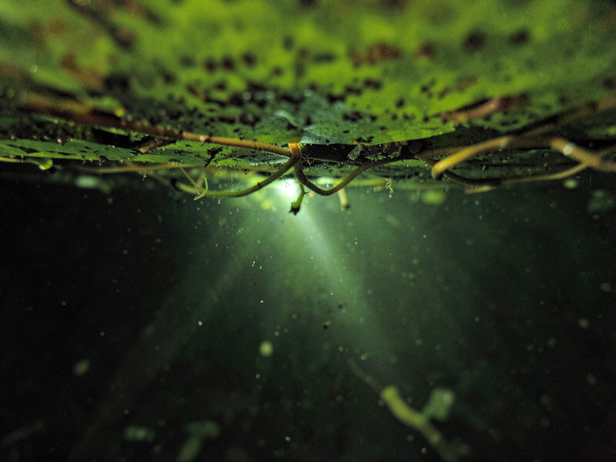
![Underwater Hyacinth Roots]()
Underwater Hyacinth Roots
Image credit : AI
I explore the submerged roots of water hyacinth in Indian lakes, a glimpse into a struggling freshwater ecosystem.
What Happens to the Fish
Freshwater fish in Indian lakes depend on a layered ecosystem: open water for pelagic species like catla and rohu, submerged vegetation for spawning, and oxygenated bottom sediment for benthic feeders. Hyacinth disrupts all three. Catla and rohu, both members of the cyprinid family and among the most commercially important freshwater fish in India, are obligate surface and mid-water feeders that cannot access feeding zones under a sealed mat. Spawning habitat disappears when submerged plants die. Species that can tolerate lower oxygen, including some invasive species, temporarily fill the gap, but they are not the fish the fishing community is harvesting or selling. The biodiversity shift is not reversible simply by removing the weed. The sediment layer, now enriched with decomposed hyacinth, releases phosphorus back into the water when disturbed, which feeds the next infestation cycle.
The Livelihood Collapse That Follows
Fishing communities around lakes like Kolleru in Andhra Pradesh, Wular in Jammu and Kashmir, and the Dal in Srinagar have documented the practical consequences over decades. Nets dragged through hyacinth mats shred or tangle, making a single fishing run take three to four times as long and destroying gear that costs thousands of rupees to replace. Boats cannot move freely, so fishers cannot reach open water. The catch itself drops not just in volume but in species composition: the high-value fish are gone, what remains fetches lower prices at market. For communities where fishing is the primary income source, a lake under heavy hyacinth cover can mean six to eight months of near-zero earnings during infestation peaks. Women in these communities, who typically handle net repair, sorting and local sale, absorb a disproportionate share of the income loss because the downstream work disappears before the upstream fishing does.
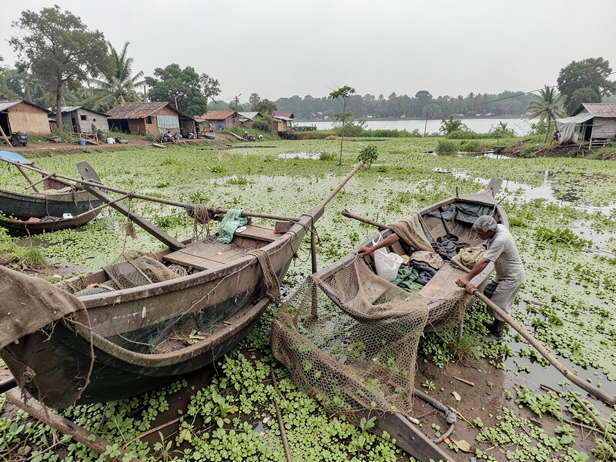
![Fishing Life Amidst Hyacinth]()
Fishing Life Amidst Hyacinth
Image credit : AI
Repairing nets amidst the pervasive water hyacinth, a fisherman faces the daily challenges of his livelihood on the Indian lake.
Why Indian Lakes Are Especially Vulnerable
Water hyacinth is native to the Amazon basin. It arrived in India in the nineteenth century as an ornamental plant, and its spread accelerated as agricultural runoff and urban sewage raised nitrogen and phosphorus levels in lakes and rivers. The plant thrives on eutrophication: the more nutrient-polluted the water body, the faster it grows. India's most ecologically stressed lakes, many of which sit adjacent to agricultural land or urban settlements, provide near-ideal conditions. Warm temperatures across most of the country for most of the year remove the seasonal die-back that limits hyacinth in temperate climates. Monsoon floods carry fragments to new water bodies, resetting the infestation cycle in lakes that had been cleared.
What Removal Actually Involves
Manual removal, the most common method used by fishing communities themselves, is effective only at small scale and requires continuous effort because regrowth outpaces hand-clearing. Mechanical harvesters have been deployed on larger water bodies including the Dal Lake, but the harvested biomass must be disposed of or composted quickly, otherwise it decomposes in place and returns nutrients to the water. Biological control using the weevil Neochetina eichhorniae has been studied by researchers at the Indian Council of Agricultural Research and shows suppression effects over multi-year periods, though it does not eradicate the plant. The composting of harvested hyacinth into organic fertiliser has been piloted in Kerala and West Bengal as a way to convert the weed into a revenue stream for the communities clearing it, though the logistics of drying, processing and marketing the compost add complexity that not every community can absorb. None of these approaches works in isolation from addressing the nutrient loading that makes the lake hospitable to the plant in the first place.