When a matriarch dies, her herd does not move on by the next morning. They stay. They touch her body with their trunks, sometimes for hours. They return to the site days later, and in some cases years later, standing over bones that have long since scattered. This is not instinct in the narrow sense. It is something researchers have spent decades trying to name accurately.
What Elephants Actually Do When One of Them Dies
Documented field observations, many from Amboseli National Park in Kenya where Cynthia Moss and her team tracked elephant families across decades, show a consistent pattern. When a herd member dies, other elephants approach the body, touch the face and mouth with their trunks, and often attempt to lift the body. They vocalise in low rumbles, including infrasonic calls below the range of human hearing. They may cover the body with soil, leaves, and branches, behaviour observed in both African and Asian elephants. Calves whose mothers have died show prolonged lethargy, loss of appetite, and reduced social engagement. These are not brief disruptions. Some orphaned calves studied at the Amboseli project displayed behavioural changes lasting months.
![Elephant's Gentle Touch]()
Elephant's Gentle Touch
Image credit : AI
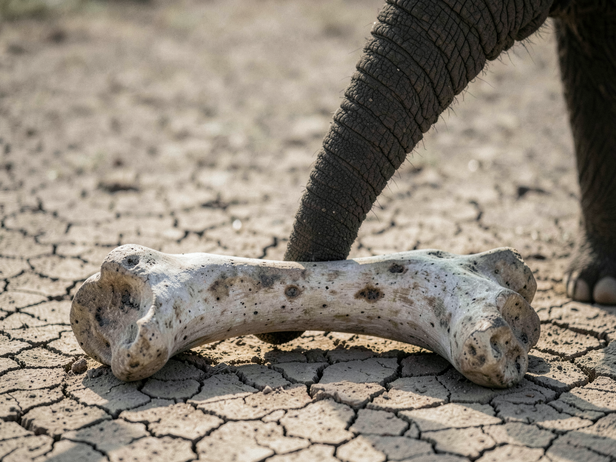
A moment of profound connection. I observe an elephant's gentle touch, a possible sign of elephant grief, on a weathered bone.
The Biology Behind the Behaviour
Elephants have the largest brain of any land animal, with a highly developed temporal lobe and a limbic system, the brain's emotional processing centre, that is proportionally large even relative to their overall brain size. Their hippocampus, critical for memory consolidation, is well-developed, which is consistent with the long-term spatial memory elephants are known for: the ability to recall water sources, migration routes, and individual faces across years and distances. The same neural architecture that supports that memory also supports what researchers describe as a sustained emotional response to loss. Elephants recognise the bones of their own dead. In experiments where elephant skulls were placed alongside the skulls of other large animals, elephants consistently spent more time investigating the elephant skulls, touching them repeatedly with their trunks and feet. They show this response even to the bones of elephants they were not closely related to, though the response is strongest for family members.
Is It Really Grief, or Are We Projecting
This is the question that serious researchers do not dismiss. The honest answer is that we cannot access elephant interiority. What we can say is that the behaviour matches the functional definition of grief: a prolonged, specific response to the loss of an individual that disrupts normal activity and involves repeated return to the site or object of loss. Joyce Poole, who has studied elephant communication and behaviour for over four decades, describes what she has observed as mourning in the functional sense, not because it is identical to human grief, but because it meets the behavioural criteria independently, without being mapped onto human emotion first. The distinction matters. Calling it grief is not anthropomorphism if the evidence supports the label on its own terms. Refusing to call it grief because elephants are not human is its own kind of bias.
![Solitary Elephant at Dusk]()
Solitary Elephant at Dusk
Image credit : AI
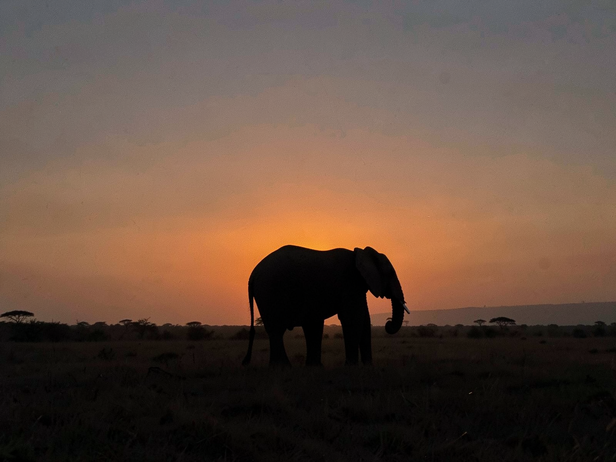
A lone elephant's silhouette against a dramatic dusk sky, evoking a profound sense of solitude and hinting at the deep emotions like grief animals can feel.
What This Means for How We Think About Animal Emotion
Elephant mourning sits within a broader body of evidence for complex emotional life in non-human animals. Cetaceans have been observed carrying dead calves for days. Chimpanzees show depressive behaviour after losing close companions. Corvids engage in what researchers call funeral gatherings around dead members of their group. But elephants present a particularly striking case because the behaviour is so sustained, so consistent across populations on different continents, and so clearly tied to individual recognition rather than a generalised response to death. The implications extend beyond sentiment. How we think about elephant cognition and emotion has direct bearing on conservation policy, on how captive elephants are housed and managed, and on what we owe them when their family structures are disrupted by culling, poaching, or translocation. An animal that grieves its dead is an animal with a social and emotional architecture complex enough to be damaged by loss in ways that outlast the immediate event.