The Great Indian Bustard weighs up to 15 kilograms, stands a metre tall, and is functionally extinct in the wild, with fewer than 150 individuals surviving across Rajasthan and Gujarat. It is the world's heaviest flying bird. It needs open grassland to breed, to forage, and to display. What it does not need, and cannot survive alongside, is trees. Yet for decades, the land it depends on has been handed over to tree-planting drives, solar farms, and agricultural conversion, all of it legally uncontroversial, because the land was officially classified as wasteland.
The Word and Where It Came From
The classification traces directly to colonial-era revenue surveys conducted across British India in the nineteenth century. Land was assessed for its agricultural productivity and taxed accordingly. Grasslands produced no crop. They were grazed by livestock, used seasonally, left open. To a revenue officer looking for a taxable yield, that made them waste. The label entered land records, was inherited by post-independence state governments, and calcified into policy. It was never a biological assessment. It was an accounting term applied to land that did not generate revenue in a form the administration could measure.
![Colonial Map & Compass]()
Colonial Map & Compass
Image credit : AI
Examining historical maps reveals the extent of Indian grasslands, highlighting habitat loss for species like the Great Indian Bustard.
What Grassland Actually Is
India's grasslands are not degraded forest. That distinction matters enormously, and it is where the policy failure compounds. The Banni grasslands of the Rann of Kutch, the Terai grasslands of Uttarakhand and Uttar Pradesh, the Deccan plateau's rolling savannahs, and the semi-arid scrub of Rajasthan are each a distinct ecological type, shaped by millennia of fire, flood, seasonal drought, and grazing. They are not forests in waiting. They are climax ecosystems, stable end-states, not intermediate stages on the way to something else. India's Forest Survey of India has historically mapped open natural grasslands as degraded or scrub forest, which then qualified them for afforestation schemes. Planting trees on a grassland does not restore it. It destroys it. The canopy closes, the grasses die, and the specialist species that cannot live anywhere else disappear.
The Species That Cannot Move
Grassland specialists are among the most range-restricted and habitat-faithful animals in the country. The Indian Wolf, genetically distinct from its Himalayan cousin, persists in the Deccan plateau's open country. The Blackbuck, one of the fastest land animals on Earth, capable of sustained speeds above 80 kilometres per hour, is built for open terrain where it can see a predator coming from half a kilometre away. The Lesser Florican, a small bustard that performs a spectacular leaping display during the monsoon, breeds only in tall grassland and has declined by over 75 percent in three decades, according to surveys by the Wildlife Institute of India. The Sociable Lapwing, the Stoliczka's Bushchat, the Indian Courser, these are birds with no forest fallback, no alternative habitat, nowhere to go when the grassland becomes a plantation or a solar array. Unlike a generalist species that can retreat to a forest edge or a wetland margin, a grassland specialist's range is its habitat. When the habitat shrinks, the population shrinks in direct proportion.
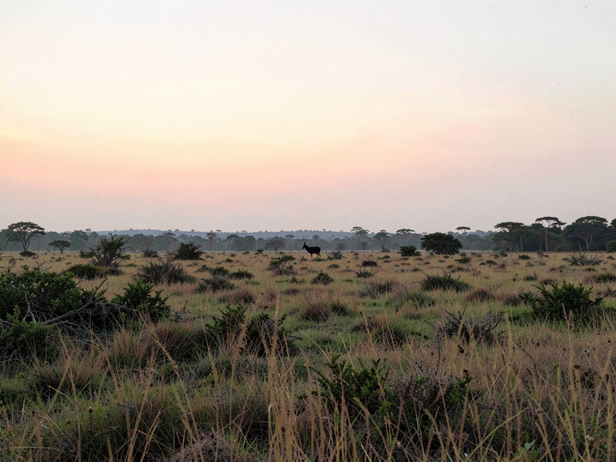
![Deccan Dawn Blackbuck]()
Deccan Dawn Blackbuck
Image credit : AI
A lone blackbuck stands alert in the vast Deccan plateau grasslands at dawn, a stark reminder of India grassland conservation policy.
The Conversion Pipeline
The wasteland classification does not merely reflect neglect. It actively enables conversion. State governments can allocate wasteland for afforestation under the compensatory afforestation mechanism, under which forest land diverted for development is offset by planting trees elsewhere. Grasslands, classified as wasteland rather than forest, absorb this offset planting. The result is a legal loop in which destroying a forest generates a mandate to destroy a grassland. Simultaneously, the national push for renewable energy has placed large solar and wind installations on open land in Rajasthan and Gujarat, precisely the last remaining Great Indian Bustard habitat. A 2021 Supreme Court order attempted to restrict overhead power lines in bustard territory after collision with lines was identified as a primary mortality cause, but implementation has been contested by state governments and energy developers. The land's official status as wasteland makes the wildlife claim on it legally weak from the start.
What a Reclassification Would Require
Researchers at the Wildlife Institute of India and conservation organisations including the Nature Conservation Foundation have argued for reclassifying natural grasslands as a distinct land-use category, with legal protections equivalent to those afforded to forests. This would require amending state land revenue codes, updating the Forest Survey of India's mapping methodology, and building a political case for land that does not produce timber, does not sequester carbon at the rates a dense forest does on paper, and does not photograph as dramatically as a tiger reserve. The carbon argument is changing: grassland soils store carbon below ground in root systems and organic matter, and unlike forests they do not release it catastrophically when they burn. But this science is recent and its translation into policy is slow. The Great Indian Bustard does not have the time that policy translation usually takes.